Demo Site
Showing posts with label Argentina: History. Show all posts

Tuesday, October 26, 2010

MY ANCESTORS: PART IV

V. The Kranichfelds


The family of my mother’s mother was also an immigrant family, but it is hard to think of my great-grandfather Ernst Krannichfeldt (1868-1941) as an immigrant, because he arrived in Buenos Aires in his own private yacht.


Ernst Krannichfeldt (1868-1941)


Although from a family that traces its background to the Crusaders of the German Middle Ages, he was actually born in the province of Rio Grande do Sul, in Brazil. His father, Friedrich Ernst Krannichfeldt, or Kranichfeld, was born in Hamburg in 1826. He was German Consul in Brazil and a banker in Rio Grande. During one of his trips back to Germany, he married a much younger woman, Johanna Clementine Reinstädter (1845-1906) and with her had two children, both born in Brazil, Oscar, and Ernst, my great-grandfather. Oscar became the founder of the present European branch of the family, and Ernst, of that of the Argentinean family of which I am a part.

Friedrich Kranichfeld committed suicide at the age of forty three, in 1869, as a result of the failure of his Brazilian bank. Johanna went back to Köln, her native city, and raised the two boys there with the help of her Reinstädter relatives.

As I say above, the Kranichfelds are an ancient Thuringian family whose genealogy can be traced without difficulty to the twelfth century. The name literally signifies “the field of Cranes.” Their name derives from a lordship situated in the valley of the river Ilm, south of the city of Weimar in Central Germany and surrounded by the forested hills of Thuringia. The town of Kranichfeld is crowned by a medieval castle, the Upper Lordship (Oberschloss), which is now a ruin.


Kranichfeld, Oberschloss


The first ancestor of whom I have notice was Wolfer I von Kranichfeld, who died in the year 1140. In that year, the patronym is first recorded by mention of his two sons, Wolfer II and Siegfried, in a deed of gift (Schenkungsurkunde) found among the ruins of the monastery of Georgenthal (Kloster Georgenthal). In 1172, the family split in two between Wolfer III and his brother, Ludger I, at which time the latter founded the Lower Lordship (Niederburg), adjacent to the town of Kranichfeld, and still extant, but both branches retained the same heraldry: argent, a crane, vigilant, or, with the devise “Vigilia (for the crane vigilant, standing on one leg and holding a stone) et labore.”


Kranichfeld coat of arms


Kranichfeld, Nieder
burg or Unter Schloss

Thuringia had come under the rule of the Merovingian kings in the sixth century, and became a frontier, or a march, against the Saxons, who were not fully subdued and conquered by the Franks until the time of Charlemagne, at the beginning of the ninth century. After their conquest by the Merovingian Franks, the Thuringii were governed by appointed Frankish duces (dukes) and comites (counts), which remained the basic administrative structure of the region until well into the Carolingian period. However, rebellion among the Thuringii was endemic. By the late seventh century, they had established themselves as an independent state once again under their chieftain Radulf, and certain parts of their realm, particularly in the unstable region along the river Unstrut, came under the rule of the Saxons. Constant warfare had weakened royal power, while the aristocracy of the duces had made great gains and procured enormous concessions from the kings in return for their support. These concessions saw the very considerable power of the weakened Merovingian kings parceled out and retained by the leading comites and duces. The northern frontier of Thuringia, on the Unstrut and Saale rivers, bordering on the Saxon plain in the north, was hence an area of great instability. Its central location in Germania, or Austrasie, as that part of the Carolingian empire came to be known, was the reason it became the point d'appui of Boniface's Christianizing mission work. Christianity spread through Thuringia, and from thence east, during the eighth century.

The Frankish conquerors, spreading out far and wide from their homeland between the Meuse and the Moselle, sought to obliterate the independence of the conquered peoples. But in the eastern, or German provinces, there was no suitable administrative machinery, such as in the west, which could be taken over and adapted to Frankish needs and interests; here, new counts (comites) were appointed by the conquering army, and these Frankish counts were themselves the agents through whom a new framework of administration had for the fist time to be established. The very circumstances in which they were appointed differentiated these counts from their peers in the West. The count was a royal commissioner appointed to enforce and maintain Frankish rule over a conquered people; his essential task was to watch over the interests of his master, the Frankish king, and his functions were primarily political. This new layer of administration gradually replaced a popular form of self government, in which an elected thunginus (or ‘thing-man’ ‘Dings-mann’) directed the affairs of the Gau, a system that had persisted for some generations after the Frankish conquest.


Frankish Counts


It is among this class of comites, counts and vassals of the Frankish king (vassi dominici) that I believe the Kranichfeld family, and its dominions on the Ilm river, have their origin. The Ilm is a tributary of the Saale, and the Saale meets the Unstrut river near Naumburg, about 94 miles north-east of Weimar. This corner of Thuringia, therefore, was the heartland of the unstable frontier with the Saxons since the original Merovingian conquest, and it is reasonable to infer that the knights (Freiherren und Ritter) von Kranichfeld were originally Frankish counts appointed by the conquerors to supervise and control the border region.

The deed of gift (Schenkungsurkunde) found among the ruins of the monastery of Georgenthal (Kloster Georgenthal), south of the city of Gotha, first records the names of two Kranichfelds, which appear as witnesses. A notice in an old Ilmenau newspaper reads as follows:

“In einer Schenkungsurkunde des Klosters Georgental treten die Herren “Volrad und Siegfried von Cranechfelt” als Zeugen auf. Mit grosser Wahrscheinlichkeit sind sie ursprünglich fränkische Kolonisatoren gewesen, die ihren Namen den damals in der Ilmaue rastende Kranichen entlehnten.” [In a deed of gift from the monastery of Georgenthal, there appear the Lords “Volrad and Siegfried von Cranechfelt” as witnesses. With great likelihood these are originally Frankish colonizers whose names were borrowed from the resting cranes of the river Ilm].


Ruins of Kloster Georgenthal in the Thüringer Wald

This notice is undated, but it is quite likely that these two witnesses mentioned in the deed of gift, Volrad and Siegfried, are the brothers of Wolfer II: Volrad I (who died unmarried in 1166) and Siegfried, whose name is recorded in 1140 and 1152, Knight and Lord of Kranichfeld, all sons of Wolfer I.

The sons of Wolfer II von Kranichfeld, Wolfer III (died in 1218) and Ludger I (died 1186), divided the township in two. This quarrel between Ludger and Wolfer, which is recorded historically, is probably the reason why records were kept henceforth of the birth and death dates of the family, as the consequences of their division affected the lives and property titles of the community thereafter. In turn, this division in the Kranichfeld realm coincided roughly with the demise of Thuringia as an independent realm. By the marriage, in 1194, of Jutta, daughter of Landgraf Hermann von Thüringen, to Dietrich von Wettin, Markgraf von Meissen, Thuringia became a part of the ruling dynasty of Saxony, the House of Wettin, until the twentieth century. The Thuringian duchy of pre-Carolingian times had never been revived, although some beginnings of Thuringian autonomy were evident at the end of the ninth century. The last mention of a dux Thuringorum occurred in 908; thereafter Thuringia tended increasingly to be absorbed into the sphere of Saxony. But the region officially became entitled to the Saxon kings only after this marriage.

In the interim, the family of Kranichfeld held on to their estates as lords of Ober Kranichfeld and Unter Kranichfeld throughout the twelfth and thirteenth centuries. The record indicates that many of these lords became bishops, others provosts and canons of Halberstadt and Naumburg, and some of the female members of the family were abbesses or prioresses at the monasteries of Quedlinburg, Ilmenau and Paulinzella, the latter now in ruins. Thus, Cunigundis von Kranichfeld, sister of Meinhard I von Kranichfeld, Bishop of Halberstadt (1245-1259), was abbess of Quedlinburg until her death in 1231, and the sister of Meinhard II, who was himself provost of Halberstadt cathedral (d. 1290), Gutta von Kranichfeld, was also abbess of Quedlinburg until her death in 1310. Volrad IV von Kranichfeld was also Bishop of Halberstadt, from 1260 to 1292.
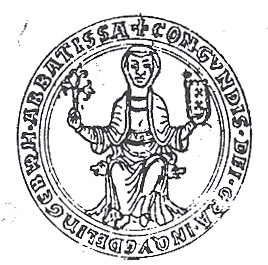


Cunigundis von Kranichfeld, Abbess of Quedlinburg
Seal of the Abbess, in the Archives of the Quedlinburg Abbey.


Jutta von Kranichfeld, Abbess of Quedlinburg
Seal of the Abbess, in the Archives of the Quedlinburg Abbey.


Volrad IV von Kranichfeld, Bishop of Halberstadt (1260 to 1292)


Meinhard I von Kranichfeld, Bishop of Halberstadt (1245-1259)


The main line of the Kranichfeld family lost its patrimony and became extinct by the middle of the fourteenth century. The record indicates there was turmoil in the region throughout the century. Starting in 1335, the Kranichfelds were at war with the city of Erfurt. Volrad IX von Kranichfeld, the last lord of Kranichfeld of the main line, was besieged in his castle, and the town of Kranichfeld was burned to the ground. On his death in 1389, the estates of both the Upper and the Lower Lordship, previously reunited under Volrad VIII, came through his granddaughter and sole heir, Margaretha, into the possession of Burgrave Albert III von Kirchberg, who, in turn, would later dispose of the Upper Lordship in 1451 and 1453 to his relative, count Heinrich von Reuss (Younger Line), lord of Plauen in Vogtland. But prior to his death, Volrad IX had to pawn his part of the lordship for “1,000 threescore Prague pence” to pay for the dowry of his sister Sophia von Kirchberg, and was forced into financial straits. The land was pawned to the Counts von Schwarzburg. Thereafter, the main line became extinct and the family moved to Erfurt, where they became retainers of the Counts von Schwarzburg-Sondershausen, a dynasty that ruled the region as an independent state until World War I.

In the Kranichfeld genealogy that I have in my possession, the story of Volrad IX, the last lord of Kranichfeld, is told a little differently. There it says that Volrad pawned the estate to the Counts von Schwarzburg for “1,000 Schock Groschen” (an ancient German currency) due to the fact that he had become senile (“offenbar altersschwach!”).


Frans van Cranevelt (1485-1564) (Stone medal, Leiden, Rijkmuseum)

Recently (1997), a collection of letters, dated 1519-1522, from Sir Thomas More, Chancellor of England, to our ancestor from a Netherlands branch of the family, Frans van Cranevelt, or Craneveldius, (1485-1564), was found and published in Louvain. [Morus ad Craneveldium - More to Cranevelt: New Badouin Letters, Leuven University Press, 1997]. This has made it possible to trace the subsequent history of the titleless members of the family. The titleless name of Kranichfeld (Cranichfeld, Krannichfeldt) is documented at the city of Erfurt until the eighteenth century, cp. Katalog der fürstlich Stolberg-Stolberg’schen Leichenpredigten-Sammlung, Bd. II, Leipzig, 1928 [-30]. S. 550. There is a xerox copy of a MS pedigree at Kranichfeld Upper Castle, drawn up in 1866 (with later additions up to 1883) by Theodor Kranichfeld in a neat late 19th century hand and compiled from the archives of the lords of Kranichfeld, from a pedigree “ab Anno 1275” said (in the MS) to have been first compiled by Wilhelm Heinrich Kranichfeld (b. 1575; d. 1630), vide his Funeral Oration (Library at Gotha). Wilhelm Heinrich was a great-great-great-grandson of that Guenther von Kranichfeld who (like his father Volrad [X]) had to serve as eques (Ritter) void of his ancestral lordship. See also Otto Dobenecker, Regesta diplomatica neenon epistolaria historiae Thuringiae, 4 vols., Jena, 1895-1939, passim.

After the death of Volrad IX, known as “the last lord of Kranichfeld of the main line,” in 1389, his son Volrad X (died 1310) and his grandson Günther (died in 1353), void of their patrimony (“des väterlichen Erbes bar” Kranichfeld MS.), had to devote themselves to military service as equites, or Knights. At this point, the MS pedigree no longer shows the names of brothers or sisters. However, the editors of the Baudouin Letters of More to Craneveldt have traced the lineage of the Netherlands branch of the family to the Knight Volrad X von Kranichfeld, who died in 1353, or to a possible brother of his, Johann von Kranichfeld who served as a knight of the Empress Margaretha of Wittelsbach. After the death in 1313 of the Roman emperor Henry VII, the Luxembourg faction in the college of electors voted in Ludwig IV “the Bavarian” (1314-1347, of the house of Wittelsbach) as anti-king, while the Hapsburg faction promoted Friedrich the Fair (1314-1330, of Hapsburg) as anti-king. Struggles for the succession followed, eventually settled by Ludwig’s victory at Mühldorf-am-Inn in 1322. In order to stabilize his domestic power, the King enfeoffed his son Ludwig V to the holding of Brandenburg and married him in 1342 to the heiress of the Tyrol. In 1340, Ludwig IV inherited Lower Bavaria. Married for a second time, in 1324, to Margaretha, daughter of count Willem III of Holland, Friesland, Zeeland and Hainaut, Ludwig the Bavarian also obtained his wife’s paternal legacy in the Netherlands and enfeoffed her to her inheritance. When Margaretha returned to her native country in March 1346, after her husband’s death, it is recorded that a Johann von Kranichfeld followed her there, settled in the Netherlands, and founded the Netherlandish branch of the Van Cranevelts.

From Ritter Günther von Kranichfeld, born in 1353, to the next recorded Kranichfeld in the titleless line of the MS pedigree, Benedictus I, who was born in 1400, there is a gap of fifty years. But more significantly, Benedictus is no longer described as a Knight, but as Ratsherr (Councilman) of the cities of Gotha and Erfurt. From the beginning of the fifteenth century onward, the titleless members of the Kranichfeld family have been closely associated with the government of towns, cities and lands generally under the hegemony of the Counts von Schwarzburg-Sondershausen, particularly the cities of Gotha, Erfurt and Arnstadt. Thus, Benedictus Kranichfeld Senior (b. 1400) was Ratsherr (Councilman) for the cities of Gotha and Erfurt; Benedictus Junior (b. 1436) was Ratsherr and Bürgermeister (Mayor) of Gotha; Johannes Junior (b. 1467), Ratsbaumeister (Councilman and Master-Builder) for the city of Erfurt; Petrus (b. 1498) was Ratsherr and Bürgermeister (Mayor) of the city of Arnstadt. This Petrus became an Evangelical Protestant in 1529 and was responsible for driving out the monks of the city of Arnstadt in 1539. Later, Sebastian Kranichfeld was Ratsherr (Councilman) and Kämmerer (Chamberlain) of the Monastery at Paulinzella, also within the dominions of the Counts von Schwarzburg-Sondershausen.


Monastery ruins at Paulinzella in Thüringen


Paulinzella, where Sebastian Kranichfeld was Kämmerer in the 1590’s

Rudolph Kranichfeld (1574-1637), who was born only ten years after the death of the humanist intellectual Frans van Cranevelt, is the first one in the family MS pedigree who is described as Handelsherr (Tradesman) doing business in the city of Erfurt. Thereafter, and throughout the seventeenth century, the family seems to have remained rooted primarily in Erfurt, and drawn to secular vocations, such as Consuls, Businessmen, and Public Notaries. Thus Wolfgang Rudolph (b. 1620) was Consulent, Notarius Publicus and Juris Practicus in the city of Erfurt; Hieronimus Rudolph (b. 1667) was a tradesman (Handelsherr) in Erfurt; Johann Cristoph (b. 1713) was also a tradesman (Handelsherr) in Erfurt, where he died in 1756. His son, Friederich Rudolph, was to be the first Hohenfeldner Kranichfeld, and the first recorded Minister of the Lutheran Church in the family. He was also a contemporary of Goethe.


Pastor Friedrich Rudolph Kranichfeld (1756-1805)


Frau Pastor Kranichfeld, Hohenfelden, 1836


Friedrich Rudolph Kranichfeld is a direct ancestor. He was born in Erfurt in 1756 and died in Hohenfelden in 1805. He was a Pfarrer (Minister of the Lutheran Church) at Hohenfelden, a small town located only a few miles north-west of Kranichfeld, in the Thüringer Wald region of Sachse-Weimar. The old school-house and the parish house of Hohenfelden are now a local museum.


Altes Pfarrhaus Hohenfelden

But the intriguing interlude of the Kranichfelds in the Hohenfelden Pfarrhof was not to last very long. Friedrich Johann Anton Kranichfeld, third son of Friedrich Rudolph, was born in Hohenfelden in 1788, but died in Hamburg in 1860, the Hamburg where Schopenhauer worked for a while as a businessman in his father's trading house, in the early 1800's. Friedrich Johann was also a tradesman (Handelsherr) in Hamburg, and was probably connected to the South American interests of that port city. He was first married to Natalie Jacobi (1806-1823),


Natalie Kranichfeld, geborene Jacobi (1806-1823)

a native of the small town of Hettstedt [Lichtstedt?] near Rudolstadt, also in the vicinity of Hohenfelden, in the Thüringer Wald. Natalie, whose beautiful portrait is in the possession of Frank Sperling in Noordwijk, did not survive her honeymoon, and died at the age of seventeen as a result of pneumonia. It is said that she caught cold at a ball during the couple’s honeymoon. Friedrich Johann then married Frederike Henriette Kirchheim (1802-1860), and had seven children by her.

Their second son, Friedrich Ernst Kranichfeld, was born in Hamburg in 1826 and died in Rio Grande do Sul, by his own hand, on August 29, 1869. He was German Consul in the Province and owned a Bank there. When his business went bankrupt, he committed suicide, leaving two sons behind, Johann Friedrich Oscar (b. October 7, 1865, died September 6, 1931 in Berlin), who was the founder of the European branch of our family, and my great-grandfather, Ernst Ludwig Maria, who was born on January 12, 1868 and died in Buenos Aires on May 17, 1941.


The young Friedrich Ernst Kranichfeld (1826-1869)


German immigration to Brazil began in 1824, shortly after Brazil won independence from Portugal -- as a result of Brazilian Emperor Dom Pedro I's (1798-1834) need to populate uninhabited regions of the huge country. Such regions were being disputed with neighboring countries, Argentina and Paraguay. Uruguay was just becoming independent. Those countries were by then former Spanish colonies, as all of South America was becoming independent, and all of them were interested in receiving European knowledge, expertise and labor.

Some Brazilian states received higher inflows of Germans than others. Such was the case in Rio Grande do Sul, where the first wave of immigrants was settled in the 1820s. In 1827, a group of Germans migrated to Brazil from the region of Trier. This was the first official German migration to Brazil. Part of this group (mainly Catholic married men) came to the farm called "Fazenda Guarei," which is today a small town in the state of São Paulo called Guarei. These Germans are considered the founders of Guarei. A second wave went to Santa Catarina in the 1850s, but also to Rio de Janeiro, in smaller number, mainly to a city called Petropolis, where the Emperor Dom Pedro II's summer house (nowadays the Imperial Museum) was located. Other German immigration waves occurred in the 1890s, as well as after the First and Second World War. The latter emigres were not necessarily only refugees, but also people who were tired of the war. They had different destinations: to the states of Sao Paulo, to Paraná, and to the other Brazilian states.


Graf Zeppelin over Porto Alegre, 1934


In the wake of the agriculturalist immigrants, mostly farmers and men of rural stock, came the professionals and businessmen to serve the burgeoning foreign communities. The waves of immigrants headed to Brazil were organized by shipping companies which were part of the recruiting and organizing process by which these men and women were transported and placed in the foreign locations. The bulk of the Brazilian immigration originated in the port of Hamburg, and it therefore quite likely that the idea to start a business career in Porto Alegre, in the province of Rio Grande do Sul, awakened in the mind of Friedrich Ernst Kranichfeld from a consciousness of the activities that were taking place all around him at the harbor, in this busy migratory movement towards the South American continent. Upon arrival in Porto Alegre, he would start out on a venture of business and professional activities and relationships that resulted in his becoming German Consul in the city, and a local banker of repute.


Friedrich Ernst Kranichfeld (1826-1869)


An English traveler, on a trip from Rio Grande do Sul to Porto Alegre by steam-boat on the Lagoa dos Patos, relates, in 1873: “Our passengers on board are mostly Germans, for Porto Alegre is in a manner a German settlement, the first colony having been fixed there in 1825, and now there are 60,000 Germans in the province. They never think of returning to Europe, but become, like the Irish in North America or Buenos Ayres, permanent settlers in their adopted home. Still they preserve the warmest recollections of the Fatherland, and in language, sentiment, and traditions are as true to their native country as if only travelers in a strange land. As the sun was setting behind the Pelotas range, one of the passengers struck up the ‘Wacht am Rhein,’ and the broad waters of the lake echoed to the chorus –

Fest steht und treu
Die Wacht am Rhein.

Memories of the Fatherland, traditions of the Rhine, stories from the recent battle-fields whiled away the hours of twilight, and the ‘young May moon’ was far on her midnight course ere we retired to sleep. Before sunrise I was again on deck to see the panorama of Itapoa, where the estuary of Guayiba communicates with the great lake. . . . The city [of Porto Alegre] has double the population of Rio Grande, probably 40,000 inhabitants, several fine shops, a splendid theatre, treasury, town hall, arsenal, college, &c. The Brazilian and Portuguese hospitals, German clubs, cathedral, plazas &c. are also very fine. The water supply is admirable; fountains play in the streets, and every house has a pipe-water service, by mains brought six miles from the mountains, and laid down in 1805 by a French contractor. . . . Delightful country-houses surround the city . . . . The wonder of the province are the German colonies, . . . [which] have converted virgin forests into waving corn-fields, interspersed with neat farm-houses and all the appliances of agricultural life . . . [In Porto Alegre] there are three newspapers published in German, and the advancement of the country is mainly due to these industrious settlers. Even the negroes often talk German; in fact it is a German principality in the heart of the Brazilian Empire.” Michael George Mulhall, Rio Grande do Sul and Its German Colonies, London, 1873, pp. 52-53 and 57.

Friedrich Ernst Kranichfeld changed his name to Krannichfeldt. He married Johanna Clementine Reinstädter, who was born in Köln in 1845 and died in Berlin in 1906. After the death of her husband in Rio Grande, she returned to Germany with her two young boys, Johann Friedrich Oscar (born October 7, 1865, died September 6, 1931 in Berlin), who was the founder of the European branch of our family, and my great-grandfather, Ernst Ludwig Maria, who was born on January 12, 1868 and died in Buenos Aires on May 17, 1941.


Johanna Clementine Reinstädter with her boys, Oscar (left) and Ernst.


Ernst Ludwig Kranichfeld is the founder of the Kranichfeld family in Argentina, my maternal grandmother’s father, and the last of the immigrants whose histories I have related in this first part of this Chronicle. Below is a photograph of his family taken in the Berlin Tiergarten on the occasion of their visit to Germany in 1914.


The Argentinean Kranichfelds in Berlin, in 1914. My grandmother is the first one on the left. To her left are her sister Ester and her mother, Clara Devitt de Kranichfeld, and father, Ernst, on the far right of the photo. The two boys in front are Ernesto, on the left, and Alfredo on the right.


MY ANCESTORS: PART III

III. The Sonntags


Maximo Sonntag (1881-1949)


Of my father’s family, I know of only one immigrant, and that was his own father, Max, or Maximo, Sonntag. I remember my grandfather quite well, having seen him on a few occasions before his death, which occurred on April 28, 1949, on the eve of what was to be another one of his great trips to Europe. My grandfather was born on November 8, 1881, in the small town of Torgau, on the River Elbe, in Saxony. His family was from the even more diminutive town of Gross Osterhausen, at the foot of the Harz Mountains in Saxony, just a few miles south of Eisleben, where Martin Luther was born and died. It is said that Maximo’s father, my great-grandfather, migrated from the farm lands to the city of Leipzig where he eventually became a well-known tramway conductor. Or perhaps he became the head of all tramway conductors in the city, for when he died, it is said that all the tramways in Leipzig were stopped for a few minutes, in his honor. But some of his relatives remained on the farm, because my father visited with them in 1937, on the occasion of a family visit to Germany. Eventually, all these Saxon Sonntags moved to Leipzig, and the family land must have been alienated some time after the Second World War. Gross Osterhausen was within the Communist state of the Deutsche Demokratische Republik.


My father often spoke of his relatives in Gross Osterhausen with a sort of loving irony. I think he was bemused at having authentic peasants for ancestors. He described the farm as a series of large buildings on a plot that was no larger than the average Los Angeles suburban back-yard. I assume he was exaggerating as to its smallness. The buildings were typical German farm structures, as evidenced in the following photograph:


Sonntags at the farm in Gross Osterhausen (probably the 1937 visit?): My grandmother Berta is second from the left, and my tia Gerda is right next to her on the left. I don’t recognize the others.


An earlier occasion in Gross Osterhausen (date unknown): Berta is second from right in the back, tia Gerda in the front center and, next to her on her right, my father being held by my uncle Max, his older brother.


To return to the story, and hence to the nineteenth century, in Leipzig, my grandfather must have trained in business and perhaps come to be noticed by the brothers Berger of Bingen, a small town in the Rhineland, in the valley of the Mosel. The Bergers owned a successful import-export business in printing supplies, a firm with international connections. The house of Curt Berger had a branch in Buenos Aires, and some time in the early years of the twentieth century, perhaps 1905, my grandfather was assigned to that post. If 1905 is the precise date of his arrival, and I do not know this for certain, then he was in his mid-twenties when he began his new life in Buenos Aires. He did not know a word of Spanish, and he arrived in a ship with little on him of any value.


I have unfortunately very little information about the early life of my grandfather in Buenos Aires. I have heard that he worked very hard in the firm, and that he would come home and put his bare feet in a pan of ice-cold water so as to stay awake and study for the Argentine naturalization examination. Eventually, he became a citizen and he learned to speak Spanish fluently. His story is one of relentless business success, as he worked his way to the board of directors of the company by the time he was in his forties. He lived in a modest house in the remote suburb of Jose C. Paz, north-west of the city, but in the 1940’s, he had it remodeled, and it became the large, elegant house that I knew as a boy. It was a very large landscaped estate, with a large garden, broad avenues, fish ponds, an old fashioned swimming pool, tall trees and flower beds everywhere.


IV. The Wessels-Napp


But I’m getting ahead of the story. Maximo married Berta (or Bertha) Wessel, my grandmother, in Buenos Aires, on January 25, 1909. My uncle Maximo (tio Bummel) was born a year later, on December 27, 1910. Berta Auguste Wessel was born on September 4, 1886 in Buenos Aires. I know even less about her family history than his, but I will leave her own personal history for later, as I am here concerned exclusively with the immigrants.


Berta Auguste Wessel de Sonntag in Mar del Plata (late 1950’s).


Berta’s father was Cesario Wessel, an engineer, lecturer, and secretary at the University of Buenos Aires, reputed to have translated into Spanish a book by Richard Napp Zinn, a relative on his wife’s side, entitled Die Argentinische Republik. He was born in the Province of Entre Rios, in the city of Concepcion del Uruguay, on December 25, 1856. I have no information on his parents or what part of Germany they came from. My father told me that visiting his home in Buenos Aires was always a gloomy experience, as it was a cold and damp house.


Cesario Wessel was married twice, and both his wives were sisters from an old Rhineland family. The first wife was Magdalene Johanna Amalie Martha Napp, born in Hamburg on January 22, 1863, in the eastern suburb of St. Pauli. She married Cesario in Buenos Aires on October 25, 1884, and their first child, also named Cesario (the old tio Cesario) was born a year later, on August 23, 1885, and my grandmother Berta on September 4, 1886. Magdalene died on July 4, 1921 in Buenos Aires.


Cesario Wessel and Tante Mali (date unknown)


Tante Mally then became Cesario’s second wife, and she was alive in my lifetime and I knew her well. Her name was Amalie (Mali, or Molly) Margarethe Napp, and she was born in Hoboken, New Jersey, on June 18, 1874. She married Cesario after her sister’s death on December 12, 1923. Her marriage was childless.

Why was Tante Molly born in Hoboken? This question is best answered in Georg Napp-Zinn's book on Jacob Felix Napp. [I have further information on this book and will make it available, with Georg's permission, to anyone interested].  Tante Mali, or Molly, as we knew her in my family, had an interesting family. Her father, Felix Jacob Napp, was a sailor and eventually a sea captain from the port of St. Pauli in Hamburg. He was born on December 17, 1833. He was living in Hoboken, New Jersey, when Tante Molly was born in 1874. I recall my father telling me that this man had died in Brooklyn, when he fell from the docks and was crushed by a ship there. In any case, his violent ending and obscure destiny belie his origins, which were solid bourgeois, from an old middle-class and well-educated family rooted since time immemorial in the beautiful Rhineland town of St. Goarshausen (below).


St. Goarshauen on the Rhine


My grandmother, Berta Wessel, was the first child of Cesario and his first wife Magdalene, and she is reputed to have been the de facto mother of all those children during the course of her early life, as her mother was in some way incapacitated. I have little evidence for this, and am ignorant of the reasons for it, but if it is true, it would account for my grandmother’s strongly totalitarian personality. There were quite a few Wessels, but I only knew my grandmother and her younger sister, Tante Juanita, (Johanna Juliane Wessel, 1889-1969) who was a delightful woman and married to one of the Hasenbalgs, the family of my brother-in-law, Rodolfo Grigera.


My father and his father in Jose C. Paz (date unknown)


MY ANCESTORS: PART II

II. The Strassburgers


Urchen (1872-1958)


My great-grandmother, Emilia Strassburger, whom we knew as Urchen (short for Ur-grossmütterchen, which means in German, “the original little grandmother”), was the daughter of Saxon immigrants, Federico Fernando Strassburger and Dora Meyer, both of them born in Saxony, in the first half of the nineteenth century. She was the beloved mother of my grandfather, Federico Alberto Redlich, my mother's father.


Federico Fernando Strassburger (1836-1911)


Urchen's father, Federico Fernando Strassburger, was born in Pulgar, on August 1, 1836. Pulgar was a small town south-west of Leipzig, which was totally destroyed in April 1945 during the Battle of Leipzig, when the American 724th Field Artillery Battalion stormed the city from the south. There is now nothing left of the town, except a battlefield memorial monument, and the entire area is the desolate landscape of a vast industrial complex, the Kraftwerk Böhlen-Lippendorf. But judging by the neighboring town of Zwenkau, it must have been a small and agreeable agricultural town in the nineteenth century, when Federico was born there in 1836. It lay only a few miles north-east from the town of Roecken, where Nietzsche was born eight years later.

I have no information on Federico Fernando’s wife, Dora Meyer, except that she was born in Trittau, to this day a beautiful little town east of Hamburg and south-west of Lübeck, located in the Launburg region of Lower Saxony. She was born on November 22, 1848, and died in Adrogue, probably in the house of my great-grandfather Federico Redlich, her son-in-law, on April 17, 1917. Whether she was married in Buenos Aires or in Germany, I do not know. The couple had two daughters, Elena and my great-grandmother Emilia (Urchen).


Federico Fernando Strassburger and his wife, Dora Meyer

Federico Fernando was a baker and owned his own shop. After 1870, he invested in real-estate in the southern neighborhoods of the city of Buenos Aires, and owned considerable land. Both of his daughters married into wealth. My grandfather, Elo, spent a lot of time with Federico Fernando, whom he always referred to as his favorite grandfather, and spoke very well of him as a kind and humorous man. Regrettably, I have very little information about him. There is a manuscript note written by Urchen, which states that her father died at 455 Calle Vidt in Buenos Aires, on August 11, 1911. This section of Calle Vidt no longer exists, but it must have been south of Avenida Rivadavia, the large street that bisects the city along its east-west axis. It was in the southern part of the city that Federico Fernando acquired most of his real-estate holdings during the time of the Yellow Fever epidemic in 1871.

I will have a lot more to say about Urchen and her husband, Federico Redlich. But before I move on to that story, I must proceed with the other immigrants that founded the proximate branches of my family tree, Ernst Krannichfeldt and Maximo Sonntag.

MY ANCESTORS: PART I

A CHRONICLE

Wherein
the AUTHOR,
attempts to set down
The story of his Proximate Ancestors,
In parts, by way of a Narrative of Certain Facts and Accounts about them,
From their Origins in Europe, To Their Deaths in America.


Ulrico Schmidl (1510-80)

First German immigrant
on Argentine soil


THE IMMIGRANTS


My father was German Cesario Sonntag, and my mother is Iliana Leonor Redlich, and this is a chronicle of the lives and deaths of their own proximate ancestors, insofar as either I, or anyone knows anything about them. I begin by recording the few facts I know of the first immigrants in my family who migrated from Germany to Argentina.

I can trace the sources of my own ancestry to five immigrant families, as follows: I. The Redlichs, the oldest immigrant family, which has its origin in the arrival of Federico Rutenberg to Buenos Aires. This is the family of my mother’s father. II. The Strassburgers, which is the family of my mother’s grandmother on her father’s side, my own great-grandmother, Urchen, whom I knew well, and whose immigrant background is traceable. III.The Sonntags, the family of my father’s father. IV. The Wessels, the family of my father’s mother, and V. The Kranichfelds, or Krannichfeldts, the family of my mother’s mother. All of these branches originate with an immigrant who was born in Germany and traveled to Buenos Aires to settle and die there.

I. The Redlichs

The first ancestor of mine in America was a man named Federico, or Friedrich, Rutenberg, who was born in Bremen on November 11, 1816.


Federico Rutenberg (1816-1890)

Of his early history, little is known, except what I have been able to obtain from a speech given by his grandson, Ricardo Redlich, in Buenos Aires, on May 14, 1954, and on the contents of which I fully rely. Before he was twenty, he was apprenticed in the furniture business in Bremen, in a manufactory owned by friends of his father. Eventually, he took over the Hamburg branch of the business, and in that city he met his future wife, Magdalene Meier (1815-1897), a native of Hamburg, who also worked for the firm. As the partners were very satisfied with his work, and he was soon running both the Bremen and the Hamburg businesses, they asked him to take responsibility for a foreign branch they intended to open in either the USA or South America, the decision as to exactly where being left up to him.


Federico Rutenberg, in his early years.


It is said that his decision to travel to Buenos Aires was based on a contingency, as he might just have likely traveled to New York instead. He seems to have settled on Buenos Aires because he had greater facility in learning the Spanish language than the English. Or he may have decided the matter by a toss of the coin. His fiancée, Magdalene, was to stay in Hamburg, where she took on the supervision of the upholstery section of the firm, and she would join him in Buenos Aires depending on the success of the venture. He left for Buenos Aires in the year 1836, in a ship with three masts, on a journey that would take him eighty to ninety days.

There are many stories about Rutenberg’s life in Buenos Aires, where he befriended the despot, Juan Manuel de Rosas, and managed to survive the turmoil of the mid-century in the city and emerge as a friend of the wealthier sorts in that primitive society. Being one of the relatively few Germans who migrated to Buenos Aires in the early nineteenth century, Federico has been credited with association in the foundation of the German institutions of the city, such as the German Hospital, the German School, the German Church and Cemetery, and the Club Concordia, all flourishing to this day, but for the Club. He seems to have lived his whole life in the city, although precisely where is a mystery. His shop, until 1883-84, was located at the corner of Avenida Rivadavia and Calle Maipu, which is the very heart of the city, a few blocks west of the Cathedral and the Plaza de Mayo, but it is uncertain whether or not he lived there as well. In his shop, about which not much is known, Federico sold heavy pieces of furniture in finely polished red wood and mahogany, which he imported from Germany. These pieces found their way into the homes of the most prestigious families of Buenos Aires, where they probably still stand, mute witnesses to traditional German handicraft in that alien territory. Rosas is said to have bought the first consignment in its entirety. I have seen some of his work in my childhood, massive cupboards containing large drawers lined in felt that glided easily in and out of their beds, within brightly polished cabinets.

There are various anecdotes about his relation to the despot Rosas, and what mostly emerges from these is that he developed a friendship with the man, confirmed by the fact of his having visited the elderly Rosas in Southampton after the tyrant was exiled in the aftermath of the battle of Caseros (1852). Rosas died in England in 1877, and I have been told that Federico visited the despot at his farm in Southampton when Rosas was a white-haired old man. In that visit, Federico was accompanied by my great-grandfather, Rutenberg’s eldest grandson, also called Federico, who recalled the event in later years and told the story to his son, my grandfather, who passed it on to me. Since my great-grandfather was born in 1867, and it is difficult for a man to recollect anything much before the age of five, I conclude that the visit must have taken place some time between 1870 and 1877. Regrettably, nothing of import must have happened thence, or I would know about it.


The home of Rosas in Southampton
My great-grandfather visited with Rosas here in the 1870's.


Federico was politically adaptable, as it is also said that he hid the fugitive Dalmacio Velez Sarsfield, eventually the author of the Argentine Civil Code, when the latter was persecuted by Rosas, a good deed that yielded him an estancia in Indian territory, never actually possessed by my family, but only promised.

I believe that Federico was a walker, because my grandfather had a walking stick that he had inherited from him, and on this stick were metal engravings and medals from different towns in Germany. When you walked into one of those towns, you hammered in the town’s medal on your walking stick. There were quite a few of these metal picture-medals on this stick that I myself saw. I assumed the man must have walked through many towns. Of course, it is possible that the walking was done mostly in the neighborhood of Bremen and Hamburg, and for business reasons rather than exercise or tourism.

Probably on a subsequent trip back to Hamburg, he married Magdalene Meier, and brought her with him to Buenos Aires. Their only daughter was Philipine Helene Juliane Rutenberg (1849-1933) the true founder of the Argentine branch of my mother’s father’s family.

Federico Rutenberg died in Buenos Aires in 1890, and his wife Magdalene survived him by seven years. Thus passed the first of the immigrants of my family in Argentina.


Philipine Helene Juliane Rutenberg (1849-1933,)
and a few of her grandchildren


Philipine Helene Juliane Rutenberg (1849-1933) or Elena, as she is known to us, born in Argentina, married Hugo Redlich in Buenos Aires, on May 20, 1866. They sired a large family during a life of prosperity and optimism that ran the course of Argentina’s most prosperous times, a golden century of national aggrandizement and wealth, unfolding from the time of the battle of Caseros to the end of the Second World War. Of thirteen children, eleven survived into adulthood. The eldest, Federico Fernando Pablo Redlich (1867-1926) was my great grandfather, and I will come back to him. Among the youngest of this family were Ana Catalina Willemen, nee Redlich (1884-1976), Elvira Turtl, nee Redlich (1890-1967), Elena Emilia Burgwardt, nee Redlich (1879-1957), and Otilia Natalia Ques, nee Redlich (1887-1967), whom I recall very well, as they lived long into my own period. They were tall, stately aunts, dressed in black, but mirthful and imperious. I also recall the military figure of Ricardo Teodoro Redlich (1879-1961), a formidable uncle, who used to be seen customarily walking all over the town of Adrogue when I was a boy, until he was run over by a car.


Elena Emilia Burgwardt, nee Redlich (1879-1957),
Ana Catalina Willemen, nee Redlich (1884-1976),
and Otilia Natalia Ques, nee Redlich (1887-1967)


This large and prosperous family was founded by F. Hugo Redlich, who was born in 1838 in the city of Memel, in the far northern East Prussian provinces of the Baltic. The city of Memel, now known as Klaipeda in Lithuania, was one of the great northern cities of the Hanseatic League, an important commercial center and a cosmopolitan port city. F. Hugo Redlich was the son of Ferdinand August Redlich (1792-1854) and Natalie Josephine Nitschmann (1802-1881), who were married in Memel in 1824, at about the time that Federico Rutenberg was making up his mind to emigrate. Natalie Nitschmann was a native of the little town of Willkowischken, which no longer exists. East Prussia, in fact, ceased to exist during the Second World War, and was later integrated with Lithuania and the Soviet Union. The town may be the same as the modern Vilkaviskis, a city in southwestern Lithuania, about twenty five kilometers northeast of Marijampole, on the bank of the River Seimena, half way between Koenigsberg (now Kaliningrad) and Vilnius. Until 1940, the city had a large Jewish Community which was annihilated by the Nazis and their local collaborators. On the other hand, the town may be the one formerly known as Wolfshof, renamed thus by the Nazis in 1938, and only a few kilometers from Popelken, half way between the old East Prussian capital of Koenigsberg and the famous city of Tilsit. In 1905, the town was included in the Labiau district and was a district of approximately 184 acres, with about 43 Protestant German households in it.


The old port of Memel


The reason for this brief digression is that Natalie Nitschmann may be the one possibility of my having Slavic blood coursing in my veins, although the Germans in Lithuania always considered themselves to be of very pure stock.

“Bin gar keine Russin, stamm' aus Litauen, echt deutsch.”
['I am definitely not Russian, come from Lithuania, pure German.' The words are said in German, in T.S. Eliot's The Waste Land)

Like Nietzsche, I have always sought pride in some sort of remote Slavic ancestry, an alluring and admirable image of Sarmatian aristocrats hovering in the background of those peasant Germans. But, also like Nietzsche, I would have trouble proving any of it.

My great-great-grandparents, F. Hugo Redlich and Elena Rutenberg de Redlich, lived most of their lives in Argentina. They were married in Buenos Aires on May 20, 1866, and their first son, my great-grandfather Federico, was born a year later, on March 28, 1867. Elena survived her oldest son Federico, and died in 1933. Hugo died in 1920. I know very little about their lives, but there are many photographs of both of them, and of their large family, still extant, and they were well known by many people who have been very close to me in my own life.


Hugo Redlich and his family (date unknown): Hugo and his wife, Elena Rutenberg, in the center and my great-grandfather Federico, directly behind his father.


On my mother’s side, Hugo Redlich and Elena’s parents are the initial pioneering immigrants from Germany. I do not know when Hugo arrived in Argentina, but he was living there by the time his first son was born, in 1867. There is some reference to the possibility that he lived in Quilmes at one time, but it is uncertain. Subsequent references always locate him in Adrogue, the suburb where I grew up, south of the city of Buenos Aires.

Monday, October 25, 2010

MY ANCESTORS: PART V - BUENOS AIRES


The city of my ancestors


The Teatro Colon was built between 1889 and 1904. It was the landmark jewel of the bourgeoisie and stood as emblem of the immigrant nation.


Teatro Colon de Buenos Aires


The City

What kind of city was Buenos Aires in the late nineteenth century, where these various
Europeans, my ancestors, arrived in their immigrant ships? A prosperous, growing, old Catholic city of secular merchants and shopkeepers, a contradiction within itself, awakening from the torpor of the years of Rosas, ‘La Gran Aldea’ of Lucio Vicente Lopez (1848-1894), a book and a concept that provides us with an accurate portrait of the town which these very immigrants would change forever. Thrown unto the muddy expanse of the Rio de la Plata, up to its very shores, it was a low lying city crowned by church steeples and domes that outlined its cityscape against the enormity of the surrounding flat Pampa and its vast skies overhead. A great political compromise had recently occurred, before these immigrants arrived.

[click on images to enhance their size]


Buenos Aires in 1816


Since the time of the country's independence from Spain (1810-1816), a struggle had been waged between those who believed that the resources of the land, particularly the customs revenues of the port of Buenos Aires, should be centralized to support a nation state (these were the Unitarios), and those who favored regional autonomy (the Federales) under various war-lords, who were mostly cattlemen from the provincial cities of the interior.


Gaucho on the plains
("My pride" drawing by Molina Campos)


This battle between Unitarios and Federales lasted until Rosas unified the country under his rule in the 1830's. Born and bred in Buenos Aires, Rosas was a Federal, and he made certain that the city would control the customs revenues of the port. But he was also a centralizer, and he ruled the entire country, as it then was, by a system of alliances with a few provincial strong-men.


Juan Manuel de Rosas

The battle of Caseros in 1852, which was the end of Rosas, was won by a combination of provincial warlords and Unitarios, on the one hand, and disaffected landowners and cattlemen from Buenos Aires, on the other. The latter saw that the winds were changing, and had become tired of the Rosas regime. But the alliance between these two groups broke up shortly after Caseros, for the Buenos Aires cattlemen wanted to keep the customs revenues of the port city, and generally felt that the city of Buenos Aires, which belonged to them, should rule the entire country. The triumphant forces of the provinces and the Unitarios, on the other hand, were nationalists, and would soon coalesce with British capital to develop the country. They wanted to nationalize the Buenos Aires Customs House for the benefit of an Argentine Republic.

The subsequent struggle between these two factions lasted until the 1880's, and it constitutes the background of the immigrant nation. In fact, the immigrants could not arrive in any great numbers until these civil wars ended. When they did, after a period when Buenos Aires seceded from the Union, the city of Buenos Aires was nationalized, together with its customs revenues, and the country around Buenos Aires became a province with a new capital in the new city of La Plata. As well, a new ruling class, headquartered in Buenos Aires but with nationwide interests, proceeded to recruit British capital to create a system of railroads that would tie the port to all the productive regions of the interior. The Argentine state was ready to be born, and hence the gates were thrown open to European immigration. It was then that the immigrants we have been considering began arriving, for the most part, in the country.

Contemporary oil-paintings and prints show the city to have been a typical Spanish colonial metropolis, its skyline dominated by church domes and steeples, its construction mostly adobe and red tiled arcades on muddy roads.


Images of the city of Buenos Aires in the 1820’s to 1840’s


My first ancestor in Argentina, Friedrich Rutenberg, knew the city of Rosas, unpaved, unlighted, with high perched sidewalks along muddy roads and streets. But by the time most of the other immigrants in the family arrived, it was the city of Lucio Vicente Lopez, the ‘Gran Aldea,’ already adorned by larger buildings, a gas-lighting system, some road improvement and a definite motion towards making the city look like Paris, the Paris of Baron Haussmann, who had re-built the French capital in the 1860’s. This is the Buenos Aires which my great-grandfather, Ernst Kranichfeld, saw in 1890.


Buenos Aires in 1894

The individuals I describe, the first immigrants in my family, did not come to America alone. They migrated in communities into communities, wherein they met their spouses, made friends and found work. Buenos Aires had its German community by the turn of the century, and my ancestors came into it and blended with it. Most of them arrived to America unmarried and found their spouses in the community. Some traveled back to Europe and married there.

Perhaps the greatest historical event to greet the immigrants as they first began to arrive to the new city of Buenos Aires was the yellow fever epidemic of 1871. My grandfather used to talk to me in awe about that catastrophe almost one hundred years after its occurrence. It did not affect my own ancestors very much. In fact, it probably made my great-great-grandfather Federico Fernando Strassburger a rich man, as he profited from the purchase of cheap real-estate in the affected areas of the city. But it was a traumatic experience for the citizenry, and one of vast consequence.


“Yellow Jack” Buenos Aires, 1871 (Juan Manuel Blanes, Episodio de la Fiebre Amarilla, (Episode during the Yellow Fever) Oil on canvas, 1871)


The first Argentine census of 1869, counted 177,787 inhabitants in the city of Buenos Aires, of which 88,126 were foreign born, and of these, 44,233 were of Italian origin, and 14,609 of Spanish origin, leaving a balance of 29,284 foreign born of other national origins. It has been difficult to establish exactly how many deaths were caused by the yellow fever that swept the capital two years later, but a total figure of 14,467 has become acceptable. Of these, 3,397 were estimated to be native born, 6,201 Italians, 1,608 Spaniards, 1,384 French, 220 English, 233 Germans, and 571 unidentified as to national origin. The Revista Médico Quirúrgica of the Asociación Médica Bonaerense established an official number of deaths at 13,763. Eight percent of the total population of the city died as a consequence of the epidemic. Many historians have identified this catastrophe as responsible for the decimation of the people of African descent in the city who were practically entirely extinguished. Indeed, the epidemic affected primarily the poorest areas of the city, where black Argentineans and the new immigrants had made their home.


Map of Buenos Aires, 1870. The epidemic devastated the Southern neighborhoods of the City (to the left of the map).


The epidemic began in the aftermath of the war against Paraguay, and was brought in by the soldiers returning to their homes in the city. In 1871, Buenos Aires hosted the Federal Government, led by President Domingo Faustino Sarmiento, the government of the Province of Buenos Aires, and the government of the City, presided by Narciso Martinez de Hoz. This made for administrative confusion and inefficiency. The city grew prodigiously over the decade that preceded the epidemic, and its neighborhoods were overcrowded, the streets narrow, the plazas without vegetation. Situated on a vast plain, the city had no proper drainage or operating water systems. Many of the houses were built of mud with thatched roofs. Housing units that were overcrowded constituted a focus for infection, and there was no public health or hygiene education at the time, particularly among the recently arrived European immigrants or among the Black population in the south of the city. The Riachuelo, a small river that marked the southern boundary of the city, was a repository of all sewage and the waste of the meat-packing plants. Given that there was no sewage system at all, human and animal wastes contaminated the water levels underground, leaving only the vast Rio de la Plata as a source of potable water.


The Riachuelo in the 1830's (Pellegrini, water color)


The consequences to the city were nefarious, but the epidemic served to inaugurate a new period in the city’s history. Not only was there an improvement in public health and medical administration, but the crisis affected the resolution of the pending political quandary whereby the city was torn between the ambitions of the provincial and the federal governments with regards to the national income, namely, the customs revenues. By the end of the decade of the 1870’s, Buenos Aires had become the capital of the Republic, and a new era of capitalist expansion began which would lift the fortunes of the immigrants to gilded status.

Labels

Labels

Labels