Demo Site
Showing posts with label Coleridge. Show all posts

Friday, March 11, 2011

Coleridge: "Constancy of an Ideal Object"


Coleridge in Rome (1806)


Coleridge on Idealized Love


In his biography of Coleridge, Richard Holmes addresses the matter of Coleridge's idealized image of the beloved, “ . . . what Coleridge himself came to see as the profound philosophic problem posed by the nature of human love itself; and by extension, of all intensely subjective experience. Was love a self-created, self-referring illusion? Or was it “some dear embodied Good?” Was [the beloved] in the end nothing more than “a fanciful dream,” or . . . genuinely a projection of his own best self, his conscience, his sense of beauty and power and hope?

This was the problem he faced again and again in his Notebooks in the succeeding months and years, and gradually in the slow accretions of his Confessional Poems, like “Constancy to an Ideal Object.” This was the questioning poem he had begun in Malta, . . . .” Richard Holmes, Coleridge: Darker Reflections, 1804-1834, (Pantheon, New York, 1998) at p. 196.


CONSTANCY TO AN IDEAL OBJECT

Since all that beat about in Nature's range,
Or veer or vanish; why should'st thou remain
The only constant in a world of change,
O yearning Thought! that liv'st but in the brain?
Call to the Hours, that in the distance play,
The faery people of the future day -- --
Fond Thought! not one of all that shining swarm
Will breathe on thee with life-enkindling breath,
Till when, like strangers shelt'ring from a storm,
Hope and Despair meet in the porch of Death!
Yet still thou haunt'st me; and though well I see,
She is not thou, and only thou art she,
Still, still as though some dear embodied Good,
Some living Love before my eyes there stood
With answering look a ready ear to lend,
I mourn to thee and say –‘Ah! loveliest friend!
That this the meed of all my toils might be,
To have a home, an English home, and thee!’
Vain repetition! Home and Thou are one.
The peacefull'st cot, the moon shall shine upon,
Lulled by the Thrush and wakened by the Lark,
Without thee were but a becalméd Bark,
Whose Helmsman on an ocean waste and wide
Sits mute and pale his mouldering helm beside.

And art thou nothing? Such thou art, as when
The woodman winding westward up the glen
At wintry dawn, where o'er the sheep-track's maze
The viewless snow-mist weaves a glist'ning haze,
Sees full before him, gliding without tread,
An image¹ with a glory round its head;
The enamoured rustic worships its fair hues,
Nor knows he makes the shadow, he pursues!

[Date uncertain²]

¹ This phenomenon, which the Author has himself experienced, and of which the reader may find a description in one of the earlier volumes of the Manchester Philosophical Transactions, is applied figuratively in the following passage of the Aids to Reflection: --
‘Pindar’s fine remark respecting the different effects of Music, on different characters, holds equally true of Genius – as many as are not delighted by it are disturbed, perplexed, irritated. The beholder either recognizes it as a projected form of his own Being, that moves before him with a Glory round its head, or recoils from it as a Spectre.’ - Aids to Reflection [1825], p. 220. [S.T.C.]

² ‘. . . those lines which a long time ago I sent to Mrs. Green.’ [S.T.C., Letter, 11 June 1835.]


From Coleridge's Letter to Henry Crabb Robinson (1811):

“In short, I believe that Love . . . is always the abrupt creation of a moment – tho’ years of Dawning may have preceded. I said Dawning – for often as I have watched the Sun-rising, from the thinning, diluting Blue to the Whitening, to the fawn-coloured, the pink, the crimson, the glory, yet still the Sun itself has always started up, out of the Horizon – ! between the brightest Hues of the Dawn and the first Rim of the Sun itself there is a chasm – all before were Differences of Degrees, passing & dissolving into each other – but this is a difference of Kind – a chasm of Kind in a continuity of Time. – And as no man who has never watched for the rise of the Sun could understand what I mean, so can no man who has not been in Love, understand what Love is – tho’ he will be sure to imagine & believe, that he does.” [emphasis in original] (Collected Letters of Samuel Taylor Coleridge, 6 vols., edited by E.L. Griggs, Oxford, 1956-71.) Vol. 3, pp. 304-5.

The 'Eros' of Centocelle


Friday, March 4, 2011

COLERIDGE - KUBLA KHAN


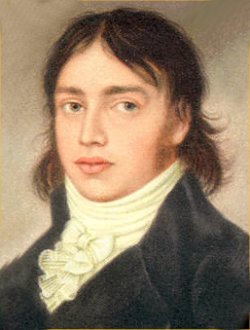
Coleridge in 1798


Much has been written about Coleridge's magnificent poem of 1797, and I am very wary to add more to such a mountain of words that will never do justice to the work, since it is the emotion in the reading or in the listening to its recital that speaks volumes more than any re-wordings.


But I am compelled to add a brief comment, for how can one stay silent before this monument? The poem is clearly divided in two parts. The second part begins with the line “A damsel with a dulcimer / In a vision once I saw . . .” The first part is a report of preternatural events, a story about a wondrous place and the fabled creations of a remote man, the kind of report that Coleridge himself was reading in Purcha’s Pilgrimage when he fell asleep in that famous farm-house that lay somewhere between Porlock and Linton. (See the 1816 Preface, below).


 The second part culminates in the vision of what the poet himself would create, - another Xanadu, greater than the first, - if he could revive within his soul the deep delight which the "symphony and song” of the Abyssinian maid had once caused in his imagination, fed on honey-dew and drunk with the milk of Paradise. It is a parable about creativity and about the power of the Imagination, which he would later articulate in the famous Chapter 13 of his Biographia Literaria. The origins of creativity, the “esemplastic Power” (Coleridge's own phrase: the power to mold things into one, from the Greek eis en plattein, "to shape into one," from hen “one,” and plastikos "able to be molded, pertaining to molding," from plastos "molded," from plassein "to mold"), - this power of the creative genius, argued Coleridge, comes from within, from the imagination and not from external causes. This is where he differed most fundamentally from the thought of Wordsworth. In his much later poem (1802) Dejection: An Ode, Coleridge states this most clearly:


My genial spirits fail;
And what can these avail
To lift the smothering weight from off my breast?
It were a vain endeavour,
Though I should gaze for ever
On that green light that lingers in the west:
I may not hope from outward forms to win
The passion and the life, whose fountains are within.

[emphasis added]


KUBLA KHAN


In Xanadu did Kubla Khan
A stately pleasure-dome decree:
Where Alph, the sacred river, ran
Through caverns measureless to man
Down to a sunless sea.
So twice five miles of fertile ground
With walls and towers were girdled round:
And here were gardens bright with sinuous rills,
Where blossomed many an incense-bearing tree;
And here were forests ancient as the hills,
Enfolding sunny spots of greenery.

But oh! that deep romantic chasm which slanted
Down the green hill athwart a cedarn cover!
A savage place! as holy and enchanted
As e'er beneath a waning moon was haunted
By woman wailing for her demon-lover!
And from this chasm, with ceaseless turmoil seething,
As if this earth in fast thick pants were breathing,
A mighty fountain momently was forced:
Amid whose swift half-intermitted burst
Huge fragments vaulted like rebounding hail,
Or chaffy grain beneath the thresher's flail:
And 'mid these dancing rocks at once and ever
It flung up momently the sacred river.
Five miles meandering with a mazy motion
Through wood and dale the sacred river ran,
Then reached the caverns measureless to man,
And sank in tumult to a lifeless ocean:
And 'mid this tumult Kubla heard from far
Ancestral voices prophesying war!

The shadow of the dome of pleasure
Floated midway on the waves;
Where was heard the mingled measure
From the fountain and the caves.
It was a miracle of rare device,
A sunny pleasure-dome with caves of ice!

A damsel with a dulcimer
In a vision once I saw:
It was an Abyssinian maid,
And on her dulcimer she played,
Singing of Mount Abora.
Could I revive within me
Her symphony and song,
To such a deep delight 'twould win me
That with music loud and long
I would build that dome in air,
That sunny dome! those caves of ice!
And all who heard should see them there,
And all should cry, Beware! Beware!
His flashing eyes, his floating hair!
Weave a circle round him thrice,
And close your eyes with holy dread,
For he on honey-dew hath fed
And drunk the milk of Paradise.


Preface of 1816

Kubla Khan was published in 1816, with the following


Author's Preface:

"In the summer of the year 1797, the Author, then in ill health, had retired to a lonely farm-house between Porlock and Linton, on the Exmoor confines of Somerset and Devonshire. In consequence of a slight indisposition, an anodyne had been prescribed, from the effects of which he fell asleep in his chair at the moment that he was reading the following sentence, or words of the same substance, in Purcha's Pilgrimage: 'Here the Khan Kubla commanded a palace to be built, and a stately garden thereunto. And thus ten miles of fertile ground were inclosed with a wall.' The author continued for about three hours in a profound sleep, at least of the external senses, during which time he has the most vivid confidence that he could not have composed less than from two to three hundred lines; if that indeed can be called composition in which all the images rose up before him as things, with a parallel production of the correspondent expressions, without any sensation or consciousness of effort. On awaking he appeared to himself to have a distinct recollection of the whole, and taking his pen, ink, and paper, instantly and eagerly wrote down the lines that are here preserved. At this moment he was unfortunately called out by a person on business from Porlock, and detained by him above an hour, and on his return to his room, found, to his no small surprise and mortification, that though he still retained some vague and dim recollection of the general purport of the vision, yet, with the exception of some eight or ten scattered lines and images, all the rest had passed away like the images on the surface of a stream into which a stone has been cast, but, alas! without the after restoration of the latter! . . .

Yet from the still surviving recollections in his mind, the Author has frequently purposed to finish for himself what had been originally, as it were, given to him . . . but the tomorrow is yet to come.

Note: This fragment with a good deal more, not recoverable, composed, in a sort of Reverie brought on by two grains of Opium taken to check a dysentery, at a Farm House between Porlock & Linton, a quarter of a mile from Culbone Church, in the fall of the year 1797."


Samuel Taylor Coleridge (1772-1834)


Labels

Labels

Labels