Demo Site
Showing posts with label Greek History. Show all posts

Friday, January 20, 2012

THE HUNT FOR THE CALYDONIAN BOAR


The Kalydonian Boar Hunt: Detail from the François Vase, Volute Krater, Attic Black-Figure style, ca. 570-560, now at the Museo Archeologico Nazionale in Florence


The hunt of the Calydonian boar (us kalydonios) is one of a series of Archaic Greek myths describing a gathering of heroes for the achievement of some great purpose, which in this particular case was the slaughter of a chthonic monster threatening the city of Calydon in western Greece. The myth of the Argonauts and their quest for the Golden Fleece was similarly such a gathering of heroes, as was the storming of Thebes by Polyneices and the Argives, and the Trojan War. In Calydon, the monstrous boar, a wild swine, was sent by the goddess Artemisa to devastate the fields and vineyards of the town. Today, nothing is left of Calydon, save the ruins of a temple to that same goddess.


Artemisa as Huntress


“Nothing is more violent than she when she sees her godhead wronged. The boar of Calydon will be my witness - fierce.” Ovid, Heroides 20. 99 ff. (trans. Showerman)


The "Diana of Versailles," Roman copy, dated 330 BCE


KALYDON (Καλυδών)


Located about a mile north from the shore of the Gulf of Corinth in Aetolia, the city of Calydon (In Greek: Καλυδών; gen.: Καλυδῶνος), was never very large. In the third century BCE, it was encircled by a wall and a fortified acropolis was built on the hill. The sacred road which led to the Sanctuary of Artemis Laphria is still visible today. Laphria was an earlier goddess whose worship antedates that of the Dorian Artemisa, and hence a syncretism of beliefs must have occurred in the region. There was a second Archaic temple on the acropolis, dedicated to Artemisa’s brother, Apollo Laphrios, and together the two shrines came to constitute an important sanctuary.


Ruins of the Temple of Artemis Laphria in Kalydon: The fourth century BCE Sanctuary of Artemis Laphria, excavated by Danish archaeologists under the leadership of Frederick Poulsen in 1925-32 stood on a platform erected on a terrace which is supported by sixth century retaining walls. From its privileged position above a natural spur of the hills it is possible to see the Gulf of Corinth and the city of Messolonghi below.


View of the city of Messolonghi from the Temple of Artemis Laphria in Kalydon


In the Hellenistic period these temples were surrounded by a series of treasuries, stoas and other minor shrines. The size of some of the Hellenistic tombs indicates that at some time there was prosperity. Strabo mentions Calydon in his Geographia, on its former beauty, as by his time it lay desolate: “. . . Calydon and Pleuron, which are now indeed reduced, though in early times these settlements were an ornament to Greece.”


Aerial view of Kalydon: In this photograph, taken from the North, the terrace constructed below the temple of Artemisa Laphria is clearly visible in the center of the picture.


Under the Roman conquest, the city declined, and in 30 BCE, after the Battle of Actium, Octavius Augustus transferred the inhabitants to the new city of Nikopolis (city of victory), further north, on the coast of the Ionian Sea. The town never reached the dimensions of a large city and gradually vanished during the Middle Ages.


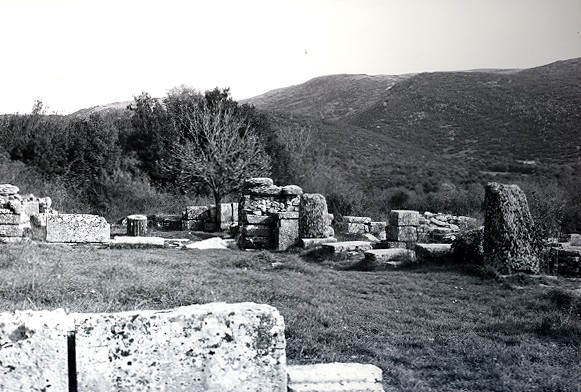
To the right of the sacred way are the ruins of a Heroön (temple to the goddess Hera), the foundations of which are visible in the photograph above.


The earliest archaeological description of the site was that of the English antiquarian and topographer William Martin Leake, whose account of his discoveries in the area, Travels in Northern Greece, was published in 1835.


William Martin Leake


In the 1890’s, the site was visited by the Englishman William John Woodhouse (1866-1937), a Victorian classical scholar. As a Newton student of the British School of Archaeology in Athens, and Craven Fellow, he undertook a thorough topographical exploration of the rugged and little known Aetolian country in 1893. He published the results of his field-work in the Journal of Hellenic Studies and, in 1897, a substantial book, Aetolia.

Archeological excavations of the area were begun in 1908 by the Greek Archeological Society of Athens under the direction of Dr. George Sotiriades. In the period 1926-1932, joint Greek and Danish excavations were carried out under the archaeological team of Frederick Poulsen and Konstantinos Romaios, which had also been exploring and digging in Corinth. Today, the ruins are open to visitors, located right off the E-55 highway that runs along the north shore of the Corinthian Gulf in Aetolia, near the small modern town of Evinochori, and about eight miles east of the Gulf city of Messolonghi.


View of Mount Varásova, ancient Mount Chalkis from the Temple of Artemis Laphria at Kalydon


The Myth of the Boar of Kalydon


Homer mentions Kalydon as the home of Oeneus (Greek for “wine man”), and makes reference to the hunt for the mythical wild swine in the Iliad. The gigantic boar was sent by Artemisa to ravage the country and the vines around Calydon so as to punish Oeneus, its king, for neglecting to offer the first fruits of the harvests to her. Artemisa was the Greek goddess of wild animals and of the chase, among other various things, and she was also a Dorian goddess, a goddess of the Dorian conquerors who descended on Greece and occupied its ancestral lands. It is reasonable to suppose that the myth evokes the punishment of an earlier people of Calydon for their reluctance to adopt the worship of the goddess of their conquerors.

The boar that Artemisa sent to Calydon ravaged the countryside, destroying vines and crops and causing the farmers to seek refuge in the town. King Oeneus, in despair, summoned the heroes from throughout Hellas to hunt the beast and offered its skin and tusks as a reward. The heroes responded, although Heracles was significantly not among them. There is a myth of Heracles hunting his own mythical boar, the Erymanthian. The names of those who did participate in the hunt at Calydon include the semi-mythical, semi-divine, progenitors of the ruling houses of many of the Dorian cities of Greece, and include some of the Argonauts. The hunt was led by the king’s son, Meleagros, who struck the boar down. He gave the skin to the beautiful huntress Atalanta as a prize and she, in turn, hung the boar’s skin from a tree in a sacred Arkadian grove and dedicated it to Artemisa. The various accounts of the myth were later compiled by Ovid and re-told in the Metamorphoses.


(Below, Corinthian black-figured aryballos depicting the Calydonian Boar Hunt, ca. 580 BC., now at the Musée du Louvre)


Among the hunters were Theseus, the founder-king of Athens and son of the god Poseidon; Peleus, one of the Argonauts and father of Achilles, whose connection with Pisa and the Olympian Games has made doubly famous; Nestor, the old man of the Iliad, who was “still in his prime” according to Ovid; Asclepius, son of Apollo and founder of the medical profession; Deucalion, son of King Minos of Crete; Laertes, the father of Odysseus, and the famous Gemini twins, Castor and Pollux, sons of Leda and a swan (Zeus), and brothers of Helen of Troy and Clytaemnestra, Queen of Sparta.

Most significant among the hunters, however, was the huntress Atalanta.


“Atalante in days of yore, Arkadian Iasios' daughter, whose shaft slew Kalydon's boar. Yea, the heroes who, summoned to hunt the terror of Kalydon, came could dispraise not her prowess: the tokens of that her victory to Arkadia were brought, and the tusks of the boar there yet may ye see.” Callimachus, Hymn 3 to Artemis, 218 ff (trans. Mair).


Atalanta


Kalydonian Boar Hunt: Detail from the François Vase, Volute Krater, Attic Black-Figure style, ca. 570-560, now at the Museo Archeologico Nazionale in Florence


She had been suckled by a she-bear, Artemisa herself in disguise, and raised as a huntress by the goddess, so why was she there, hunting Artemisa's own boar? Because as a stand-in for the goddess she became a source of dissension among the hunters, as many of the men refused to hunt alongside a woman. But Meleagros, who fell in love with her, succeeded in persuading them to do so. Atalanta was the first to wound the boar with an arrow, and when Meleagros killed the boar, he gave the dead boar’s skin as prize to Atalanta. "But the goddess again made a great stir of anger and crying battle, over the head of the boar and the bristling boar's hide . . . .” (Iliad, ix, 543) Indeed, the trouble did not end there, for some of the men objected to the woman receiving the prize of the hunt, and the subsequent fight over the trophy led to the death of Meleagros, which was Artemisa’s final revenge against Oeneus.


Tondo of a Laconian black-figure cup, ca. 555 BCE, now at the Louvre


The boar’s skin was said to have been preserved at the Temple of Athena Alae in Tegea, where Pausanias saw it in the second century A.D. The relic, “which time has shriveled and left without a single bristle . . . ,” was clearly nothing much to look at. ( Pausanias, Guide to Greece, vol.2, viii, 47). He reports that the tusks of the boar were taken by Octavius Augustus after Actium. The keepers of the Temple of Athena Alae told him that one of the tusks was broken, but the other was kept in the Emperor’s gardens, in a Sanctuary of Dionysos, in Rome, and it measured “just three feet long.” (Guide to Greece, vol.2, viii, 47).


(Below, Hans Holdt, photograph of the countryside around Kalydon taken in the 1920's)


Homer’s Version of the Myth

Iliad ix. 543 ff (trans. Lattimore):

“The Kouretes and the steadfast Aitolians were fighting and slaughtering one another about the city of Kalydon . . . For Artemis, she of the golden chair, had driven this evil upon them, angered that Oineus had not given the pride of the orchards to her, first fruits; the rest of the gods were given due sacrifice, but alone to this daughter of great Zeus he had given nothing. He had forgotten, or had not thought, in his hard delusion, and in wrath at his whole mighty line the Lady of Arrows sent upon them the fierce wild Boar with the shining teeth, who after the way of his kind did much evil to the orchards of Oineus. For he ripped up whole tall trees from the ground and scattered them headlong roots and all, even to the very flowers of the orchard. The son of Oineus killed this boar, Meleagros, assembling together many hunting men out of numerous cities with their hounds; since the Boar might not have been killed by a few men, so huge was he, and had put many men on the sad fire for burning. But the goddess again made a great stir of anger and crying battle, over the head of the boar and the bristling boar’s hide, between Kouretes [an Aitolian tribe] and the high-hearted Aitolians.”


The old sacred road leads up to the Temple of Artemis Laphria in Kalydon


Pseudo-Apollodorus’ Version of the Myth

“When Oineus [king of Kalydon] was offering his annual sacrifice of the first fruits of the land to all the gods, he overlooked Artemis. The wrathful goddess let loose a great and powerful wild boar, which made the earth unsowable and destroyed herds and people that encountered it. In order to get rid of this boar, Oineus called together all the best men of Hellas and proclaimed the skin as a trophy to the man who could slay it. Here are the people who gathered for the boar hunt: Oineus’ son Meleagros, and Dryas, son of Ares (both from Kalydon); Idas and Lynkeus, sons of Aphareus, from Messene; Kastor and Polydeukes, sons of Zeus and Leda, from Lakedaimon; Aegeus’ son Theseus from Athens; Admetos, the son of Pheres, from Pherai; Iason [Jason], Aeson’s son, from Iolkos; Iphikles, Amphitryon’s son, from Thebes; Peirithoos, son of Ixion, from Larise; Peleus, son of Aiakos, from Phthia; Atalante, the daughter of Skhoineus, from Arkadia; and Amphiaraos, the son of Oikles, from Argos. The sons of Thestios also attended the hunt.


The Hunt for the Calydonian Boar: Meleagros and Atalanta (Etruscan alabaster ash urn from Volterra)


Roman marble sarcophagus from Vicovaro, carved with the Calydonian Hunt, now at the
Palazzo dei Conservatori, Rome


When they had gathered, Oineus entertained them for nine days. On the tenth day, Kepheus and Ankaios [two of the hunters from Arkadia] and some of the others refused contemptuously to go out hunting with a woman, but Meleagros, though marries to Idas’ and Marpessa’s daughter Kleopatra, still wanted to make a child with Atalante, and so compelled the men to join the hunt with her. When they had encircled the boar, the animal killed Hyleus and Ankaios, and Peleus accidentally speared Eurytion [king of Phthia] with his javelin. Atalante was first to hit the boar, in the back with an arrow. Amphiaraos then got it in the eye, and Meleagros killed it with a blow on the flank. When he received the skin, he gave it to Atalante. But the sons of Thestios, who considered it disgraceful that a woman should get the trophy where men were involved, took the skin from her, saying that it was properly theirs by right of birth, if Meleagros chose not to accept it. Outraged by this, Meleagros slew the sons of Thestios and again gave the skin to Atalante. But Althaia, in grief over the death of her brothers, set fire to the brand [that the Moirai declared when consumed would end the life of Meleagros], and Meleagros died on the spot. Some say, however, that . . . the sons of Thestios claimed the skin on the grounds that Iphiklos had first hit the boar. A war then ensued between the Kouretes [an Aitolian tribe] and the Kalydonians.” Pseudo-Apollodorus, Bibliotheca 1. 66 (trans. Aldrich).


Rubens, The Hunt of Meleagros and Atalanta (1617-1618), Kunsthistorisches Museum, Vienna.

In Rubens' paintings, Atalanta is always rather disheveled, a plump, blonde Flemish woman with her right breast bare, in the manner of the Amazons. In the painting above, she has just flung an arrow, or some missile, at the beast, as, according to the myth, she was the one who drew first blood in the hunt.


Rubens, The Calydonian boar hunt, ca. 1636. Museo del Prado Madrid


Description of an Ancient Greek Painting by Philostratus the Younger

“Are you surprised to see a girl [Atalanta] entering into so great a contest and withstanding the attack of so savage and so huge a boar? For you see how bloodshot is his eye, how his crest bristles, and how abundant is the foam that drips from his long upright tusks, which are un-blunted at the point; and you see how the beast’s bulk is proportional to his stride, which indeed is indicated by these tracks that are as large as those of a bull. For the painter has not failed to embody any of these points in his painting. But the scene before us is already terrible. For the boar has attacked Ankaios here in the thigh, and the youth lies pouring out his blood in streams and with a long gaping wound in his thigh; therefore now that the contest is already under way, Atalanta--for we must recognize that the girl is she--having put to the bowstring the arrow she has ready, is about to let it fly . . . The youths here are Meleagros and Peleus, for the painting tells us that it is they who have slain the boar; Meleagros in an attitude of defense throws his weight upon his left foot, and watching closely the boar’s advance, awaits his onset securely with couched spear . . . the hip is the kind to make us confident that the youth will not be overthrown by the boar’s attack . . . So much for the son of Oineos; but Peleus here holds his purple mantle out before him; and he holds in his hand the sword given him by Hephaistos, as he awaits the rush of the boar; his eye is unswerving and keen of glance.” Philostratus the Younger, Imagines 15 (trans. Fairbanks).


Kalydonian Boar Hunt. Detail from the François Vase, Volute Krater, Attic Black-Figure style, ca. 570-560, now at the Museo Archeologico Nazionale in Florence


[right-click on images and open link in new window to expand size]


Friday, December 30, 2011

THE SANCTUARY AT DODONA IN EPIRUS

Travel Diaries: The Sanctuary of Zeus-Naios at Dodona
November, 2000


View of the temenos: Ruins of the Temple of Zeus-Naios and sacred oaks on the site


[right-click on the images and open link to new window to enhance their size]


Dodona is a religious sanctuary associated with the Dorian Greeks, situated in a valley in the northern Greek province of Epirus, south of Joannina. As is the case in many other Greek religious sites, there is a superimposition of cults in this sanctuary. Originally it was the site of an oracle devoted to a Mother Goddess, Rhea or Gaia, but called Dione in Epirus. Eventually, no doubt after the coming of the Dorians, it became a shrine to Zeus, here called Zeus Naios (Zeus of the Spring of Naiads). At this sanctuary, or temenos, the ancient Greeks built a temple to Zeus-Naios, a Stadion, a great theatre and various smaller temples. The great theatre of Pyrrhus, built in the third century BCE, has been reconstructed and the remains of the temple of Zeus-Naios and other ruins of the ancient temenos, or sacred site, are visible. Even some of the oaks of the sacred grove are standing.


Map showing the location of Dodona (Source: Wikipedia)


Photo of the valley of Mt. Tomaros taken in the 1920's. (Hanns Holdt)


Dodona is located just south-west of the city of Ioannina, in the valley of Mount Tomaros in Epirus, Northern Greece.


The Sanctuary


Map of the Sanctuary (Baedeker)


Until 650 BCE, Dodona was a religious and oracular centre mainly for northern tribes, which were variously known as Pelasgians, Thesprotians and Moulossians. It is only after 650 BCE that it became significant to the southern tribes, most likely because of its conquest by the Dorians who descended from the Balkans into Greece through the valleys of Epirus.
The site was identified in 1873 by Constantinos Karapanos, who discovered a number of bronze objects now in the Archaeological Museum in Athens. More scientific excavations have been undertaken by the Greek Archaelogical Service since 1952, and there has been some restoration, particularly of the Theater of Pyrrhus.


View of the temenos in Dodona


[right-click on the images and open link to new window to enhance their size]


Views of the temenos and surrounding areas


The Great Theater at Dodona.


Approach to the Theater of Pyrrhus


The Hellenistic Revival: The Theater of Pyrrhus.


The Great Theater of Pyrrhus as it was in the 1920's (Hanns Holdt)


The Great Theater of Pyrrhus today.

[right-click on the images and open link to new window to enhance their size]


"Wintry Dodona" (Iliad, 16: 234)


Bust of Pyrrhus, or Pyrros, King of Epirus (319/318 BCE–272 BCE)


In c. 290 BCE, King Pyrrhus of Epirus (“Another such victory over the Romans and we’re undone!”), made Dodona the religious capital of his domain and beautified it by implementing a series of fantastic construction projects, including the great Temple of Zeus and the great theater, designed to enact festivals of athletic and musical competition. A wall was built around the oracle itself and the holy tree, as well as temples to Herakles and Dione.


The temple and theater were burned in 219 BCE by the invading Aetolians and the site abandoned. But there was reconstruction in the late 200’s BCE by King Philip V of Macedonia. Destroyed by the Romans under Aemilius Paulus once again, the sanctuary at Dodona was later rebuilt by the Emperor Augustus in 31 BCE, after his victory over Anthony and Cleopatra at Actium that same year, but he turned the theater into an arena. In 362 A.D., the Emperor Julian consulted the oracle prior to his military adventure against the Persians, where he lost his life. When the Christian Emperor Theodosius closed all pagan temples in 391-92 A.D., it is said that he cut down one of the last remaining oaks.

The theater of Pyrrhus was unearthed in the 1950’s and restored in 1960-63.


The temenos


Aristotle believed that the region around Dodona was the place where the Hellenes originated (Meteorologica at 1.14), but this is to take the Dorians as the original Hellenes, which is dubious.

The custom of interpreting the rustling of the leaves of the oak or beech trees probably antedates the Dorian invasion, but the Dorian priesthood became famous thereafter in its competition with the Delphic oracle.


At Dodona, Zeus was worshipped as "Zeus Naios" or "Naos" (god of the spring, or of the Naiads — there was a spring below the oak in the temenos or sanctuary. Originally an oracle of the Mother Goddess, the oracle was shared by Dione (whose name, like "Zeus," simply means "deity") and Zeus. Many dedicatory inscriptions recovered from the site mention both "Dione" and "Zeus Naios".


In the Iliad, Achilles prays to "High Zeus, Lord of Dodona, Pelasgian.” There is no mention of the temple or the theater in Homer, but there is mention of the high priests of the sanctuary, the Selloi.

“High Zeus, Lord of Dodona, Pelasgian, living afar off,
Brooding over wintry Dodona, your prophets about you
Living, the Selloi who sleep on the ground with feet unwashed. Hear me!”
(Richard Lattimore translation, 16: 233-235).

The oracle is also mentioned in Odysseus's fictive yarn about himself told to the swineherd Eumaeus: (Odyssey, 14.327-14.328). Odysseus, he tells Eumaeus, has been seen among the Thesprotians, having gone to inquire of the oracle at Dodona whether he should return to Ithaca openly or in secret (as the disguised Odysseus is actually doing).

“The man himself had gone up to Dodona
To ask the spelling leaves of the old oak
The will of God: how to return, that is,
To the rich realm of Ithaka, after so long
An absence – openly, or by stealth.” (14: 327-31)

Odysseus later repeats the same tale to Penelope, who may not yet have seen through his disguise. (Homer. Odyssey, 19: 299-303) His words reveal a familiarity with Dodona, a realization of its importance, and an understanding that it was normal to consult Zeus there.


And Socrates says to Phaedrus: "They used to say, my friend, that the words of the oak in the holy place of Zeus at Dodona were the first prophetic utterances. The people of that time, not being so wise as you young folks, were content in their simplicity to hear an oak or a rock, provided only it spoke the truth." [Plato, Phaedrus 275b (trans. Fowler)]


Hesiod


Hesiod, Catalogues of Women: Fragment 97 (from the Scholiast on Sophocles Trachinae 1167) (trans. Evelyn-White) (Greek epic C8th or 7th B.C.):

"There is a land Hellopia with much glebe and rich meadows, and rich in flocks and shambling kine. There dwell men who have many sheep and many oxen, and they are in number past telling, tribes of mortal men. And there upon its border is built a city, Dodona; and Zeus loved it and appointed it to be his oracle, reverenced by men . . . And they [the doves] lived in the hollow of an oak (phêgou). From them men of earth carry away all kinds of prophecy,--whosoever fares to that spot and questions the deathless god, and comes bringing gifts with good omens."


Herodotus


Fictitious portrait of Herodotus (490-425 BCE)


Herodotus (Histories 2:54–57) was told by priests at Egyptian Thebes in the 5th century BCE "that two priestesses had been carried away from Thebes by the Phoenicians; one, they said they had heard was taken away and sold in Libya, the other in Hellas; these women, they said, were the first founders of places of divination in the aforesaid countries."

Herodotus follows with what he was told by the prophetesses, called peleiades ("doves") at Dodona:

"...that two black doves had come flying from Thebes in Egypt, one to Libya and one to Dodona; the latter settled on an oak tree, and there uttered human speech, declaring that a place of divination from Zeus must be made there; the people of Dodona understood that the message was divine, and therefore established the oracular shrine. The dove which came to Libya told the Libyans (they say) to make an oracle of Ammon; this also is sacred to Zeus. Such was the story told by the Dodonaean priestesses, the eldest of whom was Promeneia and the next Timarete and the youngest Nicandra; and the rest of the servants of the temple at Dodona similarly held it true."

"But my own belief about it is this. If the Phoenicians did in fact carry away the sacred women and sell one in Libya and one in Hellas, then, in my opinion, the place where this woman was sold was in what is now Hellas, but was formerly called Pelasgia, and later Thesprotia; and then, being a slave there, she established a shrine of Zeus under an oak that was growing there; for it was reasonable that, as she had been a handmaid of the temple of Zeus at Thebes, she would remember that temple in the land to which she had come. After this, as soon as she understood the Greek language, she taught divination; and she said that her sister had been sold in Libya by the same Phoenicians who sold her."

"I expect that these women were called 'doves' by the people of Dodona because they spoke a strange language, and the people thought it like the cries of birds; then the woman spoke what they could understand, and that is why they say that the dove uttered human speech; as long as she spoke in a foreign tongue, they thought her voice was like the voice of a bird. For how could a dove utter the speech of men? The tale that the dove was black signifies that the woman was Egyptian."

(Histories at 2: 54–57)


View of the temenos and the sacred oak at Dodona, with Mount Tomaros in the background.


Thursday, December 29, 2011

Works from the David M. Robinson Collection

The David M. Robinson Collection of Greek and Roman Antiquities at the University of Mississippi Museum of Art is one of the finest collections of its kind in the United States. Covering the period from 1500 BCE to 300 AD, the collection contains Greek and Roman sculpture, Greek decorated pottery, architectural fragments, small artifacts in terracotta and bronze, and Greek and Roman coins.


The images shown below are photographs I took at the University of Mississippi Museum of Art in July, 2011, a few examples of black-figure and red-figure Attic pottery which are works of Athenian craftsmen from the sixth and fifth centuries BCE and part of the permanent collection there. There are only a few pieces depicted in the blog, but they reveal the main characteristics of each style. As well, I show a few oil lamps, and the painting on a kylix which reveals an unusual method of depilation by means of the oil lamp.


[to enhance the size of the photos right click on them and open in new window]


Pallas Athena holding a helmet over an altar.
Amphora, Attic red-figure style, 500-490 BCE.


The Greek and Roman Antiquities Collection at the University of Mississippi Museum of Art is named after its donor, David M. Robinson, who was Professor of Classics at the University prior to his death in 1958.


David M. Robinson was born in Auburn, New York, in 1880. He received his A.B. degree in 1898 and his Ph.D. in 1904 from the University of Chicago. After serving as head of the Classics Department at Illinois College in Urbana from 1904-05, Robinson spent the majority of his career at Johns Hopkins University in Baltimore.

Considered an influential figure in Mississippi Archaeology, Robinson conducted artifact excavations in Corinth, Greece (1902-1903) and in Sardis, also in Greece in 1910. In 1924, he directed the excavation of Pisidian Antioch and Sizma for the University of Michigan. His greatest archaeological achievement was the discovery and excavation of the ancient city of Olynthus from 1928 through 1938. Throughout his career, Robinson was widely published in Archaeology as well as Greek and Roman literature, history and linguistics.

In 1947, he retired from Johns Hopkins and accepted a position as Professor of Classical Archaeology at the University of Mississippi where he taught for ten years. Robinson passed away in 1958, leaving behind a wealth of published research and a unique collection of Greek and Roman antiquities, which was donated to the University of Mississippi Museum of Art. (Source: Museum notes)
Satyr, visible in the portrait of David Robinson, is a marble Greek bust from Pergamon, dated ca. 200 BCE, part of Robinson's private collection.


Attic Black-Figure Ceramics


Attic black-figure style emerged from the Proto-Attic style, towards the beginning of the seventh century BCE. It is a reflection of the Archaic or Lyric Art of the Greeks, primarily the style of the sixth century BCE. (See my blog of October 31, 2010: "Tragic Art: The Treasure House of the Siphnians.") A new method of outline drawing developed, with extensive use of white and an occasional but inconsistent admixture of incisions. Human figures are presented on a large scale, etched against a white or red background, or against the background of the warm brown of the clay. The figures are always shown frontally or in profile and in rigid pose. The representations are one-dimensional, formalized and stiff, in the form of religious imaging. Towards the year 630 BCE, the discipline of the Corinthian school begins to be emulated and a fully developed Archaic art of ceramics becomes prevalent in the Attic peninsula until the end of the sixth century BCE, when it is displaced by red-figure style (discussed below). Around 530 BCE, the inadequacy of the black-figure method of silhouette and incision will lead to the introduction of red-figure outline drawing. Yet the black-figure style did not die off immediately and works in this style are still being made in the fifth century. Due to the conservatism of the priestly classes and the ruling elites, the black-figure style was required on the amphoras presented full of oil to the victors in the Panathenaic Games.

I photographed only two examples of the black-figure style from the David Robinson Collection. The first is the neck-amphora of 530-515 BCE showing a warrior and two youths.
Neck-amphora. Attic Black-Figure Style, 530-515 BCE.


Note that the warrior and the two youths are depicted in profile and entirely in silhouette, in one-dimensional fashion, rigidly and formally facing one another. Their eyes are in profile and the eyeballs in the center of the eye, as was the formal tradition of this style. The garments, as well as the pose, are formally stylized; the line etchings are fine and crisp.

The oldest piece portrayed here is an Attic black figure Skyphos in the Boeotian style from the Fifth century BCE, which satirizes Circe and Odysseus. The figures depict a comic satire in the form of caricatures designed for comedic purpose. Circe stands above Odysseus who is receiving a gift from her.


Attic Red-Figure ceramics


The Attic red-figure style appeared rather suddenly in Athens around the year 530 BCE. It shows a tendency towards the naturalistic which is made possible by changes in technique. The figures are outlined, and the inner details are shown by thin lines of paint. This is similar to contemporary painted panels, but the black background and the lack of any other colors must have been the vase painters' own idea. As well, major lines are emphasized by the use of a thicker and more viscous solution on the black paint so that they stand out in relief. The overall effect is one of greater naturalism and grace.

Neck amphora in Attic Red-Figure style, 470 BCE, shows Triptolemos on a winged chariot.


In the red-figure style, figures are drawn in rather than engraved. Red-figure painting made it possible for the artist to convey a more naturalistic picture of human anatomy. In the last ten years of the sixth century BCE, vase painters working in red-figure style abandoned the ancient tradition of composing figures in strictly profile or frontal views. This was followed by a new anatomical system which placed this style within the tradition that has come to be known as Classical, characterized by anatomical verisimilitude, naturalistic expressions and movements, and flowing drapery and garments that hang naturally on the body of the human figures. The eye, for example, until almost the end of the sixth century, had always been shown frontally, with the eyeball in the center (see the Athena holding a helmet, below), even if the face was in profile. In red-figure style, the eyeball moves forward and the eye begins to open in front and is shortened to a correct profile view. As well, the drapery changes from a decorative to a more natural system of folds. Scenes of human life become more common, especially the convivial and the athletic, but even in such scenes, vigorous activity becomes less common than it was in the earlier black-figure style.


Amphora in Attic red-figure style, 500-490 BCE: Athena holding a helmet over an altar


Ease of movement and grace in action are evident in the representation of a Dyonisiac Maenad holding a thyrsos, the staff made of giant fennel stalks carried by the Bacchiadae, and a snake on her right arm, below:


Kylix. Attic red-figure 490-80 BCE: Maenad with thyrsos and snake.

Note that the eyeball of the maenad has moved forward in this representation, compared to the Athena directly above. As well, the garment flows more naturally and hangs gracefully from the outline of the thigh and left knee.


Kylix. Attic red-figure 490-80 BCE: Maenad with thyrsos and snake.


[enhance viewing of the photos by right-clicking on the image and opening link in new window]


The more naturalistic representation of the eye and eyeball in Attic red-figure style is evident in the figure of the bride below, both upon her receipt of a gift and as she looks at herself in the mirror, in the Lebes Gamikos of 450-440 BCE.


Lebes Gamikos. Attic red-figure 450-440 BCE: Bride seated receiving gifts and shown on the reverse side with attendants and a mirror.

The Lebes Gamikos, literally meaning “nuptial vase” (plural - lebetes gamikoi) is a form of ancient Greek Pottery used primarily in marriage ceremonies, probably in the ritual sprinkling of the bride with water before the wedding. In form, it has a large bowl-like body and a stand that can be long or short. Painted scenes are placed on either the body of the vessel or the stand. Below are two images of the stand of the vase depicted above. It shows the hero Perseus pursuing the nymph Thetis. The classical style is evident in the representation of the eye, the graceful depiction of the movement of the limbs and the naturalness of the draped garment.


Lebes Gamikos. Attic red-figure 450-440 BCE: Perseus pursuing Thetis (detail on stem)


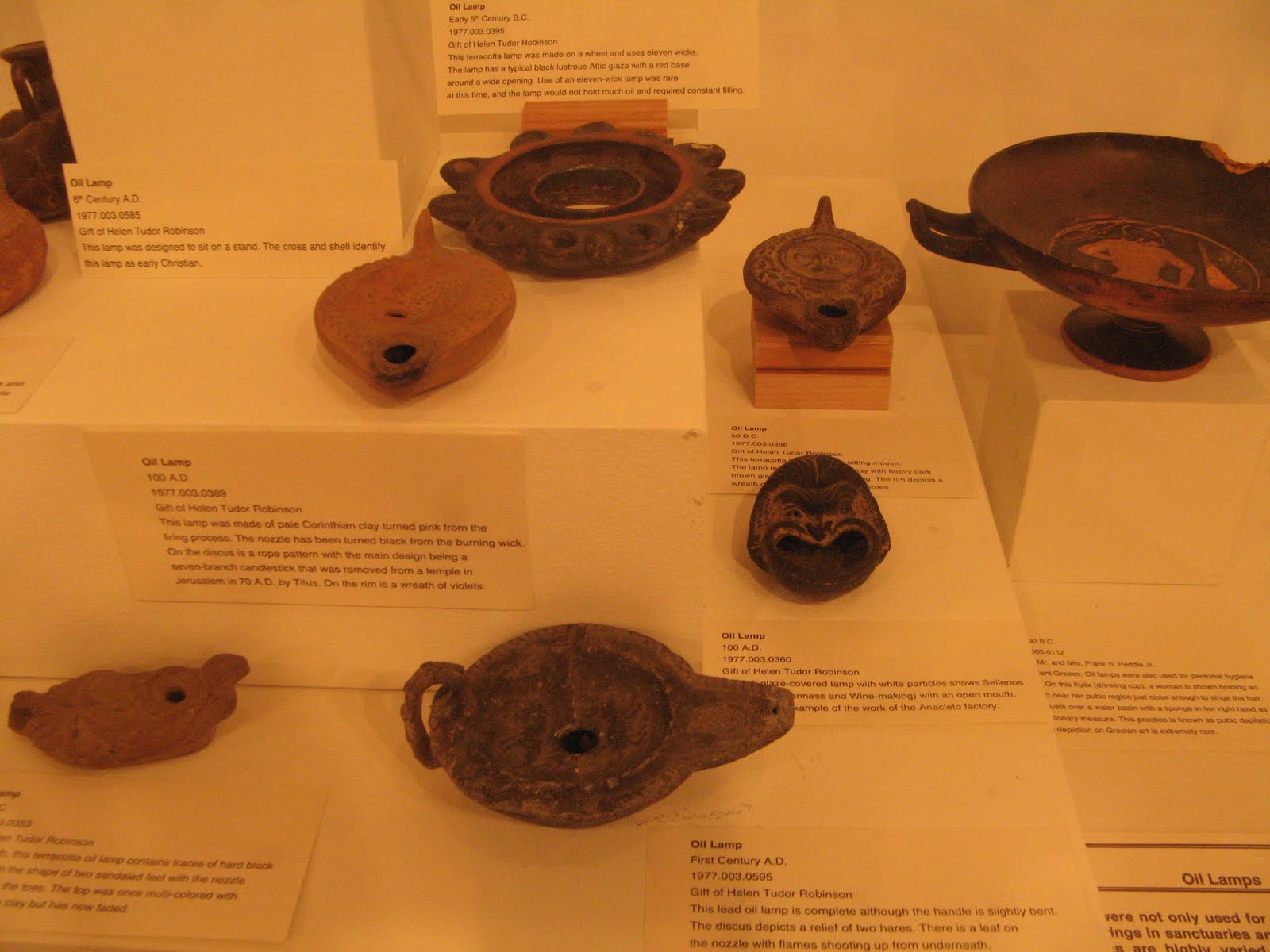
Oil Lamps


Oil Lamps were not only used for light but also served as votive offerings in sanctuaries and also as tomb furniture. Lamp forms are highly varied, ranging from simple to elaborate. Lamps used in ancient Greece could sit on stands or be suspended from cords or chains. Olive oil was a popular fuel and a wick would be placed in the lamp and out the nozzle to ensure even burning. Lamps from Athens changed around the VIIth. century BCE, with more shallow lamps and longer nozzles being made in molds. This popular form was the standard for thousands of years. Larger and more decorative lamps were specialty items and usually denote ceremonial status. (Source: Museum notes)


Kylix depicting a woman removing her pubic hair by burning it with an oil lamp.


Oil lamps were also used for personal hygiene. On this Kylix (drinking cup), a woman is shown holding an oil lamp near her pubic region just close enough to singe the hair as she squats over a water basin with a sponge in her right hand as a precautionary measure. This practice was common for pubic depilation in Greece and its depiction on Grecian art is extremely rare. (Source: Museum notes).


Labels

Labels

Labels