Demo Site
Showing posts with label English Literature: Eighteenth Century. Show all posts

Friday, March 4, 2011

COLERIDGE - KUBLA KHAN


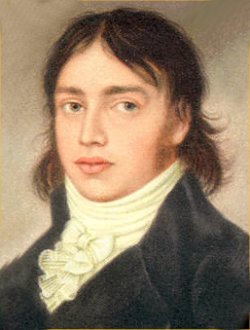
Coleridge in 1798


Much has been written about Coleridge's magnificent poem of 1797, and I am very wary to add more to such a mountain of words that will never do justice to the work, since it is the emotion in the reading or in the listening to its recital that speaks volumes more than any re-wordings.


But I am compelled to add a brief comment, for how can one stay silent before this monument? The poem is clearly divided in two parts. The second part begins with the line “A damsel with a dulcimer / In a vision once I saw . . .” The first part is a report of preternatural events, a story about a wondrous place and the fabled creations of a remote man, the kind of report that Coleridge himself was reading in Purcha’s Pilgrimage when he fell asleep in that famous farm-house that lay somewhere between Porlock and Linton. (See the 1816 Preface, below).


 The second part culminates in the vision of what the poet himself would create, - another Xanadu, greater than the first, - if he could revive within his soul the deep delight which the "symphony and song” of the Abyssinian maid had once caused in his imagination, fed on honey-dew and drunk with the milk of Paradise. It is a parable about creativity and about the power of the Imagination, which he would later articulate in the famous Chapter 13 of his Biographia Literaria. The origins of creativity, the “esemplastic Power” (Coleridge's own phrase: the power to mold things into one, from the Greek eis en plattein, "to shape into one," from hen “one,” and plastikos "able to be molded, pertaining to molding," from plastos "molded," from plassein "to mold"), - this power of the creative genius, argued Coleridge, comes from within, from the imagination and not from external causes. This is where he differed most fundamentally from the thought of Wordsworth. In his much later poem (1802) Dejection: An Ode, Coleridge states this most clearly:


My genial spirits fail;
And what can these avail
To lift the smothering weight from off my breast?
It were a vain endeavour,
Though I should gaze for ever
On that green light that lingers in the west:
I may not hope from outward forms to win
The passion and the life, whose fountains are within.

[emphasis added]


KUBLA KHAN


In Xanadu did Kubla Khan
A stately pleasure-dome decree:
Where Alph, the sacred river, ran
Through caverns measureless to man
Down to a sunless sea.
So twice five miles of fertile ground
With walls and towers were girdled round:
And here were gardens bright with sinuous rills,
Where blossomed many an incense-bearing tree;
And here were forests ancient as the hills,
Enfolding sunny spots of greenery.

But oh! that deep romantic chasm which slanted
Down the green hill athwart a cedarn cover!
A savage place! as holy and enchanted
As e'er beneath a waning moon was haunted
By woman wailing for her demon-lover!
And from this chasm, with ceaseless turmoil seething,
As if this earth in fast thick pants were breathing,
A mighty fountain momently was forced:
Amid whose swift half-intermitted burst
Huge fragments vaulted like rebounding hail,
Or chaffy grain beneath the thresher's flail:
And 'mid these dancing rocks at once and ever
It flung up momently the sacred river.
Five miles meandering with a mazy motion
Through wood and dale the sacred river ran,
Then reached the caverns measureless to man,
And sank in tumult to a lifeless ocean:
And 'mid this tumult Kubla heard from far
Ancestral voices prophesying war!

The shadow of the dome of pleasure
Floated midway on the waves;
Where was heard the mingled measure
From the fountain and the caves.
It was a miracle of rare device,
A sunny pleasure-dome with caves of ice!

A damsel with a dulcimer
In a vision once I saw:
It was an Abyssinian maid,
And on her dulcimer she played,
Singing of Mount Abora.
Could I revive within me
Her symphony and song,
To such a deep delight 'twould win me
That with music loud and long
I would build that dome in air,
That sunny dome! those caves of ice!
And all who heard should see them there,
And all should cry, Beware! Beware!
His flashing eyes, his floating hair!
Weave a circle round him thrice,
And close your eyes with holy dread,
For he on honey-dew hath fed
And drunk the milk of Paradise.


Preface of 1816

Kubla Khan was published in 1816, with the following


Author's Preface:

"In the summer of the year 1797, the Author, then in ill health, had retired to a lonely farm-house between Porlock and Linton, on the Exmoor confines of Somerset and Devonshire. In consequence of a slight indisposition, an anodyne had been prescribed, from the effects of which he fell asleep in his chair at the moment that he was reading the following sentence, or words of the same substance, in Purcha's Pilgrimage: 'Here the Khan Kubla commanded a palace to be built, and a stately garden thereunto. And thus ten miles of fertile ground were inclosed with a wall.' The author continued for about three hours in a profound sleep, at least of the external senses, during which time he has the most vivid confidence that he could not have composed less than from two to three hundred lines; if that indeed can be called composition in which all the images rose up before him as things, with a parallel production of the correspondent expressions, without any sensation or consciousness of effort. On awaking he appeared to himself to have a distinct recollection of the whole, and taking his pen, ink, and paper, instantly and eagerly wrote down the lines that are here preserved. At this moment he was unfortunately called out by a person on business from Porlock, and detained by him above an hour, and on his return to his room, found, to his no small surprise and mortification, that though he still retained some vague and dim recollection of the general purport of the vision, yet, with the exception of some eight or ten scattered lines and images, all the rest had passed away like the images on the surface of a stream into which a stone has been cast, but, alas! without the after restoration of the latter! . . .

Yet from the still surviving recollections in his mind, the Author has frequently purposed to finish for himself what had been originally, as it were, given to him . . . but the tomorrow is yet to come.

Note: This fragment with a good deal more, not recoverable, composed, in a sort of Reverie brought on by two grains of Opium taken to check a dysentery, at a Farm House between Porlock & Linton, a quarter of a mile from Culbone Church, in the fall of the year 1797."


Samuel Taylor Coleridge (1772-1834)


Sunday, April 4, 2010

Notes on Romanticism: Part 3

Wordsworth, “Lines: Composed a few miles above Tintern Abbey, on revisiting the banks of the Wye during a tour, July 13, 1798. from Lyrical Ballads [London: J. & A. Arch, 1798]


How oft, in spirit, have I turned to thee,
O sylvan Wye! thou wanderer thro' the woods,
How often has my spirit turned to thee!


Tintern Abbey on the Wye


“No poem of mine was composed under circumstances more pleasant for me to remember than this. I began it upon leaving Tintern, after crossing the Wye, and concluded it just as I was entering Bristol in the evening, after a ramble of four or five days, with my Sister. Not a line of it was altered, and not any part of it written down till I reached Bristol. It was published almost immediately after in the little volume of which so much has been said in these Notes.”--(Wordsworth, The Lyrical Ballads, as first published at Bristol by Cottle.)

My concern here turns on the notion of a Philosophy of Nature, the Pantheism of the Romantics. As well, the discovery of the self, which is the subject of my Notes on Romanticism, Parts 1 and 2, on Goethe's Werther, now leads to the more ambitious subject of The Ego in Nature: “Are not the mountains, waves, and skies, a part / Of me and of my soul, as I of them?” Byron, Childe Harold’s Pilgrimage, III, lxxv. Once again, the fundamental notion of nostalgia is central here, and particularly in its context as a re-visitation.


My concern is with the question of the relationship of the emancipated 'self' of the early Romantics and the relationship with "Nature" that was crafted onto it. Both are intimately related to one another in this discourse. In the poems of Hölderlin, for example, the self is directly reflected in Nature. Nature speaks of the absence in the poet's soul, the lack within his heart, after the gods have departed.


In Wordsworth, however, a more objective consideration of Nature begins to emerge. The Prelude is a well-known paean to the nature of the poet's homeland. But in 'Tintern Abbey,' Nature and the Gothic become the vehicles of nostalgia. And they are something else as well: they are a much needed refuge from the contemporary reality of the poet's life. The phenomenon that has come to be known as the 'industrial revolution' had unleashed a dramatic confrontation between man and Nature, where Nature came to be exploited for the sake of production determined by markets. In a whirlwind of change that began as far back as the seventeenth century, and first of all in England, not only was the economic and the social structure of the country forever changed, but its landscape as well underwent a process of transformation which is still visible in its scars and contrasts. Red brick factories rose next to Gothic church steeples in the hills and vales of England, canals cut through the fields, pits and mines were gouged out of the earth, and small towns invaded their surrounding farmlands, pitting and pocking the landscapes, a monstrously ugly process that was clearly visible during Wordsworth's life time.

The unstoppable dynamic of the industrial revolution moved to exploit the population of England no less ruthlessly than it did its landscape. In his early poems, Wordsworth had exposed the miserable lives of urban dwellers and of the children of the poor, as he became a notorious commentator on what was then known as the "condition of England question."


However, this was not going to be the tenor of the poem celebrating his return to Tintern Abbey. Wordsworth could not have expounded on nostalgia and past loves, on the search for absence, in such famous landscapes of the changing England of his own day, subject of so many discussions and parliamentary debates, such as the famous furnaces of the West Country, Coalbrookdale (Loutherbourg's painting of Coalbrookdale at night, 1801, below), the desolation of industrial landscapes (print of Lombe's silk mill at Derby, below), the iron bridges of the industrial revolution (cast iron bridge at Coalbrookdale, 1779, below), or the Birmingham canals. He chose instead, as he had to, the ruin of a Gothic Abbey, untouched in its green, sylvan, environment since the looting of the monasteries in the sixteenth century. This was required by his own intent at idealization, which is the underlying psychological mechanism of nostalgia.


Louthenbourg, Coalbrookdale, 1801


Lombe's Silk Mill (1719):
the most advanced factory in
the early eighteenth century


Coalbrookdale, Cast iron bridge built in 1779, considered a
marvel of engineering prowess at the time.


Preston Bridge with industrial landscape
in Lancashire


LINES, COMPOSED A FEW MILES ABOVE TINTERN ABBEY, ON REVISITING THE BANKS OF THE WYE DURING A TOUR. JULY 13, 1798

FIVE years have past; five summers, with the length
Of five long winters! and again I hear
These waters, rolling from their mountain-springs
With a soft inland murmur.--Once again
Do I behold these steep and lofty cliffs,
That on a wild secluded scene impress
Thoughts of more deep seclusion; and connect
The landscape with the quiet of the sky.
The day is come when I again repose
Here, under this dark sycamore, and view
These plots of cottage-ground, these orchard-tufts,
Which at this season, with their unripe fruits,
Are clad in one green hue, and lose themselves
'Mid groves and copses. Once again I see
These hedge-rows, hardly hedge-rows, little lines
Of sportive wood run wild: these pastoral farms,
Green to the very door; and wreaths of smoke
Sent up, in silence, from among the trees!
With some uncertain notice, as might seem
Of vagrant dwellers in the houseless woods,


Gainsborough, The Cottage Door, 1780


Or of some Hermit's cave, where by his fire
The Hermit sits alone. These beauteous forms,
Through a long absence, have not been to me
As is a landscape to a blind man's eye:
But oft, in lonely rooms, and 'mid the din
Of towns and cities, I have owed to them
In hours of weariness, sensations sweet,
Felt in the blood, and felt along the heart;
And passing even into my purer mind,
With tranquil restoration:--feelings too
Of unremembered pleasure: such, perhaps,
As have no slight or trivial influence
On that best portion of a good man's life,
His little, nameless, unremembered, acts
Of kindness and of love. Nor less, I trust,
To them I may have owed another gift,
Of aspect more sublime; that blessed mood,
In which the burthen of the mystery,
In which the heavy and the weary weight
Of all this unintelligible world,
Is lightened:--that serene and blessed mood,
In which the affections gently lead us on,--
Until, the breath of this corporeal frame
And even the motion of our human blood
Almost suspended, we are laid asleep
In body, and become a living soul:
While with an eye made quiet by the power
Of harmony, and the deep power of joy,
We see into the life of things.


Gainsborough, Landscape
1760


If this Be but a vain belief, yet, oh! how oft--
In darkness and amid the many shapes
Of joyless daylight; when the fretful stir
Unprofitable, and the fever of the world,
Have hung upon the beatings of my heart--
How oft, in spirit, have I turned to thee,
O sylvan Wye! thou wanderer thro' the woods,
How often has my spirit turned to thee!
And now, with gleams of half-extinguished thought,
With many recognitions dim and faint,
And somewhat of a sad perplexity,
The picture of the mind revives again:
While here I stand, not only with the sense
Of present pleasure, but with pleasing thoughts
That in this moment there is life and food
For future years. And so I dare to hope,
Though changed, no doubt, from what I was when first
I came among these hills; when like a roe
I bounded o'er the mountains, by the sides
Of the deep rivers, and the lonely streams,
Wherever nature led: more like a man
Flying from something that he dreads, than one
Who sought the thing he loved. For nature then
(The coarser pleasures of my boyish days,
And their glad animal movements all gone by)
To me was all in all.--I cannot paint
What then I was.


Gainsborough, The Marsham children 1787


The sounding cataract
Haunted me like a passion: the tall rock,
The mountain, and the deep and gloomy wood,
Their colors and their forms, were then to me
An appetite; a feeling and a love,
That had no need of a remoter charm,
By thought supplied, nor any interest
Unborrowed from the eye.--That time is past,
And all its aching joys are now no more,
And all its dizzy raptures. Not for this
Faint I, nor mourn nor murmur, other gifts
Have followed; for such loss, I would believe,
Abundant recompence. For I have learned
To look on nature, not as in the hour
Of thoughtless youth; but hearing oftentimes
The still, sad music of humanity,
Nor harsh nor grating, though of ample power
To chasten and subdue. And I have felt
A presence that disturbs me with the joy
Of elevated thoughts; a sense sublime
Of something far more deeply interfused,
Whose dwelling is the light of setting suns,
And the round ocean and the living air,
And the blue sky, and in the mind of man;


Gainsborough, Cornard Wood
1747


A motion and a spirit, that impels
All thinking things, all objects of all thought,
And rolls through all things. Therefore am I still
A lover of the meadows and the woods,
And mountains; and of all that we behold
From this green earth; of all the mighty world
Of eye, and ear,--both what they half create,
And what perceive; well pleased to recognise
In nature and the language of the sense,
The anchor of my purest thoughts, the nurse,
The guide, the guardian of my heart, and soul
Of all my moral being. Nor perchance,
If I were not thus taught, should I the more
Suffer my genial spirits to decay:
For thou art with me here upon the banks
Of this fair river; thou my dearest Friend,
My dear, dear Friend; and in thy voice I catch
The language of my former heart, and read
My former pleasures in the shooting lights
Of thy wild eyes. Oh! yet a little while
May I behold in thee what I was once,


Gainsborough, Portrait of his daughters 1759


My dear, dear Sister! and this prayer I make,
Knowing that Nature never did betray
The heart that loved her; 'tis her privilege,
Through all the years of this our life, to lead
From joy to joy: for she can so inform
The mind that is within us, so impress
With quietness and beauty, and so feed
With lofty thoughts, that neither evil tongues,
Rash judgments, nor the sneers of selfish men,
Nor greetings where no kindness is, nor all
The dreary intercourse of daily life,
Shall e'er prevail against us, or disturb
Our cheerful faith, that all which we behold
Is full of blessings. Therefore let the moon
Shine on thee in thy solitary walk;
And let the misty mountain-winds be free
To blow against thee: and, in after years,
When these wild ecstasies shall be matured
Into a sober pleasure; when thy mind
Shall be a mansion for all lovely forms,
Thy memory be as a dwelling-place
For all sweet sounds and harmonies; oh! then,
If solitude, or fear, or pain, or grief,
Should be thy portion, with what healing thoughts
Of tender joy wilt thou remember me,
And these my exhortations! Nor, perchance--
If I should be where I no more can hear
Thy voice, nor catch from thy wild eyes these gleams
Of past existence--wilt thou then forget
That on the banks of this delightful stream
We stood together; and that I, so long
A worshipper of Nature, hither came
Unwearied in that service: rather say
With warmer love--oh! with far deeper zeal
Of holier love. Nor wilt thou then forget,
That after many wanderings, many years
Of absence, these steep woods and lofty cliffs,
And this green pastoral landscape, were to me
More dear, both for themselves and for thy sake!

1798.


Tintern Abbey

Notes on Romanticism: Part 1

"Romanticism" in Art and Literature


Romanticism has its roots in the middle of the eighteenth century, and is born from the literature that was being written for the embryonic middle-classes in England and Germany. Since the “middle class,” “the middling sectors” as they were known in England, were far more conspicuous and prosperous there than in Germany, the literature is correspondingly different, and has a different chronology of development and evolution. But in both cases, it is characterized by a certain degree of social realism and an appeal to sentimentality.


T
he theme of Love and Death:
Girodet, The Burial of Atala, 1808


It is particularly in Germany, in the work of Goethe and the ‘Sturm und Drang’ group in Frankfurt (Frankfurter Gelehrter Anzeiger), that this combination between sentimentality (Empfindsamkeit) and social realism is most characteristic and definitory, and as such, it is a perfect point of entry for a discussion of the various definitions of the subsequent Romantic movement that have been traditionally advanced in the study of literature, music and history, and that we shall explore here. In sum, we are going to begin our search for a historical definition of “Romanticism” from a consideration of it as ‘an affair of the heart.’


Caspar David Friedrich, Two Friends Contemplating the Moon 1819


“The Law of the Heart” What is it?

Goethe himself did not think his early work, his characteristic Frankfurt work of the years 1771-1775, was ‘romantic.’ “Sturm und Drang” meant something else to him. But when ‘Romanticism’ became a full-blown movement in Germany, with the brothers Schlegel, the poets Hoelderlin and Novalis, the young Schiller, the music of Beethoven, he dissociated himself from the movement and its origins, now secure in the court of Weimar as the great classical poet of his day. In one of his conversations with Eckerman, late in life, he said:


“The Classical I call healthy and the Romantic sick . . . Most of the new poetry is not Romantic because it is new, but it is because it is weak, sickly, and ill, and the old is not Classical because it is old, but because it is strong, fresh, cheerful, and healthy.” (Conversations with Eckerman, April 2, 1829)


What is this weakness, this sickliness and ill health of which Goethe speaks? I will suggest to you that it is a lot of what we usually refer to as “Nostalgia.”


For Hegel, the separation of what he calls the Ideal (Art) [the Heart?] from the Real (Science) [Instrumental Reason?], is the beginning of the decline of a culture (of a “world-historical people”). (Cf. Introduction to the Greek World, in his Philosophy of History). The ‘sickliness’ of Romanticism is arguably that separation, it’s beginning, which leads through Modernism to the subjective idealism of our time.


“Romanticism” is usually associated in our culture with young heterosexual love, with the romance of infatuation, with the notion of a ‘get-away’ of two people who love each other, in short, with the sort of associations conjured up by the Valentine’s Day celebration. How can we make this fit our own approach as the aesthetic of the “heart?”


To begin with, ‘the law of the heart,’ the preoccupation with the things of the heart, of sentiment and emotion, should not be limited to love, and certainly not to sexual love.


Gros, The young Napoleon at Arcola, 1796


Romanticism also invokes the idea of the love of country, for example. I suggest to you the great patriotic orations of a poet like Manuel Jose Quintana. And, with reference to Spanish poets, I reference the Rimas (Rhymes) of Gustavo Adolfo Becquer, always c onsidered as being within the Canon of Romanticism, and many of which pertain to death and cemeteries and graves. Death is as much a part of the Romantic vision as Love, and in the little book of Goethe, ‘The Sorrows of Young Werther,’ Werther's death by suicide is the logical conclusion of his love for Lotte Buff.

To return to Manuel Jose Quintana for a moment, it is not a coincidence that patriotic fervor is associated with Romantic literature. Romanticism is the discourse of the bourgeoisie, and the bourgeoisie in Europe favored the national state as a vehicle for its own emancipation. This is not as clear in England, where the national state can be said to be consolidated since the fifteenth century, nor in Germany, where the clash of enlightened monarchies will persist until Prussia gobbled them all up in the middle of the 19th century. But it is a particularity of the Mediterranean countries, France, Italy, Spain, in particular, and certainly of the Latin American republics just coming into existence in the first quarter of the 19th century.


Delacroix, La liberte guidant le peuple, 1830


The story of Argentine independence has always been told in Romantic terms: the blue and white ribbons distributed on the day of the Revolution, the talk of freedom and national greatness as joint aspects of a volcanic eruption of spirit, the national anthem which was sung in the salons of Buenos Aires amid revolutionary fervor.


"El abrazo de Maipu"
San Martin and O'Higgins in 1817

Subercaseaux, El Abrazo de Maipu, 1908


Romanticism is also the macabre, the ghoulish, the spooky and unnatural. The paintings of Fuseli and the monster created by Frankenstein, both derive from the same preoccupation with the abnormal of naturalistic derivation.


Dr. Frankenstein, incidentally, was a reader of ‘Werther.’


What we see in Fuseli is an exaltation of emotion, of fear. It is this keenness for emotion, the frisson of sentiment that is a commonality in the movement. The common denominator being the cultivation of the affairs of the heart, whatever their psychological origin, a fetishization of emotional states.

Why do I focus on nostalgia as, perhaps, a possible trigger for this type of discourse? What is it that this cultural movement seeks to return to? What does it ache to return to? Or, which is the same thing, what sort of lack does this movement articulate?

This is an issue that could be approached from a political as well as a psychological or esthetic perspective. An esthetic is always a reconciliation of the individual body with the state, an organic adaptation to hegemony, and this is what an exploration of the Romantic’s lack would yield. Clearly, the bourgeoisie was not yet at home in the European states of the early 19th century. In Hölderlin’s Odes and Hymns, the sense of absence is keenly felt: the gods have departed, and all that is left is sadness and despair.


Despite Keats’ Grecian Urn, Romanticism is not a cult of Beauty. The ugly is also present, and highlighted. Or perhaps I should say ‘the exaggerated’ rather than ‘the ugly,’ as is evident from the Fuseli painting above, and the following, of the blind Milton dictating to his daughters:


Henry Fuseli, The Blind Milton Dictating to His Daughters, 1793


"The child is father to the Man," says Wordsworth in a little poem entitled My Heart Leaps Up When I Behold, written in Grasmere in 1802. One of the characteristics of Romanticism is the idealization of childhood, its innocence, its pristine vision. In fact, it is a function of the ultimate longing for return, for re-visitation, which is at the base of the nostalgic passion. “Something had happened once,” and it was better than the reality of the present. The longing for a return to the home is also the longing for a return to childhood and its presumed innocence. In Wordsworth’s neo-Platonic vision, the child is closer to fundamental wisdom because it has not been as yet socialized, which is an echo of Rousseau. In the Meno, Plato argues that we are born with a knowledge of the Ideas, the noumena, which are therefore more vivid in our minds in childhood than in maturity.


Henry Raeburn, The Allen Brothers, 1792


The discovery of the Ego


Kant’s “Copernican revolution” includes the notion of “productive imagination” (the energy presupposed by the unity of apperception: something touched and seen would be two objects were it not for that unity, which relies on the “power of the imagination”) The notion of “productive imagination” is the activism which sets perception and cognition in motion, and which Kant got from Rousseau’s Emile. The individual, according to Rousseau, can only have a sensation if he enters previously into a “sensation of self,” which is the Ego. The unity of the Ego therefore ensures the unity of the external objects. “I am, therefore I think.”


Safranski calls the thought of the Romantic period, ‘the wild years of philosophy.’ These started with the Kantian revolution, “with the demagification of traditional metaphysics, the erosion of traditional faith, with the pragmatic empowering of the subject and with the diversion of curiosity from the ‘world in itself’ to the production patterns of a ‘world for myself.’ The old ‘order of things’ (Foucault) broke up with Kant and gave birth to that modernity whose magic we may have lost but which we have still not overcome.” (Rudiger Safranski, The Wild Years of Philosophy, p. 63)


Labels

Labels

Labels