Demo Site
Showing posts with label Art: Seventeenth Century. Show all posts

Monday, May 23, 2011

REMBRANDT: SELF-PORTRAITS


REMBRANDT (1606-1669)


Self-Portrait, National Gallery, Washington D.C.
detail (1659), at age 53


REMBRANDT, SELF-PORTRAITS


1629, Mauritshuis, The Hague


1629, Alte Pinakothek, Munich


1630, Rijkmuseum, Amsterdam


1630, Rijkmuseum, Amsterdam


1630, Rijkmuseum, Amsterdam


1633, Louvre, Paris


1634, Uffizzi, Florence


1634, Alte Gallerie, Berlin


1635, Zwinger, Dresden (with Saskia)


1636-38, Norton Simon, Pasadena


1640, National Gallery, London


1650, National Gallery, London


1656-58, Kunsthistorisches Museum, Vienna


1657, Zwinger, Dresden


1659, National Gallery, Washington D.C.


1658, Frick Collection, New York


1660, Louvre, Paris


1660. Metropolitan Museum of Art, New York


1661, Kenwood House, UK


1661, Rijksmuseum, Amsterdam


1668, Wallraf-Richartz, Koln


1669, Mauritshuis, The Hague


1669, National Gallery, London


Friday, May 20, 2011

TRAVEL DIARIES: VERMEER IN DELFT

Vermeer, Girl with Pearl Earring, 1665 (Mauritshuis, The Hague)

[click on images to enhance viewing]


JAN VERMEER, PAINTER OF DELFT


Vermeer’s View of Delft, 1660-64 (Mauritshuis, The Hague)

In my blog entry of June 24, 2010, I wrote:

“The three great painters of the Dutch Golden Age succeed each other in such a way as to define the three periods of its history. Frans Hals (1583-1666), Rembrandt van Rijn (1606-1669), and Johannes Vermeer (1632-1675), each of them characterizes a unique phase in that Golden Age: the forthright rebelliousness of Hals, the classic monumentality of Rembrandt, and the soft and balanced maturity and refinement of Vermeer. But the proximity of their deaths, all within nine years of one another, is a symbolic foreshortening of the Golden Age, and an illustration of its relative brevity. That brief moment in the cultural history of the northern Netherlands, illuminated by its painters against the dark background of the religious war against Spanish Catholic hegemony, as well as against the dark background of its own Calvinistic faith, can be said to begin in the city of Haarlem because of the paintings of Frans Hals, its native son. Haarlem is the city of Frans Hals, and Hals is the painter of Haarlem.”

Vermeer is the painter of Delft. He was born and died there, and his 1664 painting of the city, View of Delft, (above), now at the Mauritshuis in The Hague, is very well-known. The city of Delft has appropriated him. The house of the old St. Lucas Gilde [Guild] of painters, located on the Voldersgracht near the center of the old town, is now a Vermeer museum.


It displays none of his works, which are housed primarily in the Rijksmuseum of Amsterdam and the Mauritshuis in The Hague, although there are various in the National Gallery of Art in Washington and the Metropolitan in New York, as well as in other collections. The Vermeer Centrum in Delft tries instead to show the look of the painter’s atelier, the manner and place of his work, the color of his paintings. It is by and large a disappointment.

Tomb of Vermeer in the Old Church of Delft


It is disturbing to think that the remains of the great craftsman, a man of such clarity of vision and of such manifest capacity to appreciate beauty and color, lie underneath this.


Tower of the Old Church (Oude Kerk) in Delft, as seen from the Prinsenhof


Canal next to the Old Church


The city itself still retains some of that quality that is visible in the few urban scenes that Vermeer painted. The little street in the painting Street in Delft (below), from 1657-58, now at the Rijkmuseum in Amsterdam, is not too dissimilar from what can still be seen there now.


Street in Delft, 1657-58 (Rijksmuseum in Amsterdam)


VERMEER AS THE "LAST" PAINTER OF THE DUTCH GOLDEN AGE

Whereas Rembrandt expresses turmoil in his work, and Hals exhuberance, Vermeer is the painter of the established Golden Age of Holland, an age of Empire and great wealth. His work is accordingly very refined, calm and static. Nothing seems to move much in his paintings. And Holland seems to have withdrawn mostly indoors. Vermeer’s paintings look at the world from no further than the edge of his city, and the great majority of them are domestic genre scenes.


Lady with her Maidservant, 1667-68 (Frick Collection, New York)


Genre paintings are those works that depict, in this particular medium, pictorial representations of scenes or events from everyday life. Such representations may be realistic, imagined, or romanticized by the artist. Vermeer was a genre painter.

The Love Letter, 1664-70 (Rijksmuseum, Amsterdam)


H.W. Hanson has this to say about Vermeer:

"In the genre scenes of Jan Vermeer there is hardly any narrative, by contrast to Jan Steen for example. Single figures, usually women, engage in simple, everyday tasks; when there are two, as in The Letter (below), they do no more than exchange glances. They exist in a timeless “still life” world, seemingly calmed by some magic spell. The cool clear light that filters in from the left is the only active element, working its miracles upon all the objects in its path.”


The Letter
, 1662-64 (Rijksmuseum, Amsterdam)


“As we look at The Letter, we feel as if a veil had been pulled from our eyes; the everyday world shines with jewel-like freshness, beautiful as we have never seen it before. No painter since Jan van Eyck saw as intensely as this. But Vermeer, unlike his predecessors, perceives reality as a mosaic of colored surfaces –or perhaps more accurately, he translates reality into a mosaic as he puts it on canvas. We see The Letter as a perspective “window,” but also as a plane, a “field” composed of smaller fields. Rectangles predominate, carefully aligned with the picture surface, and there are no “holes,” no undefined empty spaces. These interlocking shapes give to Vermeer’s work a uniquely modern quality within seventeenth century art. How did he acquire it? We know very little about him except that he was born in Delft in 1632 and lived and worked there until his death at forty-three, in 1675. Some of his works show the influence of Carel Fabritius, the most brilliant of Rembrandt’s pupils; other pictures suggest his contact with the Utrecht school. But none of this really explains the genesis of his style, so daringly original that his genius was not recognized until a century ago.” (H. W. Janson, History of Art, N.Y. 1971, p. 431)

Girl with Red Hat, 1666-67 (National Gallery of Art, Washington D.C.)


Sunday, October 10, 2010

DE LA BREVEDAD ENGAÑOSA DE LA VIDA


DE LA BREVEDAD ENGAÑOSA DE LA VIDA

Soneto

(English translation below, by Alix Ingber, 1995)


LUIS DE GÓNGORA Y ARGOTE (Córdoba, 11 July 1561 – Córdoba, 24 May 1627)


Menos solicitó veloz saeta
destinada señal, que mordió aguda;
agonal carro por la arena muda
no coronó con más silencio meta,

que presurosa corre, que secreta,
a su fin nuestra edad. A quien lo duda,
fiera que sea de razón desnuda,
cada Sol repetido es un cometa.

¿Confiésalo Cartago, y tú lo ignoras?
Peligro corres, Licio, si porfías
en seguir sombras y abrazar engaños.

Mal te perdonarán a ti las horas:
las horas que limando están los días,
los días que royendo están los años.


Sonnet:
Concerning the deceptive brevity of life

Less swiftly did the arrow seek
its destined mark, which it so sharply pierced;
the racing chariot on voiceless sand
did not a column with more silence round,

than swiftly runs, and surreptitiously
to its end our life. For him who doubts,
even if it's a brute of reason stripped,
every new sun a comet's warning sounds.

Carthage confesses this, yet you don't see?
You are in danger, Lycius, if you persist
in chasing shadows, grasping at a straw.

You will not soon be pardoned by the hours:
hours that erode the fabric of our days,
days that our years inevitably gnaw.

(©Alix Ingber, 1995)


Wednesday, August 4, 2010

In Memoriam: Sor Juana Inez de la Cruz


Sor Juana Ines de la Cruz (1648 – 1695)


Salud, Sor Juana Ines de la Cruz, y a tu memoria, porque entendiste que para leer libremente, para pensar, para dejarse llevar por el Conocimiento, era necesario someterse al confin de una celda, Salud!

Hail, Sor Juana Ines de la Cruz, and your memory, because you understood that in order to read freely, to think, to allow yourself to be carried away by Knowledge, it was necessary to be confined in a cell, Hail to you!


DIME VENCEDOR RAPAZ

Dime vencedor Rapaz,
vencido de mi constancia,
¿Qué ha sacado tu arrogancia
de alterar mi firme paz?
Que aunque de vencer capaz
es la punta de tu arpón,
¿qué importa el tiro violento,
si a pesar del vencimiento
queda viva la razón?

Tienes grande señorío;
pero tu jurisdicción
domina la inclinación,
mas no pasa el albedrío.
Y así librarme confío
de tu loco atrevimiento,
pues aunque rendida siento
y presa la libertad,
se rinde la voluntad
pero no el consentimiento.

En dos partes dividida
tengo el alma en confusión:
una, esclava a la pasión,
y otra, a la razón medida.
Guerra civil, encendida,
aflige el pecho importuna:
quiere vencer cada una,
y entre fortunas tan varias,
morirán ambas contrarias
pero vencerá ninguna.

Cuando fuera, Amor, te vía,
no merecí de ti palma;
y hoy, que estás dentro del alma,
es resistir valentía.
Córrase, pues, tu porfía,
de los triunfos que te gano:
pues cuando ocupas, tirano,
el alma, sin resistillo,
tienes vencido el Castillo
e invencible el Castellano.

Invicta razón alienta
armas contra tu vil saña,
y el pecho es corta campaña
a batalla tan sangrienta.
Y así, Amor, en vano intenta
tu esfuerzo loco ofenderme:
pues podré decir, al verme
expirar sin entregarme,
que conseguiste matarme
mas no pudiste vencerme.


The following is an English translation of the above poem by Beulah Limosneros, obtained from the web.


Ascendent Raptor speak...

Ascendent Raptor - speak,
victor yet vanquished by my constancy,
what has your arrogance won
from its siege against my steadfast peace?
For though your lance's barb
be sharp to pierce
the hardest heart,
what point has the most violent cast - if,
finding its mark,
sweet reason clings yet to the target?

You hold great sway, Lord,
but though your dominion
obtains against our inclination
it masters not our liberty.
And thus to this I trust as my ransom
from the madness of your audacity:
for while my freedom
is held captive, under siege,
my discretion might be yielded,
but never my consentment.

My soul is cleft
confusedly in twain.
Half - a thrall to passion,
the other - reason's slave.
Civil war, inflamed, importunate
afflicts this breast:
each strives to overwhelm his counterpart;
but amidst such mutinous counterstorms,
both helmsmen must perish,
neither, return to port.

From the field, Love,
never once did I win the palm of your favour,
but now, with you lodged within,
denying you the trophy of my soul
calls for all my valour.
But then let that very resistance
drive out Love's heartless garrison!
- for when you, Tyrant,
invade the soul, without constraint,
you take as spoil the castle,
yet lose your hold over its chatelaine.

Invincible reason has now wrought
rebel arms to oppose your vicious rages;
even as the breast cedes scant terrain
for so bloody a battle.
And so, Love, you launch in vain
your insane onslaught:
since it will be said - to see me fall
yet not surrender -
that you managed to kill
but failed to conquer.

Translated by Beulah Limosneros


Thursday, June 24, 2010

TRAVEL DIARIES: HAARLEM 6-18-2010


Sint Bavo Kerk in Haarlem on the Grote Markt, today, and as represented by the painter Gerrit Berkheyde in 1674.


TRAVEL DIARIES

Haarlem

6-18-2010

The three great painters of the Dutch Golden Age succeed each other in such a way as to define the three periods of its history. Frans Hals (1583-1666), Rembrandt van Rijn (1606-1669), and Johannes Vermeer (1632-1675), each of them characterizes a unique phase in that Golden Age: the forthright rebelliousness of Hals, the classic monumentality of Rembrandt, and the soft and balanced maturity and refinement of Vermeer. But the proximity of their deaths, all within nine years of one another, is a symbolic foreshortening of the Golden Age, and an illustration of its relative brevity. That brief moment in the cultural history of the northern Netherlands, illuminated by its painters against the dark background of the religious war against Spanish Catholic hegemony, as well as against the dark background of its own Calvinistic faith, can be said to begin in the city of Haarlem because of the paintings of Frans Hals, its native son. Haarlem is the city of Frans Hals, and Hals is the painter of Haarlem. To visit Haarlem and know it, it is necessary to visit the Frans Hals museum in the Old Men's Asylum, the Oudemannenhuis (Old Men's Alms House) on the Groot Heiligland Street.


Frans Hans Museum in Haarlem

Hals is buried in the floor of the choir of the old Cathedral of Haarlem, known as the Sint Bavo Kerk. It was said that he had lived his old age, poor and forgotten, at the old men's asylum on the Heiligland street, but that has now been refuted. The point was made because of his two great paintings of the governors and governesses (the Regenten and Regentessen) of the Asylum, painted in 1664, both works of his old age. In these paintings, the sitters appear in a less than favorable light. There is a horrid spitefulness, a meanness and callousness in some of their features, that was seen traditionally as the representation of the brutal coldness of Calvinism in its treatment of the poor, the aged, the disadvantaged. The hands of the Regentessen in the far left and far right of their common portrait look like a hammer and sickle, the hand of the woman on the right seeming to fall relentlessly as a guillotine on her black skirt. The third governess from the left has a look of skeletal severity. And the Regents, they are more bland and incompetent than cruel, but equally indifferent to their mission.


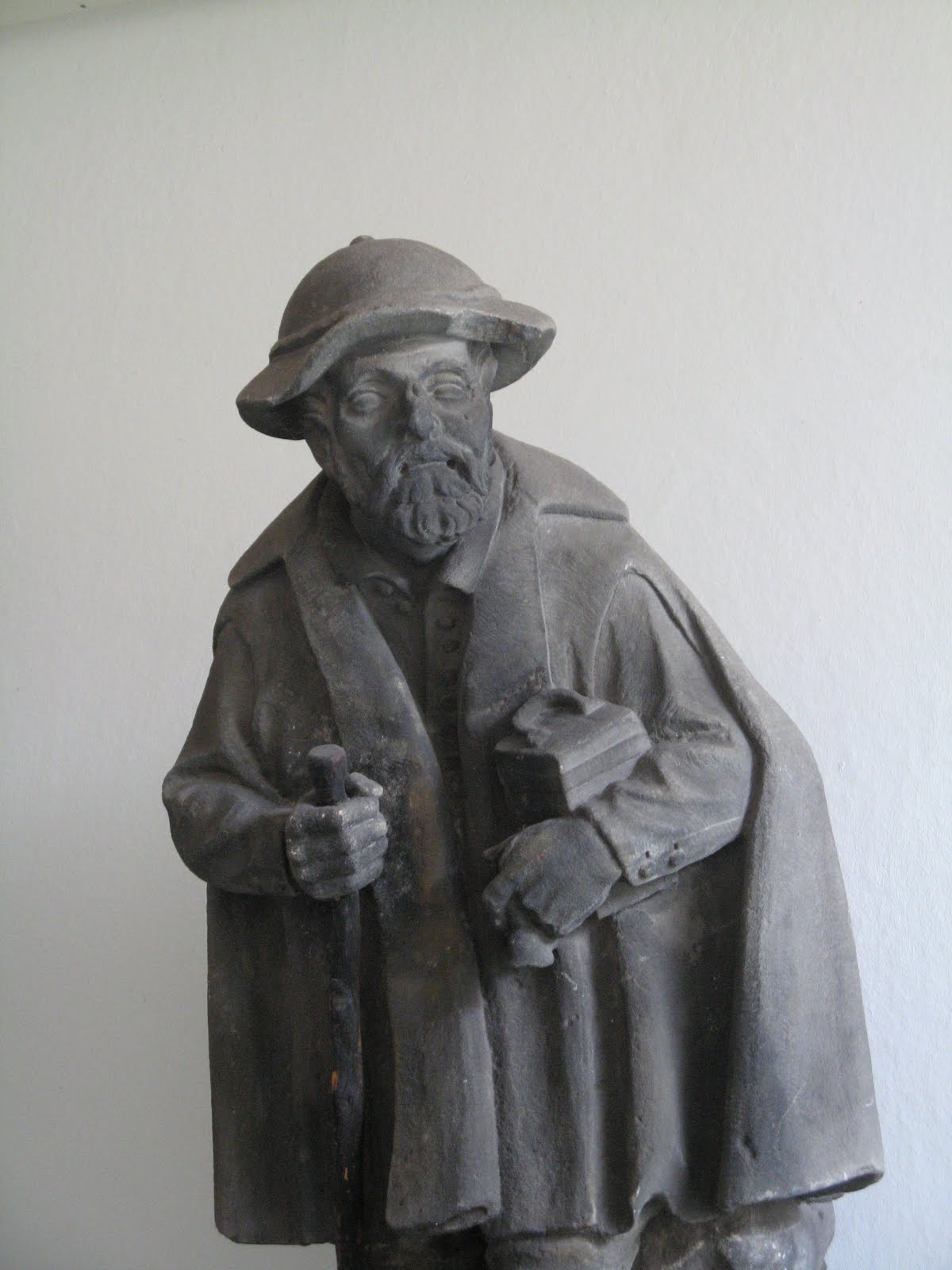
It is impossible for us to say today whether these harsh judgments on the governors and governesses of the Asylum are at all justified. Nor is it really possible to judge whether the likenesses are exaggerated to make a point, or whether they are realistic representations of the sitters. Perhaps the portraits judge an entire age, an entire attitude towards its humanity. The provisions for the aged poor were precarious. The Old Men's Asylum was a home for elderly men which was founded in 1609. The residential rooms were situated around a courtyard, which is still there, and each of the thirty tiny little houses was inhabited by two men. To be eligible for living there the men had to be at least sixty years old, Haarlem residents with no criminal record, and single. They were required to bring their own household goods listed as a bed, a chair with a cushion, a tin chamberpot, three blankets, six good shirts and six nightcaps. They were locked in, each night, at eight o'clock in the summer and at seven in the winter. They had to make a weekly collection with a poor-box. A sculpture of such a man, holding this poor-box, can be seen in the entrance hall of the museum.

This dreary culture co-existed with great prosperity and affluence of the better-off citizens, among whom were the governors and governesses of the Asylum. The wealth of the city's bourgeoisie had bred a defiant attitude toward the foreign rule of the Habsburgs and toward the religion of Rome. Haarlem was besieged by the Spanish army in late 1572. The revolt had spread to the city precisely because it was a wealthy city, known for its production of finished textiles, lace and silk, and beer exports to the southern provinces, and its proud and independent bourgeois class, which the regents of the Asylum very properly represented, supported the Dutch revolution against the Spanish Habsburgs. When the city of Brielle was taken by the Watergeuzen, the Protestant Sea Beggars, or "pirates," as the Spanish authorities called them, the town of Haarlem supported them. The King of Spain, Philip II, sent his army north under the command of Don Federico de Alba, son of the Duke of Alba whose depredations throughout the provinces were already quite famous. The cruel treatement of the citizens of Zutphen and Naarden in November 1572, put the people of Haarlem on notice of the brutality of the Spanish "tercios." Then, on December 11, 1572, the Spaniards put Haarlem under siege. For two months the situation was one of attrition. The Spanish dug tunnels to reach the city walls and blow them up. Amsterdam, in a fawning attempt at deference to the King, refused to help the besieged city, and its fleet controlled the Haarlemmermeer, through which supplies had previously reached Haarlem from Sassenheim on the south-eastern shore. The blockade became effective on that huge lake, which constituted a sea between Haarlem and Leiden, and the city was isolated from the outside. As hunger and despair spread among the people, all hopes hung on the army of William of Orange, arraigned near Leiden, but the Spanish trapped him and defeated him at Manpad. After seven months of desperate siege, the city surrendered in July, 1573, and Don Federico celebrated a Te Deum in the great church of Saint Bavo. The Spanish triumph was short lived, however,and as the situation of Spain deteriorated in Holland, the city boldly asserted its independence and confiscated all the possessions and properties of the Catholic Church. The Spanish left in 1577 and under the so-called Convention of Veere, Protestants and Catholics were given equal rights, though in government the Protestants clearly had the upper hand and Catholic possessions once seized were never returned. To restore the economy and attract workers for the brewing and bleaching businesses, the Haarlem council decided to promote the pursuit of the arts and crafts, showing tolerance for diversity among religious beliefs. This attracted a large influx of Flemish and French immigrants (Catholics and Hugenots, both) who were fleeing the Spanish occupation of their own cities. This demographic and economic expansion that followed constitutes the background to the Golden Age of Haarlem's art and crafts.


Jacob van Ruisdael's famous painting of the environs of Haarlem, with the Church of Sint Bavo in the distance, was painted around 1670, long after the siege of Haarlem. It shows a prosperous farm in the foreground where linen lace is being put out to dry after its careful rinsing with the clean water of the dunes around the city. Ruisdael was a native of Haarlem, as Hals was before him, but his work is already both more conservative and more optimistic. The rigors of the Calvinist revolution had been left far behind.


TRAVEL DIARIES: DORDRECHT


Aelbert Cuyp, The Maas at Dordrecht


Dordrecht

6-16-10

I drove south towards the delta of the great rivers with the intention of going to Brielle. This is a small harbor on the island of Voorne-Putten, located on the river known as Nieuwe Maas (the new Maas), one of the two great branches of the river Meuse, (Maas), that winds its way through Belgium, through the city of Liege, and pours out into the North Sea. The importance of Brielle is based on the role of the little town during the Dutch revolt against the Spanish Hapsburgs, and the subsequent eighty years war against Spain. On April 1, 1572, the Protestant "pirates" known as Watergeuzen (Sea Beggars) captured the town in their flat-bottomed boats, thus securing a free port through which the islands of the province of Zeeland could be supplied from the North Sea. As the Protestants throughout the provinces of Holland and Zeeland realized the strategic nature of this victory, they began openly to support William of Orange and his rebel armies against the Spanish Duke of Alba, and the nature of the conflict changed, beginning to favor the rebels. The Dutch still celebrate this event every year on April 1st., and during the night before, known as "Kalknacht (chalk night)," deface the city with white chalk, and the students sing the famous rhyme: "Op 1 april verloor Alva zijn bril" which means, "On April 1st, Alva (Alvarez de Toledo, Third Duke of Alba) lost his glasses ('bril' means eye-glasses in Dutch)."

But I did not go to Brielle. Somewhere around the enormously complex ring of freeways that surround the great port of Rotterdam, the Rotterdamring, designed to steer all traffic around that enormous city, I lost my way, and decided then, opportunely, to visit the ancient city of Dordt, or Dordrecht instead, a felicitous choice.


Views of Dordrecht: Aelbert Cuyp's painting of ca.1620, and photo of the Groote Kerk


Dordrecht is considered by the Dutch to be their oldest city. It is surrounded by the great rivers, the Rhine, the Maas, the Meerwede, and the confluence forms the famous Holland Diep, which was the point where the German occupiers of the Netherlands took their last stand at the very end of the second world war. Dordrecht was bombed, but the old cathedral still stands, with its leaning tower, a symbol of the Calvinist Reformed Church in the city that confirmed its orthodoxy. (See my entry of June 10, 2010, where I outline the significance of the Synod of Dordt, of 1618-19). In fact, it was the proceedings of the Synod of Dordt, the significance of the triumph of Calvinism in the United Provinces, that motivated my interest in the city. In the Cathedral, the Groote Kerk (Great Church) there is an exhibit on the Synod, and two miniature models of the proceedings of the Synod show the delegates from the various Protestant regions and cities of Europe (England, Switzerland, Geneva, Heidelberg, Hesse, Bremen, Krefeld) that attended, all dressed in their black suits and hats, and prominent white collars. There Arminianism was condemned, and strict Calvinism informed the period of the Dutch Empire's greatest age.

But when you travel, you always discover the unexpected. Next to the Government House (the Stadhuis) there is a large monument to the brothers De Witt. Jan and Cornelis De Witt, were prominent Dutch statesmen of the seventeenth century. In 1672, the nation experienced a series of foreign policy disasters that led to the weakening of De Witt's rule. During the so-called "rampjaar," which in Dutch means "year of disaster," France and England attacked the Republic in the course of the Franco-Dutch War, and the supporters of the family of Orange took power by force and deposed Jan de Witt. Recovering from an earlier attempt on his life, he was lynched by an organized mob after visiting his brother Cornelis de Witt in prison. He had been duped into this trap by a forged letter requesting the visit. After the arrival of Jan de Witt, the city guard was sent away on a pretext to stop farmers who were supposedly engaged in pilfering. Without any protection against the assembled mob the brothers were doomed. They were dragged out of the prison and killed next to a nearby scaffold. Immediately after their death the bodies were mutilated and fingers, toes, and other parts of their bodies were cut off. The heart of Cornelis de Witt was exhibited for many years next to his brother's by one of the ring-leaders of the mob. Some historians have theorized that his adversary and successor as leader of the government, the Stadtholder William of Orange, King William III of England, was involved in the conspiracy to kill the brothers De Witt.


Monument to Jan and Cornelis De Witt in the City of Dordrecht


As was the case with another great Dutch statesman, of an earlier period, Jan van Oldenbarnevelt, there is a recurrent division in the nation's political history between the statesmen of the province of Holland, the most wealthy and powerful of the seven original provinces, and the family of Orange. William of Orange, known as William the Silent, was the leader, by default, of the revolt against Spain. He was the Stadholder of Holland, and the holding of this position by his family eventually became hereditary. His son, Prince Maurice of Orange, prevailed against Oldenbarnevelt, where the conflict took on the color of the dispute between the Remonstrants (Arminians) and the Calvinists, as a consequence of the Synod of Dordt. Oldenbarnevelt was decapitated. In the case of the brothers De Witt, another William of Orange, also Stadholder of Holland, appears to have conspired to eliminate the De Witt brothers and hence weaken the power of the province of Holland and enhance his own. This William became William III of England, as a consequence of his marriage to Mary Stuart, daughter of King James II of England. And again, two great secular statesmen, by instinct republican, representative of all the progressive forces in the nation, were butchered by the Dutch mob, their bodies left to be devoured by dogs, as common criminals. The House of Orange is still the royal family of the Netherlands.


Jan de Baen, The bodies of the brothers De Witt


The city of Dordrecht is a port-city on the great rivers that constitute the delta of South Holland. Only four years into the Dutch revolt against Spain, in 1572, representatives of all the cities of Holland, with the notable exception of Amsterdam, but with the spirited participation of the "pirates" (Watergeuzen), gathered in Dordrecht to hold their First Assembly of Free States (Eerste Vrije Statenvergadering), known as the Union of Dordrecht. This secret meeting constituted a rebellious act against the monarchy, as only the King (now Phillip II) or his Stadholder (now the Duke of Alba) were legally permitted to call a meeting of the Estates. During the meeting, the organization and financing of the rebellion was debated, and William of Orange was elected Stadholder and leader of the revolt. As well, the Union published a manifesto of total freedom of religious worship and practice. It was an initial step towards total independence of the northern Netherlands from Spanish and Habsburg domination.


The Union of Dordrecht was held in an Augustinian monastery which has always been known as "het Hof" (the Court). Below is a photo of the Hof taken in 1935, before the bombardment of the city.


The Hof in Dordrecht, 1935


Despite the great historical significance of this city, it does not wear its history well today. It is totally off the beaten tourist trail, which runs along a North/South axis from Amsterdam to The Hague. It is considered here as a large industrial city, almost a part of the great urban region of Rotterdam. There are many Moroccan immigrants, which is also a characteristic of industrial Rotterdam, and in general the city appears poorly and sidetracked by the development of the modern age. Nevertheless, to look at the old church from beyond the distance of the old harbor and the canals of the shoreline is a reminder of what the paintings of its native son, Aelbert Cuyp, have made famous. What is totally forgotten is its turbulent religious history and its crucial role in the triumph of Dutch Calvinism.


Labels

Labels

Labels