Demo Site
Showing posts with label Ottonian Art. Show all posts

Thursday, March 3, 2011

TRAVEL DIARIES: BISHOP BERNWARD'S HILDESHEIM - IV

TRAVEL DIARIES: HILDESHEIM – PART IV

Thursday, July 8, 2010


BISHOP BERNWARD AND THE OTTONIAN ROMANESQUE


Hildesheim

[This section follows from Part III, below]


BISHOP BERNWARD AND THE ROMANESQUE TREASURES AT HILDESHEIM

On July 8, 2010, I traveled to Hildesheim, a city located west of the Elbe River, in Lower Saxony, in the district of the same name, about 40 km southeast of Hannover. I was there to visit the Church of St. Michael’s, one of Bishop Bernwald’s cathedrals. Within this Church, among other outstanding materials of Romanesque Art, is the black column of Bishop Bernward, a bronze column depicting scenes from the life of Jesus, which I described in Part III of this blog entry. Nearby, at the Römer und Pelizaeus Museum Hildesheim, are the Bernward Doors, also in bronze, which are one of the most outstanding achievements of Ottonian Romanesque Art, and the style of which replicates the craftsmanship and the spiritual gravity of the black column discussed in Part III. [See Part III below]


THE “BERNWARD DOOR” [BERNWARDS TÜR] THE BRONZE DOORS OF ST. MARY’S CATHEDRAL, HILDESHEIM

[click on images to expand their size]


Bernward’s Door at Hildesheim Cathedral of St. Mary’s


[For a series of complete photographs of the doors, see the following blog site: http://art.uga.edu/courses/arhi2100/slides/week4/st_michael.html]

The richly sculptured doors closing the western portal of the Hildesheim Cathedral are now at the Römer und Pelizaeus Museum Hildesheim. Their importance to Bishop Bernward, who commissioned them, is probably due to the fact that he intended them to be meant for the two entrances leading from the transept to the ambulatory surrounding the crypt of the Church of St Michael’s, where he planned to be buried. The doors were finished in 1015, the year the crypt was consecrated. He probably got the idea from Byzantine and Roman bronze doors he saw during his visit to Rome. But the doors are different from their predecessors in that they are divided into horizontal fields rather than vertical panels. The sectional frame system, with its division into four equally sized compartments, was possibly made after the example of the bronze doors of the Cathedral at Mainz. Each horizontal field contains a biblical scene in high relief from the Old and New Testament. The images from the Old Testament on the left wing, read from top to bottom, beginning with the Creation of Man and ending with the Fratricide. Below is a detail of the panel depicting the Creation of Eve:


The Creation of Eve


The doors also differ from anything Bernward may have seen in Rome due to the style in which the Biblical personages were depicted by the artists he commissioned. Once again, as in the Bernward column, we see the stark realism and expressionism of German Ottonian Art, with its tortured representations of both human beings, plants, animals and decorative motifs, starkly and startingly depicting the emotional content of the vision rather than attempting a naturalistic imitation of reality. This is clearly the case in the famous panel which shows the expulsion from the Garden of Eden. H. W. Janson describes the panel as follows:


The expulsion from the garden


“[The panel] shows Adam and Eve after the Fall. Below it, in inlaid letters remarkable for their classical Roman character, is part of the dedicatory inscription, with the date and Bernward’s name. . . . The entire composition must have been derived from an illuminated manuscript; the oddly stylized bits of vegetation have a good deal of the twisting, turning movement we recall from Irish miniatures [specifically the Lindau Gospels]. Yet the story is conveyed with splendid directness and expressive force. The accusing finger of the Lord, seen against a great void of blank surface, is the focal point of the drama; it points to a cringing Adam, who passes the blame to his mate, while she, in turn, passes it to the serpent at her feet.” (H.W. Janson, History of Art, New York, 1971, 207).

At the bottom of the left wing is the depiction of the fratricide:


Cain and Abel (Genesis, 4)

The right wing of the set of doors constitutes a response to the left wing depiction of Old Testament images read from top to bottom, by contrasting it with a set of fields which depict scenes from the New Testament and convey the eye of the beholder upwards towards Heaven and Redemption, instead. The positioning of Eve and Mary on opposite sides underlines the topical structure of Guilt and Redemption, which dominates the imagery on the door. Read from bottom to top, the right wing begins with the Annunciation on the bottom, whereas the topmost image depicts the risen Christ, who, like a "new Adam" has atoned for the guilt of Man and overcome Death.


The Empty Tomb: The visit to the Sepulchre of Jesus (Mark, 16, 1-8)


Christ before Pilate (John, 18, 28-38)

The Bernward doors are the door to Heaven. The Ottonian artist, or artists, have created a gate that leads to the salvation of Mankind, which lies behind and beyond it. As the faithful reaches and faces the door, he sees the Fall of Man on his left, from the Creation on the top to the war between brothers on the bottom. To his right, however, she sees the hope of Mankind in the story of Jesus, beginning at the bottom with the Annunciation and rising, through the depiction of the sad story of Jesus, to the Resurrection above.


THE TOMB OF BISHOP BERNWALD AT ST. MICHAEL’S CHURCH

The bronze doors are said to have been designed by Bernward himself for the entrance to his tomb. The tomb of Bernward, as planned, is in the crypt (Krypta) of the Church of St. Michael’s. The western choir (shown on the left of the reconstructed plan below) has a raised floor above the level of the rest of the church, so as to accommodate a half-subterranean basement chapel, or crypt, apparently a special sanctuary of St Michael, now the Bishop’s Tomb, which could be entered both from the transept and from the west. The crypt was roofed by groined vaults resting on two rows of columns, and its walls were pierced by arched openings that linked it with the U-shaped corridor, or ambulatory, wrapped around it. The bronze doors described above, were most likely designed to guard the entry from the transept to the ambulatory.


Choir screen above the crypt


The tomb of Bishop Bernward seen from the ambulatory


View of the crypt with the tomb of Bishop Bernward in the foreground


The mosaic in the background of the crypt was added in the nineteenth century. It has a Wilhelminian look to it, like the mosaics in the great Dom of Berlin.


Modern statue of Bishop Bernward

TRAVEL DIARIES: BISHOP BERNWARD'S HILDESHEIM - III

TRAVEL DIARIES: HILDESHEIM – PART III

Thursday, July 8, 2010


BISHOP BERNWARD AND THE OTTONIAN ROMANESQUE


Hildesheim

[This section follows from Part II, below]


Illustration of Bernward’s Column


On July 8, 2010, I traveled to Hildesheim, a city located west of the Elbe River, in Lower Saxony, in the district of the same name, about 40 km southeast of Hannover. I was there to see the Church of St. Michael’s, one of Bishop Bernwald’s cathedrals. Within this Church, among other outstanding materials of Romanesque Art, is the black column of Bishop Bernward, a bronze column depicting scenes from the life of Jesus. Nearby, at the Hildesheim Museum, is the Bernward Door, also in bronze, probably designed for the entrance to Bernward’s mausoleum at St. Michael’s. It is one of the most outstanding achievements of Romanesque Art, and its style replicates the craftsmanship and the spiritual gravity of the black column. [See Part IV, above]


BISHOP BERNWARD AND THE ROMANESQUE TREASURES AT HILDESHEIM

THE BERNWARD COLUMN (BERNWARDS SÄULE)
[right click on images and open link in new window for closer viewing]


Bernward’s Column: The capital


From the middle portion of the column


The miracle at Cana (John, 2, 6-8)


The metal-worker Bishop Bernward probably worked himself on the famous bronze column which is placed in the rear of the Church in the southern transept. It seeks to emulate Trajan’s column in Rome (see below), but it is evident on approaching it that it is fundamentally Christian and Romanesque, although the intention to imitate the great column of Trajan is precisely the spirit of the Romanesque, the style derived from the Classical.


Trajan’s Column in Rome


Depiction of the “turtle formation” on Trajan’s column


‘Adlocution Scene’ on Trajan’s Column


The Bernard column is Christian in its representations, in its darkness, which is not only the color of the column but the story depicted on it: the passion of Christ. The ascent is an ascent to Heaven, not to Glory, as it is in Trajan’s column, and what is depicted is not martial valor and triumph but the story of Jesus in Palestine.


The Bernward Column


It is not humanity that is celebrated here, but the soul and its travel to eternity, the “pure and infinite space” of Heaven. How different these contorted, rude and shapeless individuals, roughly clothed in peasant garb from the soldiers in Trajan’s column, from the Classical celebration of the triumphs and achievements of human beings in this earth and in this life.

And yet, the Romanesque figures are very much humane. They elicit a sympathy and compassion for the sorrowful life of humanity in its ‘vale of tears,’ which is precisely the intent of the Christian message.


Jesus speaks to his Apostles


The baptism of Jesus (Matthew 3, 13-17)


The blessing of the sisters of Lazarus (John, 11, 3)


The rich glutton and the poor beggar Lazarus (Luke, 16, 19-21)


In his book Mimesis: The Representation of Reality in Western Literature (Princeton, 1953), Erich Auerbach analyzes Gregory of Tours’ description of a local brawl between Frankish chiefs in his History of the Franks (594 CE). Auerbach’s commentary on Gregory is pertinent to the sculpted narrative on the Bernward column because of the contrast he draws between the early medieval perspective and the classical:

“[H]ow narrow Gregory’s horizon really is, how little perspective he has with which to view a large, coherent whole, how little he is in a position to organize his subject matter in accordance with the points of view which had once obtained. The Empire is no longer in existence. Gregory is no longer situated in a place where all the news from the orbis terrarum is received, sorted, and arranged according to its significance for the state. He has neither the news sources which were once available nor the attitude which once determined the manner in which the news was reported. He hardly surveys all of Gaul. A large part of his work, doubtless the most valuable, consists of what he himself witnessed in his own diocese or of what was reported to him from the neighboring territory. His material is essentially limited to what has been brought before his eyes. He has no political point of view in the old sense; if he may be said to have any at all, it is the interest of the Church; but there again his perspective is restricted; he does not conceive of the Church as a whole in such a way that his work forcibly conveys that whole; everything is locally restricted, both in substance and in thought. On the other hand, in contrast to his antique predecessors, whose work was often based on indirect and previously processed reports, most of the things Gregory relates in his History of the Franks he either saw himself or learned at first-hand from the people involved in them. This is in keeping with his natural bent. For he is directly interested in what people are doing. They interest him as they move about him, irrespective of political considerations in a wider context. Thus his work assumes a character much closer to personal memoirs than the work of any Roman historian.” (84-5)

“This brutal life becomes a sensible object; to him who would describe it, it presents itself as devoid of order and difficult to order, but tangible, earthy, alive.” (91)

“Christ’s life among the lower classes and the simultaneous sublimity and shamefulness of his Passion shattered the classical conception of the tragic and the sublime.” (92)

“A complete change has taken place since the days of Ammianus and Augustine. Of course, as has often been observed, it is a decadence, a decline in culture and verbal disposition; but it is not only that. It is a reawakening of the directly sensible. Both style and treatment of content had become rigid in late antiquity. An excess of rhetorical devices, and the somber atmosphere which enveloped the events of the time, give the authors of late antiquity, from Tacitus and Seneca to Ammianus, a something that is labored, artificial, overstrained. With Gregory the rigidity is dissolved.” (94)


Auerbach’s rich analysis of Gregory of Tours’ History pertains equally to the sculpted narrative of the Bernward column. Here are evident the provinciality of the early Romanesque, its primitive perception and unadorned simplicity, the material content of the representations “essentially limited to what has been brought before his eyes,” which is in this case the eyes of the sculptor. As well, the vital self confidence of that early Christianity is evident here. The sentence, “[a] large part of his work, doubtless the most valuable, consists of what he himself witnessed in his own diocese or of what was reported to him from the neighboring territory,” rings so true for the sculptor of the Bernward column as well.

The observation that Christ’s life among the lower classes and the shamefulness of his Passion had shattered the classical conception of the tragic and the sublime is also directly appropriate to the scenes and figures of the column’s sculpture, which so forcefully shows the dignity of the poor and downtrodden, and the sadness of the story of Jesus. Indeed, the work represents the reawakening of the directly sensible, for there is no idealization of humanity here, such as is evident in the Trajan column or in the art of Classical Greece on which it is modeled. Here the poor folk that follow Jesus are little more than beasts, and their humanity is portrayed with empirical accuracy despite the distortions of the medium and the primitivism of the representation. There is no question but that a careful reading of Auerbach’s analysis rings as true for the sculptural narrative of the Bernward column as it does for the actual object of his study.


The witnesses to the Raising of the Son of the Widow of Nain:
“And a large crowd from the town was with her.” (Luke 7:12)
These people here portrayed have witnessed the miracle performed by Jesus, according to Luke, outside the town of Nain in Galilee. Note the expression of devotion on their faces. The man in the middle above looks up to Heaven, toward “pure and infinite space.”


[CONTINUED IN PART IV]


TRAVEL DIARIES: BISHOP BERNWARD'S HILDESHEIM - II

TRAVEL DIARIES: HILDESHEIM – PART II

Thursday, July 8, 2010

BISHOP BERNWARD AND THE OTTONIAN ROMANESQUE


Hildesheim


[This section is a continuation of Part I, below]


On July 8, 2010, I traveled to Hildesheim, a city located west of the Elbe River, in Lower Saxony, in the district of the same name, about 40 km southeast of Hannover. I was there to visit the Church of St. Michael’s, one of Bishop Bernwald’s cathedrals. The church contains a treasure trove of Romanesque Art from the Ottonian period of German history. I have reviewed the objects of Ottonian Art in Hildesheim under the rubric of the Romanesque because I believe this to be the overall genus of the style. The Ottonian has been described as a translation of the gentle Byzantine image into German expressive realism (H. W. Janson, History of Art, N.Y. 1971), and to be thereby unique, but there are too many links and overlaps with the subsequent development of the Romanesque for the style to be completely isolated by emphasis on its earliest characteristics in this fashion.


BISHOP BERNWARD AND THE ROMANESQUE


Bishop Bernward


The great church foundations and the great treasure trove of Ottonian and Romanesque Art in Hildesheim are primarily the legacy of Bishop Bernward (ca. 960-1022), an ambitious patron of architecture and art. It is probable that he worked himself as a craftsman and artisan on the brass ornamentation and monuments that decorated his churches. Little is known of the facts of his life, despite the account of his life set down in writing by his student, Thangmar, in the Vita Bernwardi. His time in office fell during the era of the Saxon Emperors, who had their roots in the area around Hildesheim and were personally related to him. During his lifetime, Hildesheim was a center of power in the Empire and Bernward was determined to provide his city with an image that would fit one of its stature. Thus the column he designed for the cathedral was planned on the model of Trajan’s Column at Rome. (See Part III). Bernward was descended from a noble Saxon family and was educated at the Cathedral School in Hildesheim. After 977 CE, he served as scribe and chronicler at the court of Otto II and the Empress Theophanou. Thereafter, from 987/88 to 993 CE, he served as teacher of the young Emperor Otto III, together with the future Pope, Sylvester II. In 993 CE, Bernward became the 13th Bishop of Hildesheim.


Bishop Bernward


The foundation of the church of St. Michael’s was laid in 1010. As early as 1015, the lower church (crypt) was consecrated, the site Bernward had planned to house his tomb, and where he is buried now. (See Part IV). Close to his death, in 1022, he dedicated the church to the Archangel Michael and it is claimed that construction was finally completed in 1033, eleven years after the death of the founder. Bernward was Bishop of Hildesheim from 993 to 1022, and was himself architect and metal-worker. Three other churches besides the cathedral survive in the city from his time or that of his immediate successors, and Hildesheim of all North German cities is richest in monuments of the Romanesque.


Bishop Bernward


In his controversial history, The Decline of the West, Oswald Spengler makes reference to the Hildesheim of Bishop Bernward in the context of his “Faustian vision” of Western culture:

“Cultures are organisms, and world-history is their collective biography. Morphologically, the immense history of the Chinese or of the Classical culture is the exact equivalent of the petty history of the individual man, or of the animal, or the tree, or the flower. For the Faustian vision, this is not a postulate but an experience; if we want to learn to recognize inward forms that constantly and everywhere repeat themselves, the comparative morphology of plants and animals has long ago given us the methods. In the destinies of the several Cultures that follow upon one another, grow up with one another, touch, overshadow, and suppress one another, is compressed the whole content of human history. (I, 104, emphasis in the original).

Every Culture passes through the age-phases of the individual man. Each has its childhood, youth, manhood and old age. It is a young and trembling soul, heavy with misgivings, that reveals itself in the morning of Romanesque and Gothic. It fills the Faustian landscape from the Provence of the troubadours to the Hildesheim cathedrals of Bishop Bernward. (I, 107)."

Spengler continues:

"Henceforth we shall designate the soul of the Classical Culture, which chose the sensuously-present individual body as the ideal type of the extended, by the name (familiarized by Nietzsche) of the Apollinian. In opposition to it we have the Faustian soul, whose prime-symbol is pure and limitless space, and whose “body” is the Western Culture that blossomed forth with the birth of the Romanesque style in the 10th century in the Northern plain between the Elbe and the Tagus. (I, 183)”

In looking at the works of the Ottonian Romanesque, I believe it is most enlightening to keep in mind Spengler's conception of "pure and limitless space" as a symbol of the Faustian Western culture and its eschatological thrust towards God's ultimate purpose. I suggest it is visible in the ceiling of St. Michael's Church, for example, and in the look towards Heaven of the humble people of Nain, sculpted into the Bernward column.


THE OTTONIAN CHURCH OF ST. MICHAEL’S

[click on images to expand their size]


The outward appearance of the Church of St. Michael’s is characterized by its ‘three-tower-motif’ at each of its ends. The two heavy square towers correspond with the two round towers on each of its sides, which are octagonal in the lower region. These towers form an extension of the transepts of the inner church. The ‘three-tower-motif’ duplicated in St. Michael’s used to symbolize the town in the Middle Ages. In ecclesiastical architecture it refers to the heavenly Jerusalem of the Book of Revelation, Chapter 21, 10-13, a motif that can be seen inside the church as well. “10 - And he carried me away in the spirit to a great and high mountain, and showed me that great city, the holy Jerusalem, descending out of heaven from God . . . 13 - On the east three gates; on the north three gates; on the south three gates; and on the west three gates.” (Book of Revelation, 21, 10-13)

The ensemble of the towers conveys the impression of a castle. “Ein feste Burg ist unser Gott.” [A mighty fortress is our God].


Interior of the Church facing East


As one walks into the interior of the Church from the south, the ceiling immediately attracts all of one’s attention. Above the rather squat columns and arches and the great empty expanse of the wall reaching towards the opening of the modest arched windows in the high clerestory, a richly adorned Heaven appears to float above the vast interior.


THE CEILING OF ST. MICHAEL’S

Does the ceiling of this Church substantiate Spengler’s definition of the Faustian soul as a thrust, an arrow, pointed towards the “pure and infinite space” that characterizes it? The outward thrust of Spengler’s conception of the Faustian urge to the vast unknown is the arrow into the blue that he conceives as the true spirit of Western culture, originating in the Romanesque. In the ceiling at Hildesheim, that conception is validated. The Heaven of the Christians stretches above and towards a beyond in the East. The entire ceiling moves with the vision of its splendor as the eye is cast forward into the beyond of its chronicle of God’s greatness and of the salvation of Man in the Hereafter. The vision is a narrative: it is episodic, divided as it is in square sections, each moving the eye of the beholder below in a succession of chapters which constitute the genealogy of Jesus, pointing towards the redemption and salvation of Mankind, in a passage from West to East. Ad Oriente Lux.


Designed and executed over the years from 1220 to 1240, according to recent research, the ceiling is painted on oak boards. The comprehensive range of pictures, altogether ninety different scenes that are to be read from west to east, depicts the Tree of Jesse (Jesse meaning Isaiah, father of David, from whose tribe the Messiah was to be born), which is connected with the Biblical genealogical table of Jesus, as stated in Matthew, 1, 17 and Luke, 3, 23-38. “So all the generations from Abraham to David [are] fourteen generations; and from David until the carrying away into Babylon [are] fourteen generations; and from the carrying away into Babylon unto Christ [are] fourteen generations.” (Matthew, 1, 17). The Church linked this genealogy of the family of Christ with the concept of the tree of life from Paradise (Genesis, 3). It is the first genealogical tree. Thus the first main panel shows Paradise and the Fall of Man: Adam and Eve pick the apple from the tree of Knowledge. The second major panel shows Jesse, or Isaiah, on a luxurious bed from which a tree grows, the family tree of Jesus: “And there shall come forth a rod out of the stem of Jesse, and a Branch shall grow out of his roots.” (Isaiah 11, 1).


[“Philippeau. . . . my friends, we needn’t get too high above the earth before all this confusion and glitter disappear and our eyes see only the few broad lines that God intended. There’s an ear to which all this screaming and crying that we find so confusing is a stream of harmonies.” (Georg Büchner, Dantons Tod, IV, v).

“Philippeau. . . . Meine Freunde, man braucht gerade nicht hoch über der Erde zu stehen, um von all dem wirren Schwanken und Flimmern nichts mehr zu sehen und die Augen von einigen großen, göttlichen Linien erfüllt zu haben. Es gibt ein Ohr, für welches das Ineinanderschreien und der Zeter, die uns betäuben, ein Strom von Harmonien sind.”]


The central panels (two of them are shown below) depict the Kings of Judea, David, Solomon, Ezekiel and Joshua, dressed in the medieval attire of the Empire, thus celebrating its divine dignity.


In this panel (below), Mary, completely immaculate, is surrounded by medallions of the four cardinal virtues and is shown as a virgin, a woman working with a spindle and a wooden ball. The tradition is that Mary was one of the volunteers in the spinning of the Veil of the Temple.


Eastern portion of the ceiling


The last panel on the East shows Christ as the Judge of the World.


Ottonian Columns: Only two of the original Ottonian columns survive. The rest date from the twelfth century and replaced most of the originals. The Ottonian column is characterized by the cubic capital and the springer, an innovation of the eleventh century. On the springers the names of saints can be seen. Presumably, the corresponding relics were worked into them.


The Ottonian column and capital


One of the surviving Ottonian columns at St. Michael’s

Because the Ottonian capital is shaped in the form of an overturned Romanesque arch, it provides the overall structure of the columns and arch with a look of mathematical and symmetrical precision.

Columns and capitals. An Ottonian column is seen on the right-front foreground of the photograph


The remaining Capitals, some of which are portrayed below, were replaced at the end of the 12th century. Palm leaves, acanthus-leaves and small heads arte typical of these richly decorated capitals. Christian and heathen motifs are intertwined. Above the capitals is a frieze that combines plant ornaments, animals and heads. The abundance of the leaf motifs can be understood as a reference to Paradise.


[CONTINUED IN PART III]


TRAVEL DIARIES: BISHOP BERNWARD'S HILDESHEIM - I

TRAVEL DIARIES: HILDESHEIM – PART I

Thursday, July 8, 2010

BISHOP BERNWARD AND THE OTTONIAN ROMANESQUE


Hildesheim


On July 8, 2010, I traveled to Hildesheim, a city located west of the Elbe River, in Lower Saxony, in the district of the same name, about 40 km. southeast of Hannover, and on the banks of the Innerste River, which is a small tributary of the Leine that flows through Hannover. I was there to see the Church of St. Michael’s, one of Bishop Bernwald’s cathedrals. Hildesheim is one of the oldest cities of Lower Saxony, in the North of Germany. In 815 CE, it became the seat of the Bishopric of Hildesheim, established by the son of Charlemagne, Louis the Pious, probably because it was an important market town on the trade route known as the “Hellweg” route, which joined the Saxon lands with the Rhine along an east-west axis. Thereafter, during the rule of the Saxon Ottonian dynasty, Hildesheim, together with the neighboring bishoprics of Halberstadt and Magdeburg, became the central ecclesiastical territory of the Holy Roman Empire under its Saxon and Salian rulers.


THE REIGN OF THE CHURCH

The Saxon dynasty relied for local government on the Church, rather than on the secular hierarchy of counts, because there was in that way no danger of the establishment of hereditary succession, and because the clergy was the educated class, trained to follow the ramifications of policy and competent to deal with the intricacies of legal documents. Finally, local landed interests were scarcely as strong among the clergy as among the laity, though with recruitment to monasteries and cathedral chapters limited in the tenth and eleventh centuries almost exclusively to members of the aristocratic classes, this was not always the case. The Ottonian monarchy and the Church developed a solidarity of interests, the alternative, in an age of violence, being not between a Church free from lay control and a Church under lay domination, but rather between a Church dominated and exploited by dukes and counts, and a Church controlled, freed from oppression, and utilized for the benefit of the kingdom, by the monarchy. The king became rex et sacerdos. (Cf. Geoffrey Barraclough, The Origins of Modern Germany, Norton, 1984)


Otto I Theutonicorum rex ("Otto the First, King of the Germans")


In pursuit of this consolidation of power, and with the alliance of the Church, the Saxon kings proceeded over the years to increase the power of the Church at the expense of that of the counts, who had ruled these territories as civilian authorities since the time of the Franks. In order to strengthen the Church and make it a more effective instrument of government, the monarchy increasingly adopted the practice of investing bishops and abbots with the powers of counts, conferring whole counties on them, with all the rights and powers of the counts formerly in administrative control. Such grants were made by Otto I to the archbishops of Mainz, Köln and Magdeburg, and to the bishoprics of Speyer, Chur, Worms and Minden. But the culmination of this process was reached under Henry II when, following the rebellion of the counts of Schweinfurt, he created the bishoprics of Würzburg and of Bamberg from the expropriation of the Schweinfurt family estates in 1007. Thus endowed, Würzburg and Bamberg became the two great bulwarks of Germany on the river Main: bulwarks of defense and outposts of Christianity against the Slavs, and also bulwarks of royal government against the refractory nobility within the land.


Henry II, Kunigundis and Bamberg Cathedral


Apart from the work of administration, the churches had to bear out of their revenues the largest share in supporting the royal court, as it wandered from stopping-place to stopping-place through the land. The Church also provided the backbone of the army; 74 percent of the forces for Emperor Otto II’s Italian campaign of 981 were furnished by German abbeys and bishoprics, only 26 percent by the laity. That ratio is eloquent of the part played by the Church in German government by the end of the tenth century, and of its importance for the political work of the monarchy. Less easily measured, but no less important, was its work of civilization and culture, which bound the provinces together around the king, who was ruler of Church and State. The great bishops and abbots of Saxon times, traveling the country in the service of Christianity or king, broke down provincial boundaries, particularly the boundaries between south Germany and the Saxon north, thus contributing in large part to the consolidation of German unity. (Cf. Barraclough, Origins).


Christ’s blessing on Emperor Otto II and the Greek Empress Theophanou Byzantine Ivory in the Musée de Cluny


The town of Hildesheim, a Bishopric since 815 CE, became a Prince-Bishopric (Hochstift) under the rule of Frederick II, Hohenstaufen. As the bishopric prospered and expanded its influence, it came in conflict with the surrounding Guelph Duchy of Braunschweig-Lüneburg. Henry the Younger of Braunschweig (Brunswick) -Wolfenbüttel struck back in a series of battles known as the Hildesheim Stift Feud, which took place in the course of the years 1519-1523. The outcome was a loss of territory and power for the bishopric, leaving the city open to the disruption of Protestantism. For a far greater crisis would now lead the bishopric to an involvement in the big-power conflict over the succession of the Jülich-Kleve-Berg Duchies, the prelude to the Thirty Years War in Europe.


Ernst von Bayern, Prince Bishop of Köln and of Hildesheim


The bishopric of Hildesheim established the Catholic Wittelsbachs, rulers of Bavaria, in the center of Lower Saxony. Hildesheim’s involvement in the events that would lead to the Thirty Years War was initiated when Ernst von Bayern, a Bavarian prince and scion of the Wittelsbach family, was chosen as Bishop of the See at age nineteen, in 1577. Hildesheim had become a Protestant state in 1542, and only the cathedral and a few other buildings remained in imperial (Catholic) hands. Several villages around the city remained Catholic as well. A conflict, subsequently known as the Cologne (Köln ) War (1583-88), or “Sewer War” (see the illustration below), soon followed, a contest aimed at testing the principle of ecclesiastical reservation which was a provision of the Peace of Augsburg (1555) between Catholic and Protestant powers in Germany. This principle excluded, or “reserved” the ecclesiastical territories of the Empire from the application of the rule of cuius regio, eius religio (“whosoever rules, his religion”) as the primary means of determining the religion of a territory or city. It stipulated, instead, that if an ecclesiastical prince converted to Protestantism, he would resign from his position and not force the conversion of his subjects. In 1582, the bishop of Köln converted to Protestantism, but refused to resign, and hence the war was on. A faction of the cathedral Chapter in Köln, supported by the Catholic party, chose the young Bishop Ernst of Bavaria as Prince-Bishop of Köln, and the triumph of the Catholic party in this war consolidated his position. The result was the consolidation of Wittelsbach authority in the northwestern German territories and in a Catholic consolidation on the lower Rhine which has lasted until this day. Protestant Hildesheim became a part of the Catholic territories controlled by the Dukes of Bavaria.


The capture of Godesberg during the Köln War in 1583.
Godesberg was a fortress a few kilometers from the Elector's capital city of Bonn which was taken by storm in late 1583 after a brutal month-long siege. When Bavarian cannonades failed to break the bastions, sappers tunneled under the thick walls and blew up the fortifications from below. The Catholic Archbishop's forces still could not break through the remains of the fortifications, so they crawled through the gardrobe sluices, and hence the name of the conflict, Sewer War.
Etching in the Museum Boijmans Van Beuningen in Rotterdam


Since the very beginning of the Reformation the Wittelsbach court in München had proved very calculating in weighing which side it was on. Reasons of state kept them on the side of the Roman Catholic Church. In exchange, they demanded of the Roman Curia the grant of a series of strategic bishoprics to Wittelsbach family relatives, regardless of the prescripts of Canon Law. Thus the Wittelsbachs obtained the bishopric of Hildesheim in the heart of the lands of the Guelphs, and over the years from 1580 to 1763, Köln, Münster, Paderborn and Liege remained in almost permanent occupation by Wittesbach bishops. Thus the ruling family of Bavaria became the most powerful rulers not only in south-east Germany, but also in north-west Germany, where in 1613 the duke of Jülich-Berg allied himself by marriage to the Bavarian Wittelsbachs. Most of this expansion was the work of the Great Elector, Maximilian I.


Maximilian I Wittelsbach, Elector of Bavaria (1573 -1651)


The Wittlesbachs ruled over the Hildesheim territories of Lower Saxony, in the middle of the Braunschweig lands until 1761. At the time of the annexation and secularization of the German cities and bishoprics in 1803, a process known as the Reichsdeputationshauptschluss (formally the Hauptschluss der außerordentlichen Reichsdeputation, or "Principal Conclusion of the Extraordinary Imperial Delegation") Hildesheim lost its statehood, and the territory was given to Prussia. Despite a short period of Hannoverian rule, Hildesheim would remain a part of Prussia until the First World War.


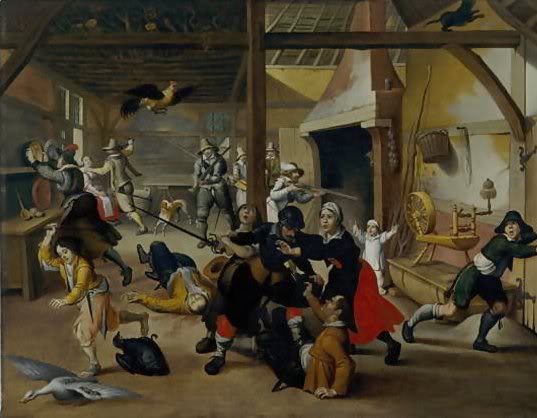
Sebastian Vrancx, Soldiers Plundering a Farm during the Thirty Years’ War (1620)


The point of this long digression is to bring to light the rich and varied pattern of startling political history that formed the city of Hildesheim throughout its long trajectory of conquest and destitution. From the inception of its written history, the plain of northern Germany had been ruled by the Church from nodes of civilization and culture such as the town of Hildesheim, with its great cathedrals, its monasteries and abbeys, along the trade routes. The empire of Catholicity embraced all of these foundations, as it also informed the soldiers that would periodically disturb the peace of the town, claiming the territory and its subjects for one prince or another. But the wars over religion which followed the German Reformation in the early sixteenth century marked an abrupt end to that period of Catholic dominion and cultural universality. Short and abrupt wars, succeeding each other almost uninterruptedly, terrorized the town and its people and the territories of the ancient cathedral city for a hundred years. The faith of the people was changed by command from one day to the other. Many emigrated; most submitted. The hegemony of the Wittelsbachs enabled the town to survive the Thirty Years War without a mayor calamity. In the end, Hildesheim was swallowed up, like the rest of North Germany, by the Kingdom of Prussia. But the treasures of its Romanesque past, of the period when all of Germany was part of a universal Catholic Church, remained intact. Until, that is, the American and British bombing attacks of 1945.


St. Michael’s after the bombing raids of March, 1945

Like Hannover to the North, Hildesheim was heavily damaged by air raids in 1945, especially on March 22 of that year. Although it was of little military significance, two months before the end of the war in Europe the historic city was bombed as part of the Area Bombing Directive designed to undermine the morale of the German people. 28.5% of the city’s buildings were completely destroyed and 44.7% damaged. The centre of the old city, which had retained its medieval character until then, was almost leveled. In the aftermath of war, as in most other German cities, priority was given to rapid building of badly needed housing, and concrete structures took the place of the destroyed buildings. Fortunately, most of the major churches, including St. Michael’s, now UNESCO World Heritage Sites, were rebuilt in the original style soon after the war. Reconstruction of St. Michael’s was begun in 1950 and completed in 1957. Valuable historical and artistic objects and materials had been hidden during the war in the basement of the city wall.


The Ottonian Church of St. Michael’s today


[CONTINUED IN PART II]


Labels

Labels

Labels