Demo Site

Monday, October 25, 2010

TRAVEL DIARIES: JASON AND SOSIPATER IN CORFU


A PALEO-CHRISTIAN ARCHITECTURAL J
EWEL


Church of Jason and Sosipater, Corfu


One of the jewels in the island of Corfu is the small church of Saints Jason and Sosipater, located between the Garitsa neighborhood of the town of Corfu and the palace of Mon Repos. The church is not visible at first sight, as it is surrounded by a neighborhood of varied buildings and some tall houses, but once found, it is quite unforgettable for its elaborate Byzantine style. Built of stone and marble, sometime prior to the year 1000 A.D., it is the oldest church in Corfu Town and a rare Byzantine work of art. It is dedicated to two disciples of the Apostle Paul who were reputedly responsible for the island’s conversion to Christianity in the first century. It is said that the tombs of the two saints are located on the right and the left of the entrance, but this has never been verified.

The church is of the simple cross-in-square type on two columns with a dome. The cloisonné wall masonry (stone blocks enclosed in bricks) is decorated with bricks and tiles set in various patterns. Stones taken from ancient structures in the neighboring village of Paleopolis, within walking distance of the church, were used as building material in the walls.


Church of Jason and Sosipater, Corfu
Detail of cloisonne


The church was built by skilled masons, probably from Attica or Boeotia, on a pre-existing church, located in the area previously known as the Anemomylos. This earlier church was a standing catholicon of a monastery originally dedicated to St. Andrew. Katherine, wife of Thomas Palaiologos (brother of the last Roman Emperor, Constantine XI), sought refuge in this monastery when Constantinople fell to the Ottomans in 1453.

In the interior, of the original decoration of the walls only a few fragments of frescoes have survived, dated to the 11th - 13th centuries A.D. In the 17th century, the church was enriched with icons painted by the famous Cretan artist, Emmanuel Tzanes. In the years 1960, 1969, 1972, 1976, and 1978 the monument was restored, the wall paintings and portable icons were cleaned, and the surrounding area was remodeled. The church still functions today, although it does not belong to a parish.


Church of Jason and Sosipater (detail), Corfu

Who were these saints, Jason and Sosipater? There lives appear to be well documented by an archeological record that supports their history as enlighteners of the island. They are mentioned by St. Paul in his letter to the Romans, where he refers to them as his relatives. "Timothy, my fellow worker, sends his greetings to you, as do Lucius, Jason and Sosipater, my relatives." (Romans 16:21).


Jason and Sosipater


Jason was born in Tarsus, as was Paul, so he was probably kin; Sosipater was born in Achaea. The former was appointed bishop of Tarsus by Paul; the other was appointed bishop of Iconium. Eventually, they made their way to Corfu and arrived there in about 40 A.D. The sources coincide in attributing to them the building of a church for Stephen, the protomartyr, on this Roman island. They are both jointly reputed for having Christianized the island, one of the first corners of the Roman Empire in Greece to be Christianized. After a long life, they themselves died peacefully of old age.


Jason and Sosipater


Wild stories surround their rather prosaic reputation as proselytizers, however. An extensive hagiography began to develop around them. Traveling about and preaching the Gospel, it appears, soon got them into trouble. The lord of Corfu threw them both in prison where seven thieves were also imprisoned. According to legend, their names were Sagornius, Jakishol, Faustian, Januarius, Marsalus, Euphrasius and Mamminus. The ethnic background of those who peopled Corfu in the first century is rather difficult to establish. The apostles converted these seven to the Faith, and turned wolves into lambs. Upon hearing this, the lord of the island ordered that these seven be put to death in boiling pitch. Thus, they received the wreath of the martyrs. While the king was torturing the Christians, his daughter, the virgin Cercyra (which is also the ancient Greek name of the island), watched from the window at the suffering of these men, and learning the reason for which they were being tortured, she declared herself a Christian as well, and promptly distributed her jewelry among the poor. The lord, her father, was enraged at his daughter and, failing to extirpate the religion from her mind, ordered the prison burned, with her in it. The prison burned, but the virgin remained alive however. Upon hearing of this miracle, many people of the island sought baptism. The infuriated lord ordered his daughter to be tied to a tree to be slain by arrows, no doubt a method he had learned from the story of the proto-martyr Stephen. In the course of subsequent persecution of the Christians among neighboring islands, this lord drowned off the coast of Corfu, which only confirmed to the faithful the righteousness of their faith and of the martyrdom of Cercyra. Thereafter, Jason and Sosipater were probably able to operate more freely, and lived in the island to a ripe old age.

Today, Jason and Sosipater lie peacefully under the stone floor of the beautiful little church in Corfu which was built at the beginning of the eleventh century of Christian rule. The tranquility of the place, its ancient and elaborate stone-work, the peace which is conveyed by its age, belies the violence whereby the Christian faith was originally established in this Greek island, as well as the violence of the Slavic invasions that followed the collapse of Roman power in the island. To look at the quiet architecture of this small building is to sense the meaning of the Greek concept of hesychia, with its connotations of stillness, rest, quiet, and silence. As well, it is tranquility in the eremitic tradition of prayer which was prevalent in the Eastern Orthodox churches of the Byzantine rite. Hesychazo: to keep stillness, is the sensation given by these ancient stones.


The church of Sts. Jason and Sosipater on Kerkyra, sole church of Byzantine architecture from the Roman period on the island. Here are preserved relics of Sts. Jason and Sosipater (their skulls are in the Monastery of Hosios Loukas in mainland Greece).


LORD BYRON AT CAPE SOUNION


Cape Sounion in Attica


Temple of Poseidon on Cape Sounion


"Tis something, in the dearth of fame,
Though linked among a fettered race,
To feel at least a patriot's shame,
Even as I sing, suffuse my face;
For what is left the poet here?
For Greeks a blush--for Greece a tear....

Fill high the bowl with Samian wine!
Our virgins dance beneath the shade--
I see their glorious black eyes shine;
But gazing on each glowing maid,
My own the burning teardrop laves,
To think such breasts must suckle slaves.

Place me on Sunium's marbled steep,
Where nothing, save the waves and I,
May hear our mutual murmurs sweep;
There, swanlike, let me sing and die:
A land of slaves shall ne'er be mine--
Dash down yon cup of Samian wine! "

(George Gordon, Lord Byron, The Isles of Greece)


"Maid of Athens, ere we part,
Give, oh! give me back my heart."


Monument to Lord Byron in Athens
Hellas to Byron (1896)


"Yet to the remnants of thy splendor past
Shall pilgrims, pensive, but unwearied throng;
Long shall the voyager, with th' Ionian blast,
Hail the bright clime of battle and of song;
Long shall thy annals and immortal tongue
Fill with thy fame the youth of many a shore;
Boast of the aged! lesson of the young!
Which sages venerate and bards adore,
As Pallas and the Muse unveil their awful lore!"

(Childe Harold's Pilgrimage, 1812-1818)


View from Sounion down on the Aegean


Sunday, October 24, 2010

GOETHE: ROMAN ELEGY V


JOHANN WOLFGANG VON GOETHE

Römische Elegien (1790-1795)


'To see with a feeling eye: feel with a seeing hand.'

"Sehe mit fühlendem Aug, fühle mit sehender Hand."


Goethe in 1787-88 Portrait by Angelica Kauffmann


RÖMISCHE ELEGIE V

[English and Spanish translation below]


Froh empfind ich mich nun auf klassischem Boden begeistert,
Vor- und Mitwelt spricht lauter und reizender mir.
Hier befolg ich den Rat, durchblättre die Werke der Alten
Mit geschäftiger Hand, täglich mit neuem Genuß.
Aber die Nächte hindurch hält Amor mich anders beschäftigt;
Werd ich auch halb nur gelehrt, bin ich doch doppelt beglückt.
Und belehr ich mich nicht, indem ich des lieblichen Busens
Formen spähe, die Hand leite die Hüften hinab?
Dann versteh ich den Marmor erst recht: ich denk und vergleiche,
Sehe mit fühlendem Aug, fühle mit sehender Hand.
Raubt die Liebste denn gleich mir einige Stunden des Tages,
Gibt sie Stunden der Nacht mir zur Entschädigung hin.
Wird doch nicht immer geküßt, es wird vernünftig gesprochen,
Überfällt sie der Schlaf, lieg ich und denke mir viel.
Oftmals hab ich auch schon in ihren Armen gedichtet
Und des Hexameters Maß leise mit fingernder Hand
Ihr auf den Rücken gezählt. Sie atmet in lieblichem Schlummer,
Und es durchglühet ihr Hauch mir bis ins Tiefste die Brust.
Amor schüret die Lamp' indes und gedenket der Zeiten,
Da er den nämlichen Dienst seinen Triumvirn getan.

[Propertius, Tibulus, Catullus]


Sculpture at Staglieno, Genoa

[Elegiac Meter: Refers to elegiac couplets, a poetic form used by the Greek lyric poets for themes requiring a smaller scale than those of epics. The Romans used elegiac couplets in love poetry, as in Ovid's Amores, a model for Goethe. Elegiac couplets consist of alternating lines of dactylic hexameter and pentameter: two dactyls followed by a long syllable, a caesura, then two more dactyls followed by a long syllable. The form was felt by the ancients to contrast the rising action of the first verse with a falling quality in the second. The sentiment is summarized by a line from Ovid's Amores I.1.27: Sex mihi surgat opus numeris, in quinque residat - "Let my work surge in six feet, quiet down in five."]

English translation:

Roman Elegy V

I feel I’m happily inspired now on Classical soil:
The Past and Present speak louder, more charmingly.
Here, as advised, I leaf through the works of the Ancients
With busy hands, and, each day, with fresh delight.
But at night Love keeps me busy another way:
I become half a scholar but twice as contented.
And am I not learning, studying the shape
Of her lovely breasts: her hips guiding my hand?
Then I know marble more: thinking, comparing,
See with a feeling eye: feel with a seeing hand.
If my darling is stealing the day’s hours from me,
She gives me hours of night in compensation.
We’re not always kissing: we often talk sense:
When she’s asleep, I lie there filled with thought.
Often I’ve even made poetry there in her arms,
Counted hexameters gently there on my fingers
Over her body. She breathes in sweetest sleep,
And her breath burns down to my deepest heart.
Amor trims the lamp then and thinks of the times
When he did the same for his three poets of love.

[Propertius, Tibulus, Catullus]

(Translation by A.S. Kline, 2004)


Lovis Corinth, Self-portrait with Model (1903)


Elegia Romana V


Ahora me siento alegre y entusiasta en este suelo

clásico.

Seductores, el mundo del pasado y el mundo del presente

me hablan en voz alta. Aquí sigo el consejo:

con mano atareada hojeo las obras de los antiguos,

cada día con un goce nuevo. Pero toda la noche Amor

me ocupa de otra manera; así, soy sabio a medias,

pero doblemente feliz. ¿Acaso no me instruyo,

cuando contemplo la amorosa forma del pecho, y baja

mi mano a las caderas? Hasta entonces comprendo bien

el mármol. Pienso y comparo, veo con ojos que sienten,

siento con manos que ven. Y si la amada me roba

algunas horas en el día, me da en compensación

las horas de la noche. Pero no todo es siempre

besarnos,

tenemos buena conversación. Cuando ella duerme, pienso

acostado muchas cosas. Entre sus brazos muchas veces

hice mis poemas y he medido los hexámetros suavemente,

con mis dedos, sobre su espalda. Ella respiraba

en su hermoso sueño, y su aliento me quemaba

hasta lo más profundo del pecho. Amor atizaba la

lámpara, entretanto, y recordaba los tiempos

en que hizo el mismo servicio a sus triunviros.


[Propercio, Tíbulo, Catulo]


(Traducción de José Joaquín Blanco (Breve Fondo Editorial, México, 1994).


Lovis Corinth, Self-portrait with his wife
and a Glass of Champagne (1902)


Tuesday, October 19, 2010

TRAVEL DIARIES: GOETHE ON THE BROCKEN. PART IV


Faust’s Atonement: The Repudiation of Sexual Desire on
Walpurgis Night


[This section follows from Part III, below]


Lilith, Adam’s first wife

John Collier, Lilith (1892)


IV. Faust's Atonement: The Repudiation of Sexual Desire on Walpurgis Night


To dampen Faust’s ardor for Gretchen, to remove him from the scene of his crime, and to cause him to sin against God, Mephistopheles has led Faust into his domain, the Brocken, on the night of the Witches’ Sabbath, into the ‘sphere of dreams and magic.’ His contempt for the crowds, however, initially diverts the travelers from their ultimate goal, but towards the conclusion of the Walpurgisnacht episode, the focus turns to Mephisto’s true design: to seduce Faust through sexual desire.

Faust himself has urged Mephistopheles onward to the summit, and chafes at the temporary diversion in the campsite of the émigrés (see Part III). He has made it clear he wants to see the place where the Devil Lord is encamped with the witches, and believes that this encounter will provide him with the key to human existence:

Doch droben möcht’ ich lieber sein!
Schon seh’ ich Glut und Wirbelrauch.
Dort strömt die Menge zu dem Bösen;
Da muss sich manches Rätsel lösen.

[But I prefer that higher region
Where even now I see a smoky, churning glow,
And crowds advancing to the Evil One;
Many riddles may be answered there.]


Walpurgis Night: a Neo-classical interpretationLuis Riccardo Faléro, “The Vision of Faust” (1878)


After listening to the laments of the émigrés, which had the effect of making Mephisto feel very old (see Part III), the two travelers come upon a ‘peddler witch’ (“Trüdelhexe”), whose wares are displayed about her and promoted in a manner chillingly reminiscent of the spectacle of the consumer society:


Ihr Herren, geht nicht so vorbei!
Lasst die Gelegenheit nicht fahren!
Aufmerksam blickt nach meinen Waren,
Es steht dahier gar mancherlei.
Und doch ist nichts in meinem Laden,
Dem keiner auf der Erde gleicht,
Das nicht einmal zum tücht’gen Schaden
Der Menschen und der Welt gereicht.

[Gentlemen, pray give me some attention!
Don’t pass up this opportunity!
Pay close attention to my wares
Some curious things are on display
You’ll find no single object in my shop –
The like of which you never saw on earth –
That has not caused at least on one occasion
Some splendid hurt to man and nature.]


Ernst Barlach, Illustration to Goethe’s Walpurgisnacht: Trüdelhexe


Faust believes he is seeing ‘the fair to end all fairs’ (“Heiss ich mir das doch eine Messe!”), but Mephisto is unimpressed, and dismisses the peddler with the blasé attitude of the seasoned consumer (Been there, done that!):

Frau Muhme! Sie versteht mir schlecht die Zeiten.
Getan geschehn! Geschehn getan!
Verleg’ Sie sich auf Neuigkeiten!
Nur Neuigkeiten ziehn uns an.

[Cousin, you are way behind the times.
What’s done is past! What’s past is done!
You should go in for novelties!
Something new is what we want.]

But material commodities fail to tempt Faust, and in an abrupt change of mood, he notices a woman, and points her out to Mephisto, whose opportunity to lead Faust to sin thereby finally arrives. For it is the Vision of Lilith:

Faust: Wer ist denn das?

Mephitopheles: Betrachte sie genau!

Lilith ist das.

Faust: Wer?

Mephistopheles: Adams erste Frau.

[Faust: Who is that?
Mephistopheles: Observe her very closely!
She is Lilith.
Faust: Who?
Mephistopheles: The first of Adam’s wives.]

In ancient rabbinic tradition, Lilith, Lamia in the Vulgate, was Adam’s first wife. She was banished from the Garden of Eden when she refused to make herself subservient to Adam by refusing to adopt the conventional ‘missionary’ position during sex. When she was cast out, she was made into a demon figure, and Adam was given a second wife, Eve, who was fashioned from his rib to ensure obedience to her man. In the Western tradition, Lilith has been depicted with Adam and Eve, as the serpent in the tree of knowledge.


Adam, Lilith, and Eve.
Left portal of the
Western façade of Notre Dame, Paris. (ca. 1210)


Her name is first mentioned in Isaiah 34: 14, in the description of the desolation of Edom: “And wild animals shall meet with hyenas; the wild goat shall cry to his fellow; indeed, there the night bird (liylith) shall settle and find for herself a resting place.” There is a vast literature and considerable scholarly controversy regarding her identity, but tradition has her as an ancestral witch. She was said to have left Adam and mated with demons, begetting dangerous spirits, and in medieval and Renaissance books of magic she occurs as a frightening spirit, and is known as succuba.


Ernst Barlach, Illustration to Goethe’s Walpurgisnacht:
Lilith and the swine

Mephisto warns Faust about Lilith’s charms, while tempting him:

Nimm dich in acht vor ihren schönen Haaren,
Vor diesem Schmuck, mit dem sie einzig prangt.
Wenn sie damit den jungen Mann erlangt,
So lässt sie ihn so bald nicht wieder fahren.

[Be on guard against her lovely hair,
Against adornments that outshine all others
When a man is tangled in its toils,
Lilith will not lightly let him go.]


Faust notices that Lilith is accompanied by an older witch, and that both of them have been actively dancing about. Faust and Mephisto then take both women as dancing partners, Mephisto the old one (Die Alte) and Faust Lilith (Die Schöne), whilst engaging in reparte that is pure sexual innuendo:

Faust (mit der Jungen tanzend):
Einst hatt’ ich einen schönen Traum:
Da sah ich einen Apfelbaum,
Zwei schöne Äpfel glänzten dran,
Sie reizten mich, ich stieg hinan.

[Once I fell to pleasant dreaming:
I saw a sturdy apple tree
With two apples on it gleaming
I climbed it, for they tempted me.]

Die Schöne: Der Äpfelchen begehrt ihr sehr,
Und schon vom Paradiese her.
Von Freuden fühl’ ich mich bewegt,
Dass auch mein Garten solche trägt.

[Pretty witch: You want apples of a pleasing size;
You’ve looked for them since Paradise.
I am thrilled with joy and pleasure,
For my garden holds such treasure.]


Ernst Barlach, Illustration to Goethe’s Walpurgisnacht:
Faust dances with Lilith


The ‘apples’ metaphor is a reference both to the Song of Solomon, 4:13, where Solomon expresses his love for his bride, (“Your shoots are an orchard of pomegranates, with choice fruits, henna with nard plants”), and to Satan’s seduction of Eve in Genesis. It is also a veiled reference to the young witch’s breasts. Mephisto’s reparte is, on the other hand, obscene, and Goethe deleted the more suggestive words in his first edition of the Faust, Part I:


Mephistopheles (mit der Alten):
Einst hatt’ ich einen wüsten Traum;
Da sah ich einen gespaltnen Baum,
Der hatt’ ein ungeheures Loch;
So gross es war, gefiel mir’s doch.

[Once I had a savage dream:
I saw an ancient, cloven tree
In which a giant hole did gleam,
Big as it was, it suited me.]

Die Alte: Ich biete meinen besten Gruss
Dem Ritter mit dem Pferdefuss!
Halt’ Er einen rechten Pfropf bereit,
Wenn Er das grosse Loch nicht scheut.

[Let me salute and welcome Him,
The Knight with the cloven hoof!
If He had not shied
away from the giant hole,
a giant stopper would ensure
That He could fill the aperture.]
[translation is my own]


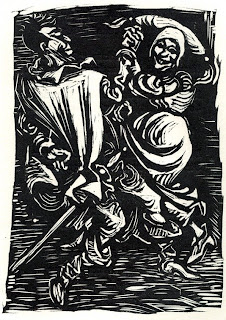
Ernst Barlach, Illustration to Goethe’s Walpurgisnacht:
Mephistopheles dances with the Old Witch


After this witty dialogue between the partners, there follows the exchange with the Proktophantasmist, discussed in Part III, at which point Mephisto’s attention is distracted. The hiatus is fatal. When he turns again to Faust, the latter has ditched his dancing partner and stands alone. When Mephisto inquires for the reason, Faust tells him that he saw a scarlet mouse jump out of Lilith’s mouth as she was concluding a song (“Ach! Mitten im Gesange sprang / Ein rotes Mäuschen ihr aus dem Munde.”). Predictably, this baffles Mephisto:

Das ist was Rechts! Das nimmt man nicht genau;
Genug, die Maus war doch nicht grau.
Wer fragt darnach in einer Schäferstunde?

[That’s nothing much. You need not be alarmed,
The mouse was after all not gray.
Who’d ask questions in so sweet an hour?]


But the real reason for Faust’s disappointment with Lilith, and for the dampening of his ardor, is far more significant. It is, in fact, the denouement of the Walpurgisnacht episode in what turns out to be the defeat of Mephistopheles’ designs on Faust. Here Goethe shows to what extent he had been influenced by Kant’s works on the philosophy of Ethics during the course of the 1790’s, for what Faust does now is to elevate himself above the phenomenal world of intention and desire to the noumenal realm of Morality. His display of autonomous moral agency, which is in effect his bid for freedom from Mephistopheles’ wiles, is triggered by love. He has a vision of Gretchen, a reminiscence of the woman he has abandoned, and he will speak words of love. This alone accounts for his repudiation of carnal desire.


The broken-hearted Gretchen

Kathe Kollwitz, Gretchen (1899)


In the distance, Faust is struck by the vision of a girl who appears to be gliding slowly in fettered feet, and who resembles his ‘dear’ Gretchen (“dem guten Gretchen gleicht”). Mephisto attempts to distract him from his curiosity, and describes the vision as that of a mere magic shape, an idol. He reminds Faust of the Medusa, whose rigid stare congealed the blood of men (“Vom starren Blick erstarrt des Menschen Blut”), and turned them into stone.


Ernst Barlach, Illustration to Goethe’s Walpurgisnacht: The Vision of Gretchen


Faust is not deterred, however, and insists upon gazing on the vision of his beloved:

Fürwahr, es sind die Augen einer Toten,
Die eine liebende Hand nicht schloss.
Das ist die Brust, die Gretchen mir geboten,
Das ist der süsse Leib, den ich genoss.

[Now I see a dead girl’s eyes
Which were never closed by loving hands.
That is the breast which Gretchen yielded me,
The Blessed body I enjoyed.]

His recognition of her, which arouses both affection and guilt in his heart, is now compounded by a premonition of her death. He notes a crimson thread upon her throat, as if cut. The vision causes him both ecstasy and despair.

Welch eine Wonne! Welch ein Leiden!
Ich kann von diesem Blick nicht scheiden.
Wie sonderbar muss diesen schönen Hals
Ein einzig rotes Schnürchen schmücken,
Nicht breiter als ein Messerrücken!

[What ecstasy! What anguish and despair!
I cannot turn my eyes away.
How strange a single crimson thread,
No broader than a razor’s edge,
Would look upon her lovely throat.]

Mephistopheles knows he has been defeated, that Faust has turned his back on sexuality and carnal desire, and that the battle for his soul will still have to be waged again, on other fronts. The magic is broken. In the interim, though he has deliberately brought Faust to the Brocken because it is his own domain, a domain of ‘dreams and magic,’ he complains about how Faust is always hankering after phantoms! (“Nur immer diese Lust zum Wahn!”). He beckons Faust to the feast that is occurring on the summit, which he now describes as a ‘little hill’ (Hügelchen), because it is as lively as ‘the Prater,’ the notorious amusement park in Vienna, which had actually just opened as a public park very recently in Goethe’s own time, in 1766! In effect, though Mephistopheles does not say so, he has failed to capture Faust’s soul within his own realm and domain, the sphere of magic and illusion, and must now entice Faust with reality. The anachronistic reference to the Prater, the diminishment of the Brocken, the lame pursuit of the Perseus metaphor, are devises meant to bring Faust back to earth and make a direct bid for his carnal lust. But before Mephisto can conclude his bid, he can already tell that the episode is over and the curtain must fall on this act.

Ganz recht! Ich seh’ es ebenfalls.
Sie kann das Haupt auch unterm Arme tragen;
Denn Perseus hat’s ihr abgeschlagen. –
Nur immer diese Lust zum Wahn!
Komm doch das Hügelchen heran,
Hier ist’s so lustig wie im Prater;
Und hat man mir’s nicht angetan
So seh’ ich wahrlich ein Theater.

[Quite right. Now I can see it too. What’s more,
She also holds her head beneath her arm,
Since Perseus struck it from her trunk.
Must you always hanker after phantoms?
Climb up that little hill with me;
It is as lively as the Prater there.
And unless I’m totally bewitched,
I see a ready stage and curtain.]

Accordingly, the Walpurgisnacht episode concludes, appropriately, with a curtain fall. In comes “Servibilis” on stage, a huckster type such as one would find before a circus tent. His function is to end the Walpurgisnacht scene and, literally, set the stage for the following scene, the Intermezzo, entitled “Walpurgis Night Dream, or, Oberon and Titania’s Golden Wedding” (Walpurgisnachtstraum, oder Oberons und Titanias Goldne Hochzeit), which follows:

Servibilis: Gleich fängt man wieder an.
Ein neues Stück, das letzte Stück von sieben;
So viel zu geben, ist allhier der Brauch.
Ein Dilettant hat es geschrieben,
Und Dilettanten spielen’s auch.
Verzeiht, ihr Herrn, wenn ich verschwinde;
Mich dilettiert’s, den Vorhang aufzuziehn.”

[We shall resume in just a moment
Another piece, the last of seven.
It is the custom here to show a lot.
An amateur composed the play,
And amateurs make up the cast.
Allow me, sirs, to disappear
And be an amateurish curtain-raiser.]

Mephisto, in a commentary on the play within the play, ironically responds:

Wenn ich euch auf dem Blocksberg finde,
Das find’ ich gut’ denn da gehört ihr hin.

[I am glad to find you on the Brocken,
For that’s the proper place for you.]


Two hundred years after the Walpurgisnacht scene was written, the Brocken has been secularized. Chorus of disembodied voices, spectacles of money and sexuality, are broadcast daily from the TV tower on top of the mountain. In the Museum, the intricacies of the mountain’s geology, the minute accounts of its literary reputation, the richness of its botanical varieties and the habits of its fauna, are methodically displayed. Today the mountain has been thoroughly explained; it can no longer be the “Traum- und Zaubersphäre,” the ‘sphere of dreams and magic.’ Would Faust turn his back on the Devil today?


Monday, October 18, 2010

TRAVEL DIARIES: GOETHE ON THE BROCKEN. PART III


GOETHE ON THE BROCKEN


III. The 'Revolt of the Masses' on Walpurgis Night


[This section follows from Part II, below]


Salvador Dali, Illustrations to the Faust:

Sorcieres au Balais, 1969


III. The 'Revolt of the Masses' on Walpurgis Night.


The effect which the arrival of the witches and wizards to the Sabbath has on Mephistopheles leads to a polemical interpretation of the Walpurgisnacht scene: as Goethe’s reflection on the 1789 revolution in France. Nicholas Boyle writes: “During the winter of his illness [1801] Goethe built up the ‘Walpurgis Night’ into what promised to become his most devastating satirical onslaught on the intellectual lackeys of the Revolution, and on the Revolution itself. Faust is shown abandoning his true and personal responsibilities in the little world of Gretchen and striding through the Harz with Mephistopheles towards the Brocken and into ‘the sphere of dreams and magic,’ the world, at once violent and unreal, of those who think they are making history.” (Boyle, vol. II, op.cit., p. 770).


Storming of the Bastille, July 14, 1789


In 1930, Ortega y Gasset wrote: “There is one fact which, whether for good or ill, is of utmost importance in the public life of Europe at its present moment. The fact is the accession of the masses to complete social power. As the masses, by definition, neither should nor can direct their own personal existence, and still less rule society in general, this fact means that actually Europe is suffering from the greatest general crisis that can afflict peoples, nations and civilization. . . . . Strictly speaking, the mass, as a psychological fact, can be defined without waiting for individuals to appear in mass formation. In the presence of one individual we can decide whether he is "mass" or not. The mass is all that which sets no value on itself -- good or ill -- based on specific grounds, but which feels itself "just like everybody," and nevertheless is not concerned about it; is, in fact, quite happy to feel itself as one with everybody else.” Jose Ortega y Gasset, The Revolt of the Masses [La Rebelión de las Masas] (1930).


The execution of Louis XVI in 1793


For Goethe, this social eruption, in its very early stage, was symbolized by the Terror which swept through France from 1792 onward. In the Walpurgisnacht scene, he depicts the Terror as the orgiastic Sabbath of the witches, so grotesque that even Mephistopheles cannot abide by it. Instead, he leads Faust to a campfire where those displaced by the revolution languish in disillusionment. And he reserves his most pointed criticism for the rationalists of the German Enlightenment who, for the most part, had welcomed the Revolution.


At this stage in the play, Faust and Mephistopheles are almost at the summit of the Brocken, accompanied by a swarm of witches and wizards racing to the top. Mephisto is annoyed and bothered by the push and pull of the mass.


Das drängt und stösst, das ruscht und klappert!
Das zischt und quirlt, das zieht und plappert!
Das leuchtet, sprüht und stinkt und brennt!

Ein wahres Hexenelement!

[They crowd and crush, they squeal and they clatter!
They hiss and whirl, they pull and they chatter!
They spew and sparkle, burn and stink;
This is the proper sphere of witches!]

Faust is anxious to get to the top, where Lord Satan will preside over the Sabbath, but Mephisto is so repelled by the crowds that he is not in the least interested in proceeding with the ceremonies or leading Faust in that direction. Mephisto seems strangely out of control and worried about losing Faust in the mass. “Keep close to me, or we’ll be separated. Where are you?” - he cries after Faust, and the latter refers to him as ‘a spirit of contradiction’ (“Du Geist des Widerspruchs!”), because of his reluctance to proceed to their expected goal.

Indeed, Mephisto definitely wants to head in a different direction, where he can find relief from the pressure of the crowds:

Hier, Doktor, fasse mich! und nun, in einem Satz,
Lass uns aus dem Gedräng’ entweichen; 
Es ist zu toll, sogar für meinesgleichen. 

Dort neben leuchtet was mit ganz besonderem Schein, 
Es zieht mich was nach jenen Sträuchen.

 Komm, komm! Wir schlupfen da hinein.”

[Now, Doctor, seize my coat! We will escape
In one leap to safer ground;
This is too crazy even for the likes of me.

Over there I see a very special glimmer,
Something draws me to that clump of bushes.

Come, come, let us crawl in for now.]

We never see the climactic performance on the summit, presided over by the Devil Lord, ‘Herr Urian,’ because Mephisto drags Faust away from the crowd to a side-spot where a group of sad and broken characters are sitting before a campfire. Faust is diverted to the grieving remnants of Germany after the Revolution in France, to witness the end of an era. There, lamenting the passing of better times, sit a sad group of nostalgic impotents, a General, a Minister, a Parvenu, and an Author. I quote their laments in full, as they provide an accurate representation of reactionary discontent.

General: Wer mag auf Nationen trauen,
Man habe noch so viel für sie getan;
 Denn bei dem Volk, wie bei den Frauen,
Steht immerfort die Jugend oben an.


[General: Who wants to put his faith in nations,
No matter what you’ve done for them?
For with the people just as with a woman
The prize goes always to the young.]

Minister: Jetzt ist man von dem Rechten allzu weit,
Ich lobe mir die guten Alten;
Denn freilich, da wir alles galten, 
Da war die rechte goldne Zeit.

[Minister: They have abandoned all that’s good these days
Bring me back the older generation;
For when we better men held sway
It was a happy, golden age.]

Parvenu: Wir waren wahrlich auch nicht dumm,
Und taten oft, was wir nicht sollten;
Doch jetzo kehrt sich alles um und um,
Und eben da wir’s fest erhalten wollten.”

[Parvenu: We were not altogether stupid either;
Here and there we made some tricky deals.
But now the world is topsy-turvy,
Just when we meant to keep the status quo.]

Autor: Wer mag wohl überhaupt jetzt eine Schrift
Von mässig klugem Inhalt lesen!
Und was das liebe junge Volk betrifft,
Das ist noch nie so naseweis gewesen.”

[Author: Who would want to read these days
A work of any depth and compass?
As for the touted younger generation,
I never saw one more irreverent.]


Goethe had often heard the laments of German émigrés from the lands conquered by the French revolutionary armies, and those of their French aristocratic counterparts, the resentful complaints of the displaced and the disappointed of the Ancien Regime. He had accompanied Karl August and the army of Sachse-Weimar in the march of the First Coalition into France, and been witness to its defeat at Valmy in 1792. He had lived the reaction against the Revolution, and was now putting it into the mouths of these sad and broken old men. And he put his own thoughts into the mouth of the Author, whose ambiguous feelings towards the new generation of the Romantics he shared.


The Ancien Regime: Portrait of
Jean Baptiste De Belloy-Morangle
(1709-1808)


The lamentations have an effect on Mephistopheles, “who suddenly feels very old” (“der auf einmal sehr alt erscheint”). The implication being that even the Devil has seen enough:

Zum jüngsten Tag fühl’ ich das Volk gereift,
Da ich zum letzten Mal den Hexenberg ersteige,
Und weil mein Fässchen trübe läuft,
So ist die Welt auch auf der Neige.

[Now that I scale this magic hill a final time,
I feel that men are ripe for Judgment Day;
And since my keg is running dry,
The world has reached the edge of time.]

Goethe seems to have planned a crowning scene for this Walpurgis Night wherein Satan himself, Herr Urian, in the guise of Napoleon Bonaparte, was to redistribute to his flatterers the crowns of Europe and much wealth, on the summit of the Brocken, the whole scene concluding with a volcanic eruption. It was never written. Goethe “shied away from depicting the epicenter of the French earthquake, a scene of “Goya-like intensity,” as Nicholas Boyle envisions it, which would have exposed “the moral hollowness of the modern age which Faust has taken it upon himself to represent.” (Boyle, vol. 2, op.cit. p. 771.

It is not so much that Goethe is taking the side of the victims of the Revolution, but rather that he is illustrating the frustration of those whom the revolution had disenfranchised or cast out, in the context of the turbulence and violence that accompanied the overarching social eruption, which was the coming of the age of the masses. He feared the Terror.

And yet, Goethe’s sharpest barbs in the Walpurgisnacht scene are reserved for his rationalist critics. Before the campfire scene, a reference is made to these philosophers, in the form of one voice in the chorus of witches and wizards heading for the summit:

Stimme (von unten):
Wir möchten gerne mit in die Höh’.

Wir waschen, und blank sind wir ganz und gar;
Aber auch ewig unfruchtbar.

[Voice (from below):
We’d like to be with you in the heights;
We are scrubbed and polished to the bone
But forever parched and sterile.]

Scrubbed and polished, but eternally fruitless, the rationalist upholders of the old German Enlightenment had criticized Goethe and disparaged his idealism. In terms of the polemical interpretation of this section of the Faust, these rationalist ideologues stand for the support of the Gironde, the initial unquestioned endorsement of the events in Paris. Thus the satire tails that of the emigres. But whereas the latter were lampooned as impotent nostalgists, the rationalists are reviled for their misunderstanding of the Revolution. Johann Friedrich Reichardt, for example, the intellectual collaborator with the Revolution, is one of them. But most important of all was Friederich Nicolai, who is mercilessly lampooned, not so much as upholder of the Gironde, but as narrow-minded rationalist.


Friedrich Nicolai (1733-1811)


Nicolai’s enthusiasm for English literature won for him the friendship of Lessing and Moses Mendelssohn. In association with Mendelssohn he established in 1757 the Bibliothek der schönen Wissenschaften, a periodical which he conducted until 1760. Together with Lessing and Mendelssohn, Nicolai edited the famous Briefe, die neueste Literatur betreffend between 1759 and 1765; and from 1765 to 1792 he edited the Allgemeine deutsche Bibliothek. This latter periodical served as the organ of the so-called popular philosophers, who warred against authority in religion and against what they conceived to be extravagance in literature. In his old age, he became the enemy of the new heavyweights of German culture, Herder, Goethe, Schiller, Kant and Fichte, whom he was incapable of understanding. Nicolai criticized the emotionalism of the Sturm und Drang movement, which he believed made its literature incomprehensible, and in 1775 published a satire on the reception of Goethe’s Werther in Europe, thus making an enemy of Goethe. But on Walpurgis Night he is lampooned for his dogged rejection of the magical and the supernatural in literature, which he took to be consistent with his rationalism.

Goethe satirizes Nicoai in the play as the “Proktophantasmist,” a term he invented, which derives from the Greek proktos, meaning "anus" and phantasma, "phantom"; the last syllable homophonous with the German word for dung (mist). Thus the word literally means something like “buttocks’ ghost-imaginer.” Nicolai had notoriously argued that ghostly visions and phantasmagorical hallucinations could be treated successfully by the application of leeches on the buttocks. This upon the heels of reported ghostly apparitions at the Tegel Schloss in Berlin, hence the mention of Tegel in the play. Thus to satirize Nicolai on the Brocken, surrounded by witches and ghosts, was a most appropriate idea.


Ernst Barlach, Illustration to Goethe’s Walpurgisnacht:

Proktophantasmist: “ Wir haben ja aufgeklärt!”
[We have become enlightened!]


The Proktophantasmist appears on scene during Faust’s dance with the young witch, which I shall discuss further in Part IV. He is therefore witnessing the spectacle of carnal sensuality which Mephisto has reserved as a last resort to seduce the increasingly impatient Faust. The rationalist dismisses on the grounds of reason what he perceives empirically with his own eyes:

Verfluchtes Volk! Was untersteht ihr euch?
Hat man euch lange nicht bewiesen:
Ein Geist steht nie auf ordentlichen Füssen?
Nun tanzt ihr gar, uns andern Menschen gleich!

[Shameless mob! What on earth is this?
Has it not been proven long ago:
Spirits do not walk on solid ground?
Now you presume to dance like one of us!]

And, as Faust and the young witch continue to dance before him:

Ihr seid noch immer da! Nein, dass ist unerhört.
Verschwindet doch! Wir haben ja aufgeklärt!
Das Teufelspack, es fragt nach keiner Regel.
Wir sind so klug, und dennoch spukt’s in Tegel.
Wie lange hab’ ich nicht am Wahn hinausgekehrt,

Und nie wird’s rein; das ist doch unerhört!

[You are still here! Incredible, such insolence!
Clear out! We are enlightened, don’t you know?
The devil’s pack ignores all rules and standards.
We are so smart, but still the ghosts haunt Tegel.
How I have worked to clear the air of superstition!
But – such insolence - the folly still clings everywhere]

Frustrated, the old rationalist promises to vanquish all the devils and the poets. (“Die Teufel und die Dicther zu bezwingen”).

In the meantime, Mephistopheles is aware that in ‘the sphere of dreams and magic,’ Faust will not commit the sin that will alienate him from God, for a dream is just a dream. The Walpurgis Night must end therefore in an orgiastic dance which might perhaps bring Faust down from the realm of dreams to the material realm, and entice him to sin against God. Faust himself is impatient at lingering over this gloomy campfire, surrounded by gloomy people, and is eager to move on to the summit of the mountain, where the orgiastic Sabbath is being enacted, and he wants to meet there the Devil as Lord, enthroned, as it were. The struggle between desire and reason, between inclination and the Moral Law, is already raging within his own breast, without the need for the promptings of Mephistopheles.

Doch droben möcht’ ich lieber sein!
Schon seh’ ich Glut und Wirbelrauch.
Dort strömt die Menge zu dem Bösen;
Da muss sich manches Rätsel lösen.

[But I prefer that higher region
Where even now I see a smoky, churning glow,
And crowds advancing to the Evil One;
Many riddles may be answered there.]

The scene moves on then to the Vision of Lilith.

[CONTINUED IN PART IV]

Sunday, October 17, 2010

TRAVEL DIARIES: GOETHE ON THE BROCKEN. PART II


II. Goethe’s Return to the Mountain on Walpurgis Night


[This section follows from Part I, below]


Goethe returned to the Brocken, this time in spirit, in the "Walpurgisnacht" scene of his Faust, Part I, composed in 1801, but which first made its appearance in the completed Faust I of 1808. (ll. 3835-4222). According to the legend, devils, witches and other evil spirits congregated on the Blocksberg, known as Brocken in the modern period, on Walpurgis Night, the night of April 30-May 1. Goethe inserted this scene directly after the scene where Gretchen, praying in the Cathedral (Dom), is confronted by the Evil Spirit (Böser Geist) and accused of various foul crimes for which she is only partially guilty, and Faust complicit. The scene marks an abrupt change in mood and circumstance. To remove Faust from Gretchen, to dampen his ardor, assuage his guilt and withdraw him from the location of his crime against Gretchen and the mess he has made, Mephistopheles takes Faust to the Brocken for the Witches Sabbath on Walpurgisnacht.

The Walpurgisnacht scene begins with an ironic question of Mephistopheles to Faust, an allusion to the connotations of witchery with which the Brocken has traditionally been associated: Verlangst du nicht nach einem Besenstiele? (Don’t you want a broomstick to convey you hence?). He himself would prefer to ride a sturdy goat, because they are still very far from their goal. Their ascent commences in “the vicinity of Schierke and Elend,” (‘Elend’ means misery in German), which is the location of Goethe’s own assent with the forester, in the neighborhood of the two little towns which lie south of the summit, at the foot of the Brocken.

In response to Mephistopheles’ grousing about the difficulty of the climb, Faust responds with a paean to the beauty of the place, the excitement of finding a way through the forest, toward the cliff, the source of eternal spurting and plunging waters (“Von dem der Quell sich ewig sprudelnd stürtzt”), and the joy of experiencing the hike. “Das ist die Lust, die solche Pfade würzt!" (That is the joy and seasoning of such a path!). The coming of spring is visible in the birches and firs, should it not also lighten his limbs and thus make his climb more enjoyable? Faust has a positive attitude and looks forward to finding his way through the labyrinth of the forest to the spurt of ascent. But Mephisto shares none of this enthusiasm and complains about hunger and cold. “Führwahr, ich spüre nichts davon! Mir ist es winterlich im Leibe . . . .” (Myself I notice no such thing. I feel the winter in my belly). Because the reddish pale moon above them gives sparse illumination, he decides to call upon a Will-o’-the-Wisp (Irrlicht), a “friend,” to shine a light on their path through the forest. The Irrlicht is the ignis fatuus, a wavering light formed by marsh gas, which in the tradition of German folklore was thought to lead travelers to their destruction.

Mephistopheles is the Lord of the Brocken, which is a crucial factor in the understanding of the scene in its totality. In all of the tasks set by his relationship with Faust, in the latter’s constant striving for new ventures and horizons, Mephistopheles is always in alien territory, particularly in Hellas, where the Classical Walpurgisnacht (Klassische Walpurgisnacht) takes place, in Faust Part II, and where he makes no secret of his acute discomfort. But here, in the Brocken, he is Lord and Master. He is disguised, but his cloven feet expose him. The Will-o’-the-Wisp however recognizes him by his peremptory manner of command, and says so: “Ich merke wohl, Ihr seid der Herr vom Haus , / Und will mich gern nach Euch bequemen. / Allein bedenkt! der Berg ist heute zaubertoll, / Und wenn ein Irrlicht Euch die Wege weisen soll, / So müsst Ihr’s so genau nicht nehmen.” (I see you are the lord and master in this house; I’ll do my best to keep you satisfied. But keep in mind, the mountain is magic-mad today and since you’re asking me to light the way, do not expect too much precision.).


Ernst Barlach, Illustration to Goethe’s Walpurgisnacht: Faust, Mephisto and the Will-o’-the-Wisp (Irrlicht)


The three figures now begin a fast chant in the manner of an operatic trio, which in trochaic tetrameter bears the rhythm of the strenuous hike, of the ascent through the forest, presaging the surge of elemental demonic forces that is the essence of the Walpurgisnacht scene. It is as well an introduction to the Witches’ Sabbath, an acknowledgement of Faust’s and Mephisto’s arrival and penetration into the “Traum- und Zaubersphäre,” the ‘sphere of dreams and magic,’ which is the Brocken on the night of Walpurgis. The poem takes on the enchanting atmosphere of witchery and mystery by echoing the sounds of the forest at night, the heels crushing the undergrowth, and the creatures that reveal themselves in a variety of colors therein:

“Uhu! Schuhu! Tönt es näher,
Kauz und Kiebitz und der Häher, 
Sind sie alle wach geblieben?
 Sind das Molche durchs Gesträuche? 
Lange Beine, dicke Bäuche!
Und die Wurzeln, wie die Schlangen,
Winden sich aus Fels und Sande,
Strecken wunderliche Bande, 
Uns zu schrecken, uns zu fangen;
Aus belebten derben 
MasernStrecken sie Polypenfasern 
Nach dem Wandrer. 
Und die Mäuse
Tausendfärbig, scharenweise,
 Durch das Moos und durch die Heide! 
Und die Funkenwürmer fliegen
 Mit gedrängten Schwärmezügen
 Zum verwirrenden Geleite.”

[To-whit! To-whoo! Not far away
Are the plover, owl, and jay.
Have they all remained awake?
Are there newts behind the reeds?
Skinny legs and swollen glands!
Here a root and there a snake,
Coiling through the roots and sands,
Sending strange and dewy threads
To frighten us and hold us here.
From living burls on crooked trees
They wind their fibrous polyp-tether
To trap the wanderer. And the mice
Of myriad colors, far and near,
Scuttle through the moss and heather
Glowworms gleaming in a crowd
Conjure up a sparkling cloud,
A shimmering escort of confusion.]

[Unless otherwise indicated, all English translations from the Faust are from the Peter Salm translation of the Faust, First Part, in the Bantam Classics edition of 1962]


The sphere of magic dreams, wherein which the Will-o’-the-Wisp is guiding the travelers, is also a kingdom of material wealth and sexuality, the realm, as well as the medium, of Mephistopheles’ power over human beings. This is quickly evident as Mephisto breaks off from the song and reveals to Faust the presence of the “seams of gold” which glow through the rocks in the mountain and which illuminate the palace where the orgiastic Sabbath celebration will take place.

“Fasse wacker meinen Zipfel!
Hier ist so ein Mittelgipfel,
Wo man mit Erstaunen sieht, 
Wie im Berg der Mammon glüht
.
. . . . . . . . . . . .
Erleuchtet nicht zu diesem FesteHerr
 Mammon prächtig den Palast?”

[Seize my coattail with a steady hand;
we’re flying by a central peak
where we can marvel at the sight
of Mammon glowing deep within.
. . . . . . . . . . . . . .
Has not Sir Mammon lighted splendidly
The palace for this great occasion?]

Yet, Faust is unaware of the significance of Mammon, the diabolic personification of gold and material wealth, but is rather more in wonder of the spectacle before him, which appears as if the mountain were on fire, with deep ravines and gaping chasms emitting fumes and golden mists and showers of sparks. “Doch schau! In ihrer ganzen Höhe / Entzündet sich die Felsenwand.” [And look! The mountain wall from top to bottom ignites and seems on fire.] Mephisto will shortly introduce him to the great witches feast, but as yet Faust is unaware.


Ernst Barlach, Illustration to Goethe’s Walpurgisnacht: Faust and Mephistopheles: “Hier ist so ein Mittelgipfel . . . .”


What kind of world is this realm of Mephistopheles, wherein he is leading the dreamy Faust? Already he has pointed to the veins of gold in the mountain. But his design on Faust, who is by now in the play totally under his governance and influence, is to lead him into a world of sexuality.

Faust’s wager with Mephistopheles contains within it the logic of the World Journey that follows, and the first experience in that journey is Faust’s passion for Gretchen and its outcome. Thus far in the drama, as Erich Trunz observes in his Commentary on the Faust (Goethes Faust, Kommnentiert von Erich Trunz, Christian Wegner Verlag, Hamburg, 1963), all has been action, but in Walpurgisnacht we enter the realm of the symbolic. Goethe is not reluctant to uncover the Erotic, but he does so in the form of the symbolic, and not as reality, and not in the domain of human action, but rather in a magical world of spirits. Walpurgisnacht is carnality, fleshliness and sensualism, in a word, sexuality. But sexuality is not in itself evil, rather, evil only in terms of what human beings make of it.

Indeed, Faust’s journey into Walpurgisnacht is an arc which spans the initial “Spring fever” of his exhilaration in personal physical strength and admiration for the natural, as he sets out on the climb (“So lang’ ich mich noch Frisch auf meinen Beinen fühle, / Genügt mir dieser Knotenstock.” The "Knotenstock" bei[As long as my legs feel fresh and strong the knotted stick will serve me well]), as a bridge to the subsequent Vision of Lilith, (discussed in Part IV), and his dance with the young witch. These two encounters with sexual desire, still in the realm of the symbolic, are the moment when Mephisto is total Lord over Faust. Yet what concludes the scene is a rejection of the fleshly temptations offered by Mephistopheles, just as Jesus rejected the temptations of Satan. Mephisto leads Faust into Walpurgisnacht, his domain, but Faust ultimately remains autonomous. When, at the conclusion of the scene, Faust has a vision of Gretchen in distress, and utters words of love, a fundamental reversal of the symbolic occurs, and the arc is closed.


The orgiastic element of the Witches’ Sabbath, the Erotic element in the drama, is introduced against a backdrop of wind, thunder and storm, by the sudden sound of various choruses of witches and wizards. As well, the entire tone of the poem changes abruptly as the trochaic tetrameters of the hiking song suddenly cease, and Faust ominously exclaims “Wie rast die Windsbraut durch die Luft!” (How the wind-hag races through the air!) To which Mephisto responds in tenebrous iambic pentameters as he begins to notice the rising mist (“Du musst des Felsens alte Rippen packen, / Sonst stürzt sie dich hinab in dieser Schlünde Gruft. Ein Nebel verdichtet die Nacht.” [You must grasp these ancient ribs of rock, or else she’ll hurl you down headlong. A mist is thickening the night.], and he is alerted to the emerging commotion which threatens to decimate the forest:


“Höre, wie’s durch die Wälder kracht!
Aufgescheucht fliegen die Eulen.Hör’,
es splittern die Säulen
Ewig grüner Paläste.
Girren und Brechen der Äste!
Der Stämme mächtiges Dröhnen!
Der Wurzeln Knarren und Gähnen!”

[Hear how the timbers creak and moan;
Frightened owls are streaking through the trees
Hear through the palaces of evergreen
The towering pillars crack and shatter,
The squeal and crash of tumbling branches!
The hollow thunder of the trunks!
The groaning of the roots below!]


He then asks Faust whether he can hear the choruses, above them and below them, near and far, as the mountain comes alive:

“Hörst du Stimmen in der Höhe?
In der Ferne, in der Nähe?
Ja, den ganzen Berg entlang
Strömt ein wütender Zaubergesang!”

[Do you hear the voices high above?
Far away and close at hand?
The entire mountainside has come alive
With frenzied chants of sorcery.]


And, indeed, what follows is a dialogue among choruses, some of them proceeding from above and some from below, of wizards and of witches, all intent, like Faust and Mephisto, on reaching the summit of the Brocken. Among them comes the old Frau Baubo.


Ernst Barlach, Illustration to Goethe’s Walpurgisnacht:
“Die alte Baubo kommt allein, Sie reitet auf einem Mutterschwein.”


“Stimme: Die alte Baubo kommt allein,
Sie reitet auf einem Mutterschwein.

 Chor: So Ehre denn, wem Ehre gebührt! 
Frau Baubo vor! Und angeführt
Ein tüchtig Schwein und Mutter drauf, 
Da folgt der ganze Hexenhauf.”

[Voice: Our ancient Baubo rides alone
With a mother sow beneath her buttocks.

Chorus: We like to cheer when cheers are due!
Let Lady Baubo lead the crew.
With mother on a strapping swine
The other hags will stay in line.]


Frau Baubo, here depicted by Goethe as a leader and mother of the witches, is a personage of Greek mythology, variously described as the midwife of the Greek goddess Demeter, who jested with the goddess to console her for the loss of Proserpina. The story goes that Baubo exposed her genitals to the goddess, and this made Demeter laugh. [In the witches’ chorus scene, she cries out, among the gaggle of the others: “Mich hat sie geschunden, Da sieh nur die Wunden!” (The sow has treated me badly, look at my wounds!)]. But according to Robert Graves, it was Iambe, the lame daughter of Celeus, King of Eleusis, who "tried to console Demeter with comically lascivious verses, when a dry nurse, old Baubo, persuaded her [Demeter] to drink barley-water by a jest: she groaned as if in great travail and, unexpectedly, produced from beneath her skirt Demeter's own son Iacchus, who leapt into his mother's arms and kissed her." Graves writes, "Iambe and Baubo personify the obscene songs, in iambic meter, which were sung to relieve emotional tension at the Eleusinian Mysteries; but Iambe, Demeter, and Baubo form the familiar triad of maiden, nymph, and crone. Old nurses in Greek myth nearly always stand for the goddess as crone." (Robert Graves, The Greek Myths. (London: Folio Society, 1996, at vol.1, pp. 92 and 96).


In Walpurgisnacht, old Baubo sets the tone for the obscenity of the rabble of witches, sweeping the wind like locusts, whom she leads towards the summit where Herr Urian, the Devil, will preside as Lord. The scene is all confusion, shouting and scrambling, as the witches mounted on broomsticks race to the top of the hill.


Ernst Barlach, Illustration to Goethe’s Walpurgisnacht: “Nehmt mich mit! Nehmt mich mit!”
[Take me along! Take me with you!]


The effect which the gaggle and noise of the choruses of witches and wizards have on Mephistopheles points to a further interpretation of the Walpurgisnacht scene: the Witches Sabbath as Goethe’s reflection on the 1789 revolution in France. Nicholas Boyle writes: “During the winter of his illness [1801] Goethe built up the ‘Walpurgis Night’ into what promised to become his most devastating satirical onslaught on the intellectual lackeys of the Revolution, and on the Revolution itself. Faust is shown abandoning his true and personal responsibilities in the little world of Gretchen and striding through the Harz with Mephistopheles towards the Brocken and into ‘the sphere of dreams and magic,’ the world, at once violent and unreal, of those who think they are making history.” (Boyle, vol. II, op.cit., p. 770).


[CONTINUED IN PART III]


Labels

Labels

Labels