Demo Site

Thursday, March 3, 2011

TRAVEL DIARIES: BISHOP BERNWARD'S HILDESHEIM - III

TRAVEL DIARIES: HILDESHEIM – PART III

Thursday, July 8, 2010


BISHOP BERNWARD AND THE OTTONIAN ROMANESQUE


Hildesheim

[This section follows from Part II, below]


Illustration of Bernward’s Column


On July 8, 2010, I traveled to Hildesheim, a city located west of the Elbe River, in Lower Saxony, in the district of the same name, about 40 km southeast of Hannover. I was there to see the Church of St. Michael’s, one of Bishop Bernwald’s cathedrals. Within this Church, among other outstanding materials of Romanesque Art, is the black column of Bishop Bernward, a bronze column depicting scenes from the life of Jesus. Nearby, at the Hildesheim Museum, is the Bernward Door, also in bronze, probably designed for the entrance to Bernward’s mausoleum at St. Michael’s. It is one of the most outstanding achievements of Romanesque Art, and its style replicates the craftsmanship and the spiritual gravity of the black column. [See Part IV, above]


BISHOP BERNWARD AND THE ROMANESQUE TREASURES AT HILDESHEIM

THE BERNWARD COLUMN (BERNWARDS SÄULE)
[right click on images and open link in new window for closer viewing]


Bernward’s Column: The capital


From the middle portion of the column


The miracle at Cana (John, 2, 6-8)


The metal-worker Bishop Bernward probably worked himself on the famous bronze column which is placed in the rear of the Church in the southern transept. It seeks to emulate Trajan’s column in Rome (see below), but it is evident on approaching it that it is fundamentally Christian and Romanesque, although the intention to imitate the great column of Trajan is precisely the spirit of the Romanesque, the style derived from the Classical.


Trajan’s Column in Rome


Depiction of the “turtle formation” on Trajan’s column


‘Adlocution Scene’ on Trajan’s Column


The Bernard column is Christian in its representations, in its darkness, which is not only the color of the column but the story depicted on it: the passion of Christ. The ascent is an ascent to Heaven, not to Glory, as it is in Trajan’s column, and what is depicted is not martial valor and triumph but the story of Jesus in Palestine.


The Bernward Column


It is not humanity that is celebrated here, but the soul and its travel to eternity, the “pure and infinite space” of Heaven. How different these contorted, rude and shapeless individuals, roughly clothed in peasant garb from the soldiers in Trajan’s column, from the Classical celebration of the triumphs and achievements of human beings in this earth and in this life.

And yet, the Romanesque figures are very much humane. They elicit a sympathy and compassion for the sorrowful life of humanity in its ‘vale of tears,’ which is precisely the intent of the Christian message.


Jesus speaks to his Apostles


The baptism of Jesus (Matthew 3, 13-17)


The blessing of the sisters of Lazarus (John, 11, 3)


The rich glutton and the poor beggar Lazarus (Luke, 16, 19-21)


In his book Mimesis: The Representation of Reality in Western Literature (Princeton, 1953), Erich Auerbach analyzes Gregory of Tours’ description of a local brawl between Frankish chiefs in his History of the Franks (594 CE). Auerbach’s commentary on Gregory is pertinent to the sculpted narrative on the Bernward column because of the contrast he draws between the early medieval perspective and the classical:

“[H]ow narrow Gregory’s horizon really is, how little perspective he has with which to view a large, coherent whole, how little he is in a position to organize his subject matter in accordance with the points of view which had once obtained. The Empire is no longer in existence. Gregory is no longer situated in a place where all the news from the orbis terrarum is received, sorted, and arranged according to its significance for the state. He has neither the news sources which were once available nor the attitude which once determined the manner in which the news was reported. He hardly surveys all of Gaul. A large part of his work, doubtless the most valuable, consists of what he himself witnessed in his own diocese or of what was reported to him from the neighboring territory. His material is essentially limited to what has been brought before his eyes. He has no political point of view in the old sense; if he may be said to have any at all, it is the interest of the Church; but there again his perspective is restricted; he does not conceive of the Church as a whole in such a way that his work forcibly conveys that whole; everything is locally restricted, both in substance and in thought. On the other hand, in contrast to his antique predecessors, whose work was often based on indirect and previously processed reports, most of the things Gregory relates in his History of the Franks he either saw himself or learned at first-hand from the people involved in them. This is in keeping with his natural bent. For he is directly interested in what people are doing. They interest him as they move about him, irrespective of political considerations in a wider context. Thus his work assumes a character much closer to personal memoirs than the work of any Roman historian.” (84-5)

“This brutal life becomes a sensible object; to him who would describe it, it presents itself as devoid of order and difficult to order, but tangible, earthy, alive.” (91)

“Christ’s life among the lower classes and the simultaneous sublimity and shamefulness of his Passion shattered the classical conception of the tragic and the sublime.” (92)

“A complete change has taken place since the days of Ammianus and Augustine. Of course, as has often been observed, it is a decadence, a decline in culture and verbal disposition; but it is not only that. It is a reawakening of the directly sensible. Both style and treatment of content had become rigid in late antiquity. An excess of rhetorical devices, and the somber atmosphere which enveloped the events of the time, give the authors of late antiquity, from Tacitus and Seneca to Ammianus, a something that is labored, artificial, overstrained. With Gregory the rigidity is dissolved.” (94)


Auerbach’s rich analysis of Gregory of Tours’ History pertains equally to the sculpted narrative of the Bernward column. Here are evident the provinciality of the early Romanesque, its primitive perception and unadorned simplicity, the material content of the representations “essentially limited to what has been brought before his eyes,” which is in this case the eyes of the sculptor. As well, the vital self confidence of that early Christianity is evident here. The sentence, “[a] large part of his work, doubtless the most valuable, consists of what he himself witnessed in his own diocese or of what was reported to him from the neighboring territory,” rings so true for the sculptor of the Bernward column as well.

The observation that Christ’s life among the lower classes and the shamefulness of his Passion had shattered the classical conception of the tragic and the sublime is also directly appropriate to the scenes and figures of the column’s sculpture, which so forcefully shows the dignity of the poor and downtrodden, and the sadness of the story of Jesus. Indeed, the work represents the reawakening of the directly sensible, for there is no idealization of humanity here, such as is evident in the Trajan column or in the art of Classical Greece on which it is modeled. Here the poor folk that follow Jesus are little more than beasts, and their humanity is portrayed with empirical accuracy despite the distortions of the medium and the primitivism of the representation. There is no question but that a careful reading of Auerbach’s analysis rings as true for the sculptural narrative of the Bernward column as it does for the actual object of his study.


The witnesses to the Raising of the Son of the Widow of Nain:
“And a large crowd from the town was with her.” (Luke 7:12)
These people here portrayed have witnessed the miracle performed by Jesus, according to Luke, outside the town of Nain in Galilee. Note the expression of devotion on their faces. The man in the middle above looks up to Heaven, toward “pure and infinite space.”


[CONTINUED IN PART IV]


TRAVEL DIARIES: BISHOP BERNWARD'S HILDESHEIM - II

TRAVEL DIARIES: HILDESHEIM – PART II

Thursday, July 8, 2010

BISHOP BERNWARD AND THE OTTONIAN ROMANESQUE


Hildesheim


[This section is a continuation of Part I, below]


On July 8, 2010, I traveled to Hildesheim, a city located west of the Elbe River, in Lower Saxony, in the district of the same name, about 40 km southeast of Hannover. I was there to visit the Church of St. Michael’s, one of Bishop Bernwald’s cathedrals. The church contains a treasure trove of Romanesque Art from the Ottonian period of German history. I have reviewed the objects of Ottonian Art in Hildesheim under the rubric of the Romanesque because I believe this to be the overall genus of the style. The Ottonian has been described as a translation of the gentle Byzantine image into German expressive realism (H. W. Janson, History of Art, N.Y. 1971), and to be thereby unique, but there are too many links and overlaps with the subsequent development of the Romanesque for the style to be completely isolated by emphasis on its earliest characteristics in this fashion.


BISHOP BERNWARD AND THE ROMANESQUE


Bishop Bernward


The great church foundations and the great treasure trove of Ottonian and Romanesque Art in Hildesheim are primarily the legacy of Bishop Bernward (ca. 960-1022), an ambitious patron of architecture and art. It is probable that he worked himself as a craftsman and artisan on the brass ornamentation and monuments that decorated his churches. Little is known of the facts of his life, despite the account of his life set down in writing by his student, Thangmar, in the Vita Bernwardi. His time in office fell during the era of the Saxon Emperors, who had their roots in the area around Hildesheim and were personally related to him. During his lifetime, Hildesheim was a center of power in the Empire and Bernward was determined to provide his city with an image that would fit one of its stature. Thus the column he designed for the cathedral was planned on the model of Trajan’s Column at Rome. (See Part III). Bernward was descended from a noble Saxon family and was educated at the Cathedral School in Hildesheim. After 977 CE, he served as scribe and chronicler at the court of Otto II and the Empress Theophanou. Thereafter, from 987/88 to 993 CE, he served as teacher of the young Emperor Otto III, together with the future Pope, Sylvester II. In 993 CE, Bernward became the 13th Bishop of Hildesheim.


Bishop Bernward


The foundation of the church of St. Michael’s was laid in 1010. As early as 1015, the lower church (crypt) was consecrated, the site Bernward had planned to house his tomb, and where he is buried now. (See Part IV). Close to his death, in 1022, he dedicated the church to the Archangel Michael and it is claimed that construction was finally completed in 1033, eleven years after the death of the founder. Bernward was Bishop of Hildesheim from 993 to 1022, and was himself architect and metal-worker. Three other churches besides the cathedral survive in the city from his time or that of his immediate successors, and Hildesheim of all North German cities is richest in monuments of the Romanesque.


Bishop Bernward


In his controversial history, The Decline of the West, Oswald Spengler makes reference to the Hildesheim of Bishop Bernward in the context of his “Faustian vision” of Western culture:

Cultures are organisms, and world-history is their collective biography. Morphologically, the immense history of the Chinese or of the Classical culture is the exact equivalent of the petty history of the individual man, or of the animal, or the tree, or the flower. For the Faustian vision, this is not a postulate but an experience; if we want to learn to recognize inward forms that constantly and everywhere repeat themselves, the comparative morphology of plants and animals has long ago given us the methods. In the destinies of the several Cultures that follow upon one another, grow up with one another, touch, overshadow, and suppress one another, is compressed the whole content of human history. (I, 104, emphasis in the original).

Every Culture passes through the age-phases of the individual man. Each has its childhood, youth, manhood and old age. It is a young and trembling soul, heavy with misgivings, that reveals itself in the morning of Romanesque and Gothic. It fills the Faustian landscape from the Provence of the troubadours to the Hildesheim cathedrals of Bishop Bernward. (I, 107)."

Spengler continues:

"Henceforth we shall designate the soul of the Classical Culture, which chose the sensuously-present individual body as the ideal type of the extended, by the name (familiarized by Nietzsche) of the Apollinian. In opposition to it we have the Faustian soul, whose prime-symbol is pure and limitless space, and whose “body” is the Western Culture that blossomed forth with the birth of the Romanesque style in the 10th century in the Northern plain between the Elbe and the Tagus. (I, 183)”

In looking at the works of the Ottonian Romanesque, I believe it is most enlightening to keep in mind Spengler's conception of "pure and limitless space" as a symbol of the Faustian Western culture and its eschatological thrust towards God's ultimate purpose. I suggest it is visible in the ceiling of St. Michael's Church, for example, and in the look towards Heaven of the humble people of Nain, sculpted into the Bernward column.


THE OTTONIAN CHURCH OF ST. MICHAEL’S

[click on images to expand their size]


The outward appearance of the Church of St. Michael’s is characterized by its ‘three-tower-motif’ at each of its ends. The two heavy square towers correspond with the two round towers on each of its sides, which are octagonal in the lower region. These towers form an extension of the transepts of the inner church. The ‘three-tower-motif’ duplicated in St. Michael’s used to symbolize the town in the Middle Ages. In ecclesiastical architecture it refers to the heavenly Jerusalem of the Book of Revelation, Chapter 21, 10-13, a motif that can be seen inside the church as well. “10 - And he carried me away in the spirit to a great and high mountain, and showed me that great city, the holy Jerusalem, descending out of heaven from God . . . 13 - On the east three gates; on the north three gates; on the south three gates; and on the west three gates.” (Book of Revelation, 21, 10-13)

The ensemble of the towers conveys the impression of a castle. “Ein feste Burg ist unser Gott.” [A mighty fortress is our God].


Interior of the Church facing East


As one walks into the interior of the Church from the south, the ceiling immediately attracts all of one’s attention. Above the rather squat columns and arches and the great empty expanse of the wall reaching towards the opening of the modest arched windows in the high clerestory, a richly adorned Heaven appears to float above the vast interior.


THE CEILING OF ST. MICHAEL’S

Does the ceiling of this Church substantiate Spengler’s definition of the Faustian soul as a thrust, an arrow, pointed towards the “pure and infinite space” that characterizes it? The outward thrust of Spengler’s conception of the Faustian urge to the vast unknown is the arrow into the blue that he conceives as the true spirit of Western culture, originating in the Romanesque. In the ceiling at Hildesheim, that conception is validated. The Heaven of the Christians stretches above and towards a beyond in the East. The entire ceiling moves with the vision of its splendor as the eye is cast forward into the beyond of its chronicle of God’s greatness and of the salvation of Man in the Hereafter. The vision is a narrative: it is episodic, divided as it is in square sections, each moving the eye of the beholder below in a succession of chapters which constitute the genealogy of Jesus, pointing towards the redemption and salvation of Mankind, in a passage from West to East. Ad Oriente Lux.


Designed and executed over the years from 1220 to 1240, according to recent research, the ceiling is painted on oak boards. The comprehensive range of pictures, altogether ninety different scenes that are to be read from west to east, depicts the Tree of Jesse (Jesse meaning Isaiah, father of David, from whose tribe the Messiah was to be born), which is connected with the Biblical genealogical table of Jesus, as stated in Matthew, 1, 17 and Luke, 3, 23-38. “So all the generations from Abraham to David [are] fourteen generations; and from David until the carrying away into Babylon [are] fourteen generations; and from the carrying away into Babylon unto Christ [are] fourteen generations.” (Matthew, 1, 17). The Church linked this genealogy of the family of Christ with the concept of the tree of life from Paradise (Genesis, 3). It is the first genealogical tree. Thus the first main panel shows Paradise and the Fall of Man: Adam and Eve pick the apple from the tree of Knowledge. The second major panel shows Jesse, or Isaiah, on a luxurious bed from which a tree grows, the family tree of Jesus: “And there shall come forth a rod out of the stem of Jesse, and a Branch shall grow out of his roots.” (Isaiah 11, 1).


[“Philippeau. . . . my friends, we needn’t get too high above the earth before all this confusion and glitter disappear and our eyes see only the few broad lines that God intended. There’s an ear to which all this screaming and crying that we find so confusing is a stream of harmonies.” (Georg Büchner, Dantons Tod, IV, v).

Philippeau. . . . Meine Freunde, man braucht gerade nicht hoch über der Erde zu stehen, um von all dem wirren Schwanken und Flimmern nichts mehr zu sehen und die Augen von einigen großen, göttlichen Linien erfüllt zu haben. Es gibt ein Ohr, für welches das Ineinanderschreien und der Zeter, die uns betäuben, ein Strom von Harmonien sind.”]


The central panels (two of them are shown below) depict the Kings of Judea, David, Solomon, Ezekiel and Joshua, dressed in the medieval attire of the Empire, thus celebrating its divine dignity.


In this panel (below), Mary, completely immaculate, is surrounded by medallions of the four cardinal virtues and is shown as a virgin, a woman working with a spindle and a wooden ball. The tradition is that Mary was one of the volunteers in the spinning of the Veil of the Temple.


Eastern portion of the ceiling


The last panel on the East shows Christ as the Judge of the World.


Ottonian Columns: Only two of the original Ottonian columns survive. The rest date from the twelfth century and replaced most of the originals. The Ottonian column is characterized by the cubic capital and the springer, an innovation of the eleventh century. On the springers the names of saints can be seen. Presumably, the corresponding relics were worked into them.


The Ottonian column and capital


One of the surviving Ottonian columns at St. Michael’s

Because the Ottonian capital is shaped in the form of an overturned Romanesque arch, it provides the overall structure of the columns and arch with a look of mathematical and symmetrical precision.

Columns and capitals. An Ottonian column is seen on the right-front foreground of the photograph


The remaining Capitals, some of which are portrayed below, were replaced at the end of the 12th century. Palm leaves, acanthus-leaves and small heads arte typical of these richly decorated capitals. Christian and heathen motifs are intertwined. Above the capitals is a frieze that combines plant ornaments, animals and heads. The abundance of the leaf motifs can be understood as a reference to Paradise.


[CONTINUED IN PART III]


TRAVEL DIARIES: BISHOP BERNWARD'S HILDESHEIM - I

TRAVEL DIARIES: HILDESHEIM – PART I

Thursday, July 8, 2010

BISHOP BERNWARD AND THE OTTONIAN ROMANESQUE


Hildesheim


On July 8, 2010, I traveled to Hildesheim, a city located west of the Elbe River, in Lower Saxony, in the district of the same name, about 40 km. southeast of Hannover, and on the banks of the Innerste River, which is a small tributary of the Leine that flows through Hannover. I was there to see the Church of St. Michael’s, one of Bishop Bernwald’s cathedrals. Hildesheim is one of the oldest cities of Lower Saxony, in the North of Germany. In 815 CE, it became the seat of the Bishopric of Hildesheim, established by the son of Charlemagne, Louis the Pious, probably because it was an important market town on the trade route known as the “Hellweg” route, which joined the Saxon lands with the Rhine along an east-west axis. Thereafter, during the rule of the Saxon Ottonian dynasty, Hildesheim, together with the neighboring bishoprics of Halberstadt and Magdeburg, became the central ecclesiastical territory of the Holy Roman Empire under its Saxon and Salian rulers.


THE REIGN OF THE CHURCH

The Saxon dynasty relied for local government on the Church, rather than on the secular hierarchy of counts, because there was in that way no danger of the establishment of hereditary succession, and because the clergy was the educated class, trained to follow the ramifications of policy and competent to deal with the intricacies of legal documents. Finally, local landed interests were scarcely as strong among the clergy as among the laity, though with recruitment to monasteries and cathedral chapters limited in the tenth and eleventh centuries almost exclusively to members of the aristocratic classes, this was not always the case. The Ottonian monarchy and the Church developed a solidarity of interests, the alternative, in an age of violence, being not between a Church free from lay control and a Church under lay domination, but rather between a Church dominated and exploited by dukes and counts, and a Church controlled, freed from oppression, and utilized for the benefit of the kingdom, by the monarchy. The king became rex et sacerdos. (Cf. Geoffrey Barraclough, The Origins of Modern Germany, Norton, 1984)


Otto I Theutonicorum rex ("Otto the First, King of the Germans")


In pursuit of this consolidation of power, and with the alliance of the Church, the Saxon kings proceeded over the years to increase the power of the Church at the expense of that of the counts, who had ruled these territories as civilian authorities since the time of the Franks. In order to strengthen the Church and make it a more effective instrument of government, the monarchy increasingly adopted the practice of investing bishops and abbots with the powers of counts, conferring whole counties on them, with all the rights and powers of the counts formerly in administrative control. Such grants were made by Otto I to the archbishops of Mainz, Köln and Magdeburg, and to the bishoprics of Speyer, Chur, Worms and Minden. But the culmination of this process was reached under Henry II when, following the rebellion of the counts of Schweinfurt, he created the bishoprics of Würzburg and of Bamberg from the expropriation of the Schweinfurt family estates in 1007. Thus endowed, Würzburg and Bamberg became the two great bulwarks of Germany on the river Main: bulwarks of defense and outposts of Christianity against the Slavs, and also bulwarks of royal government against the refractory nobility within the land.


Henry II, Kunigundis and Bamberg Cathedral


Apart from the work of administration, the churches had to bear out of their revenues the largest share in supporting the royal court, as it wandered from stopping-place to stopping-place through the land. The Church also provided the backbone of the army; 74 percent of the forces for Emperor Otto II’s Italian campaign of 981 were furnished by German abbeys and bishoprics, only 26 percent by the laity. That ratio is eloquent of the part played by the Church in German government by the end of the tenth century, and of its importance for the political work of the monarchy. Less easily measured, but no less important, was its work of civilization and culture, which bound the provinces together around the king, who was ruler of Church and State. The great bishops and abbots of Saxon times, traveling the country in the service of Christianity or king, broke down provincial boundaries, particularly the boundaries between south Germany and the Saxon north, thus contributing in large part to the consolidation of German unity. (Cf. Barraclough, Origins).


Christ’s blessing on Emperor Otto II and the Greek Empress Theophanou Byzantine Ivory in the Musée de Cluny


The town of Hildesheim, a Bishopric since 815 CE, became a Prince-Bishopric (Hochstift) under the rule of Frederick II, Hohenstaufen. As the bishopric prospered and expanded its influence, it came in conflict with the surrounding Guelph Duchy of Braunschweig-Lüneburg. Henry the Younger of Braunschweig (Brunswick) -Wolfenbüttel struck back in a series of battles known as the Hildesheim Stift Feud, which took place in the course of the years 1519-1523. The outcome was a loss of territory and power for the bishopric, leaving the city open to the disruption of Protestantism. For a far greater crisis would now lead the bishopric to an involvement in the big-power conflict over the succession of the Jülich-Kleve-Berg Duchies, the prelude to the Thirty Years War in Europe.


Ernst von Bayern, Prince Bishop of Köln and of Hildesheim


The bishopric of Hildesheim established the Catholic Wittelsbachs, rulers of Bavaria, in the center of Lower Saxony. Hildesheim’s involvement in the events that would lead to the Thirty Years War was initiated when Ernst von Bayern, a Bavarian prince and scion of the Wittelsbach family, was chosen as Bishop of the See at age nineteen, in 1577. Hildesheim had become a Protestant state in 1542, and only the cathedral and a few other buildings remained in imperial (Catholic) hands. Several villages around the city remained Catholic as well. A conflict, subsequently known as the Cologne (Köln ) War (1583-88), or “Sewer War” (see the illustration below), soon followed, a contest aimed at testing the principle of ecclesiastical reservation which was a provision of the Peace of Augsburg (1555) between Catholic and Protestant powers in Germany. This principle excluded, or “reserved” the ecclesiastical territories of the Empire from the application of the rule of cuius regio, eius religio (“whosoever rules, his religion”) as the primary means of determining the religion of a territory or city. It stipulated, instead, that if an ecclesiastical prince converted to Protestantism, he would resign from his position and not force the conversion of his subjects. In 1582, the bishop of Köln converted to Protestantism, but refused to resign, and hence the war was on. A faction of the cathedral Chapter in Köln, supported by the Catholic party, chose the young Bishop Ernst of Bavaria as Prince-Bishop of Köln, and the triumph of the Catholic party in this war consolidated his position. The result was the consolidation of Wittelsbach authority in the northwestern German territories and in a Catholic consolidation on the lower Rhine which has lasted until this day. Protestant Hildesheim became a part of the Catholic territories controlled by the Dukes of Bavaria.


The capture of Godesberg during the Köln War in 1583.
Godesberg was a fortress a few kilometers from the Elector's capital city of Bonn which was taken by storm in late 1583 after a brutal month-long siege. When Bavarian cannonades failed to break the bastions, sappers tunneled under the thick walls and blew up the fortifications from below. The Catholic Archbishop's forces still could not break through the remains of the fortifications, so they crawled through the gardrobe sluices, and hence the name of the conflict, Sewer War.
Etching in the Museum Boijmans Van Beuningen in Rotterdam


Since the very beginning of the Reformation the Wittelsbach court in München had proved very calculating in weighing which side it was on. Reasons of state kept them on the side of the Roman Catholic Church. In exchange, they demanded of the Roman Curia the grant of a series of strategic bishoprics to Wittelsbach family relatives, regardless of the prescripts of Canon Law. Thus the Wittelsbachs obtained the bishopric of Hildesheim in the heart of the lands of the Guelphs, and over the years from 1580 to 1763, Köln, Münster, Paderborn and Liege remained in almost permanent occupation by Wittesbach bishops. Thus the ruling family of Bavaria became the most powerful rulers not only in south-east Germany, but also in north-west Germany, where in 1613 the duke of Jülich-Berg allied himself by marriage to the Bavarian Wittelsbachs. Most of this expansion was the work of the Great Elector, Maximilian I.


Maximilian I Wittelsbach, Elector of Bavaria (1573 -1651)


The Wittlesbachs ruled over the Hildesheim territories of Lower Saxony, in the middle of the Braunschweig lands until 1761. At the time of the annexation and secularization of the German cities and bishoprics in 1803, a process known as the Reichsdeputationshauptschluss (formally the Hauptschluss der außerordentlichen Reichsdeputation, or "Principal Conclusion of the Extraordinary Imperial Delegation") Hildesheim lost its statehood, and the territory was given to Prussia. Despite a short period of Hannoverian rule, Hildesheim would remain a part of Prussia until the First World War.


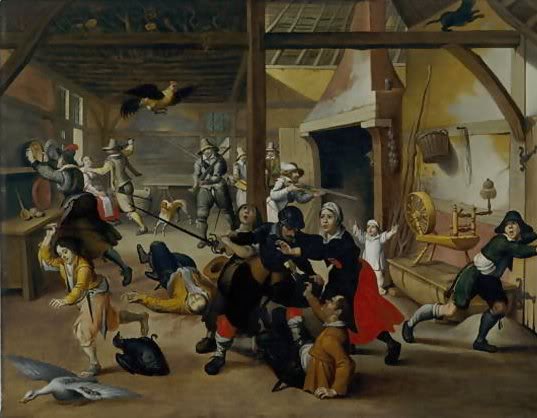
Sebastian Vrancx, Soldiers Plundering a Farm during the Thirty Years’ War (1620)


The point of this long digression is to bring to light the rich and varied pattern of startling political history that formed the city of Hildesheim throughout its long trajectory of conquest and destitution. From the inception of its written history, the plain of northern Germany had been ruled by the Church from nodes of civilization and culture such as the town of Hildesheim, with its great cathedrals, its monasteries and abbeys, along the trade routes. The empire of Catholicity embraced all of these foundations, as it also informed the soldiers that would periodically disturb the peace of the town, claiming the territory and its subjects for one prince or another. But the wars over religion which followed the German Reformation in the early sixteenth century marked an abrupt end to that period of Catholic dominion and cultural universality. Short and abrupt wars, succeeding each other almost uninterruptedly, terrorized the town and its people and the territories of the ancient cathedral city for a hundred years. The faith of the people was changed by command from one day to the other. Many emigrated; most submitted. The hegemony of the Wittelsbachs enabled the town to survive the Thirty Years War without a mayor calamity. In the end, Hildesheim was swallowed up, like the rest of North Germany, by the Kingdom of Prussia. But the treasures of its Romanesque past, of the period when all of Germany was part of a universal Catholic Church, remained intact. Until, that is, the American and British bombing attacks of 1945.


St. Michael’s after the bombing raids of March, 1945

Like Hannover to the North, Hildesheim was heavily damaged by air raids in 1945, especially on March 22 of that year. Although it was of little military significance, two months before the end of the war in Europe the historic city was bombed as part of the Area Bombing Directive designed to undermine the morale of the German people. 28.5% of the city’s buildings were completely destroyed and 44.7% damaged. The centre of the old city, which had retained its medieval character until then, was almost leveled. In the aftermath of war, as in most other German cities, priority was given to rapid building of badly needed housing, and concrete structures took the place of the destroyed buildings. Fortunately, most of the major churches, including St. Michael’s, now UNESCO World Heritage Sites, were rebuilt in the original style soon after the war. Reconstruction of St. Michael’s was begun in 1950 and completed in 1957. Valuable historical and artistic objects and materials had been hidden during the war in the basement of the city wall.


The Ottonian Church of St. Michael’s today


[CONTINUED IN PART II]


Monday, February 28, 2011

INVALUABLE DOCUMENT: The Diaries of Victor Klemperer - Part II


The Lesser Evil (1945-1959)

So sitze ich denn zwischen allen Stühlen. Tagebücher 1945-1959
von Victor Klemperer (Berlin, 1999)


Victor Klemperer (1881-1960)


The Diaries of Victor Klemperer, painfully written during the Nazi period and throughout the Second World War by a Jewish outcast in Dresden, must be regarded as one of the most important documents of the twentieth century. Klemperer had been professor of Romance languages and literature at the Technische Universität in Dresden since 1920, having distinguished himself as a teacher and as a scholar, with several publications to his name. He was an expert on French Literature, and particularly on Voltaire, but had written extensively on Montesquieu and Corneille. In 1933, he lost his academic status, and thenceforth began his desperate struggle for dignity and survival amid the horror of Nazi rule, which is all faithfully and extensively memorialized in the Diaries. He survived ultimately because he was married to an Aryan woman, Eva Schlemmer, a Protestant from Königsberg, and because his final deportation date, along with that of the few remaining Jews in the city, coincided with the destruction of Dresden, on the 13th and 14th of February , 1945. Only 198 Jews, all married to non-Jews, were left in Dresden in January 1945.


Klemperer's diaries were published between 1995 and 1999 as Tagebücher (Berlin, Aufbau). They were an immediate literary sensation and rapidly became bestsellers in Germany. An English translation has appeared in three volumes: I Will Bear Witness (1933 to 1941), To The Bitter End (1942 to 1945) and The Lesser Evil (1945 to 1959). This last one, the subject of this review [for the earlier diaries see my blog entry of October 7, 2010], was entitled by Klemperer So sitze ich denn zwischen allen Stühlen. Tagebücher 1945-1959 (Berlin, 1999), which means ‘so I sit then in between all the stools.’ After the Holocaust, and living in Communist East Germany, this metaphor was meant to elicit his recognition that he had become unable to feel comfortable within any particular political, ideological or even ethnic, identity. His true identity was bound to a world that had passed. The English translation is significantly entitled “The Lesser Evil” to deflect opprobrium from the fact that Klemperer never contemplated leaving Communist East Germany.

The Lesser Evil provides an invaluable account of life under Communism in Eastern Germany from the perspective of a pre-bellum European intellectual. This last installment of the Klemperer diaries differs from the two previous volumes in the significant absence from it of the terror of impending deportation and assassination. Hardship and discontent, despite success in his professional ventures, a growing alienation from his wife Eva, and doubts about his commitment to the East German state are persistent themes in Klemperer’s diary entries of the 1945-1959 period, but the horror of Nazism is now absent, and hence an underlying tone of world-weariness and even boredom suggest themselves in its stead. Even his late-blossoming passion for the young Hadwig Kirchner (1926-2010), a student whom he married in 1952 after the death of Eva, is often subsumed in feelings of guilt, regret and melancholy.


Victor Klemperer and Eva (geb. Schlemmer) in 1940


Post-bellum Dresden

"No twenty-year-old can be half as hungry for life," wrote Klemperer in June 1945. The diary entries accumulated under the title of The Lesser Evil begin shortly after his return to Dresden and to the home in Dölzschen he had been forced to abandon by the Nazis. Even as he began to organize this new record of his life, he had already entitled it So sitze ich denn zwischen allen Stühlen, “so I sit between all stools.” I believe this phrase accurately reflects how Klemperer generally felt after the war about his life, about his social and academic status in post-war Germany, and about his temperament and ideology in an unfamiliar new age. I believe therefore that this important document must be viewed from the perspective that the title itself provides for us. Klemperer was left sitting uncomfortably, perched between stools, as a scholar, as a Communist, as a liberal, and as a Jew.


Central Dresden after the bombing attack of February, 1945


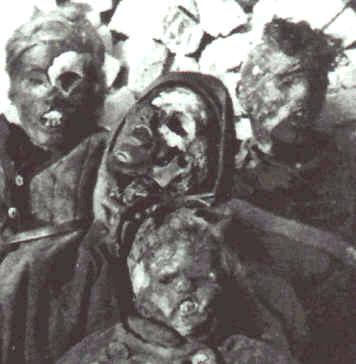
Klemperer’s city of Dresden was devastated by the war. After years of hunger and hatred, years in which the people had turned against one another with loathing and contempt, cast off all modalities of civilization, eyed each other with fear and suspicion, and persecuted the Jews amongst them with a virulence that outdid that of other German cities, including Berlin, Dresden was utterly devastated by the American firebomb attacks of February, 1945. Klemperer witnessed the final destruction with an equanimity born of resentment and hatred of the Nazi regime, as well as from an elevated sense of justice and requital.


View of Dresden after the bombing attacks of February, 1945


Victims of the firebomb attack, 1945


Monument to Martin Luther in front of the ruins of the Frauenkirche, Dresden, 1945

Amidst the rubble and the hunger of the aftermath, Klemperer was guided by a determination to foresee, and to act to forestall, any possible return or reaction, or any attempt to revert to the all-too possible domination of Nazism. The specter of Fascism was all about him; not for an instant did he believe that it was eradicated. The hatred expressed by the German population towards the conquering Russians was a sign of surviving Nazi sentiments. The Red Army therefore became in his mind a guarantor of his life and liberty, as well as of his restored status as an intellectual and a scholar.


The Liberal Scholar


The following diary entry is illustrative of Klemperer’s ambiguities:

8th March [1954], Monday forenoon. In bed.

“Finished Feuchtwanger’s Goya. Final chapter [. . .] weaker. But the thing as a whole is once again magnificent. F. is not merely ‘humanist’ in the GDR [German Democratic Republic] sense but also entirely humane. He knows all about politics and the social, but also about the absolutely human. And he knows everything that goes to make up a single human being. He is a sceptic like Anatole France and like him believes in progress. I was probably under something of a delusion as far as my adherence to the Party [KPD] was concerned. In the end I am liberal. And also the Barbusse quotation, every scholar is a Marxist, even if he himself does not yet know it, is only partly right; in the very last analysis people like us are liberal.”


Lion Feuchtwanger (1884-1958)

Lion Feuchtwanger, a German author, was a fugitive from the Nazi regime who died in exile in Los Angeles in 1958. His novel Goya, oder der arge Weg des Erkentniss (translated as Goya: This is the Hour) was published in 1951. Klemperer met Feuchtwanger after the war and developed a great affection and admiration for him, which is reflected in their correspondence. It is clear from the diary entry quoted above that Klemperer admired what he saw as Feuchtwanger’s humanistic liberalism, a philosophy he believed they both shared. The reference to ‘humanism’ in the GDR sense, is a genuflection to propaganda. The humanistic ‘liberalism,’ Klemperer is truly referring to, as he understood it, was characterized by a commitment to tolerance, to individual freedom, certainly at least in the intellectual realm, and to a humanism which had served as a goal, if not an achievement, of bourgeois Europe, and which can be adumbrated by reference to Kant’s doctrine that human beings ought never to be treated as a means to an end, but only as an end in themselves.


This shared ideal of bourgeois liberal humanism causes Klemperer, in the diary entry cited above, to immediately question his own commitment to the Communist Party of East Germany, - is every scholar truly a Marxist, even if he doesn’t yet know it? His response is that this assertion is only “partly right.” The humanistic thrust of Marxism can become compromised by the power of the State. Klemperer therefore highlights the contradictions in his position within the German Democratic Republic, as a functionary and official of the regime, and as an intellectual and scholar in the Academy as well. In the aftermath of the war, Klemperer had joined the party without much hesitation. As an intellectual and scholar whose identity had been intimately bound to Germany and to the German University, as well as to German Kultur and its language, his sudden and appalling collapse into outcast status during the Nazi period had left him with no illusions about the capacity of a capitalist state to safeguard the survival of democracy and individual freedom. He had no trouble articulating these doubts and fears, and hence no ambiguities about endorsing the Communist rise to power in Dresden after the war. He did not doubt that the Red Army would prove to be the best bulwark against the resurrection of Nazism, whose specter he discerned all about him in the hearts and minds of the people around him.


Flag of the German Democratic Republic (GDR)


In the East, as Germany awakened from the nightmare of the war, the Western Economic Union, the so-called “Bizone” of U.S. and English Western Germany, was generally regarded as a ‘collaborator’ regime. It was referred to as "Vichy," based on a comparison with the French government of the non-occupied zone that had collaborated with the Nazis. The reason for this lay not only in that the West seemed to be much more tolerant of ex-Nazis, whom they failed to prosecute, waived investigations on its suspects, forgave many, but also in that it was the collaboration of a German government, run by the Christian Democrats, with the American occupation, which meant capitalism, oligarchy, and an alien culture. As well, there was a clear consciousness of the extent of anti-Semitism in Bavaria and the antipathy of the Bavarians towards the Russian conquered Eastern zone.


GDR stamp: Twentieth year anniversary (1969)
The bright colors and smiling faces represent the joyful sense of
progress and confident optimism which the Communists had anticipated
at the end of the war. By 1969, the image becomes a mockery of those hopes.


In the East, instead, it was generally felt that, even though the Red Army was robbing the Germans of their infrastructure, stealing everything from boilers to rail lines and scientists (which latter the Americans were also doing in the West), they had nonetheless a greater appreciation for the old German culture, and did not intend to threaten it with extinction, as was the case in the West. These were sentiments that Klemperer shared with other officials and intellectuals working for the East German regime. The East German intellectuals, and the East Germans involved in politics, in the SED (Sozialistische Einheitspartei Deutschlands) the Socialist Unity Party, in particular, and the Kultur Bund (Cultural Union), and other such organizations, were truly “victims of Fascism,” Jews, such as Klemperer himself, as well as exiled or imprisoned Socialists and Communists, a very different composition from that of the Western political and intellectual leadership. It followed logically from the ideological posture of the Soviet Union that it would favor those who had been victims of Fascism, whereas in the West the effort was to rebuild Germany as a buffer against the Soviets, with the cooperation of any existing political elements.

These considerations informed Klemperer’s decision to become an official of the East German regime, and to refuse to contemplate departure to the West at any time until his death in 1960. This is not to say that he was untroubled by the characteristics of a regime which, long before the building of the notorious Berlin Wall, showed signs of dogmatism, paranoia and brutal authoritarianism. His diary entries show a preoccupation over allegations that the Russians had stolen half of Poland and had compensated the Poles by giving them German Silesia, and that they were depriving the socialists of any freedom of expression, in contradiction to the Marxist materialist philosophy they espoused. He had contempt for the large military parades organized by the Red Army, and for the ubiquitous iconization of Stalin in portraits and statutes that reminded Klemperer of the cult of Hitler and of Herrmann Göring. In time, his dislike of the East German regime grew apace, but he never considered exile, and he was contemptuous of fellow academicians who defected to the West to enhance their careers and their prestige.

To his liberal humanism and his academic and scholarly past, grounded in the Wilhelminian Gymnasium, can also be attributed his criticism of the educational policies of the East German regime, as illustrated in the following diary entry:

9th May, 7 p.m. Friday [1958]

“On Saturday, 3 May, in Berlin alone for the Advisory Committee and back immediately. The new curricula entirely tailored to the training of teachers, to the ten-year school, to Marxism, factory, de-intellectualisation. I said and had it minuted: Romance Languages and Literatures as a University subject was thereby extinguished, we were practically giving instruction at a teacher-training college, it would be more honest if we taught at a college and did not call ourselves professors. No one contradicted, Rita said, she had said it all at the crucial ministerial and Party meeting, but we had to acquiesce. It was a kind of mourning session. I also said: as in the SU [the Soviet Union]. On the visiting cards of their scholars there is only ‘Academician’. Only within the Academy are they scholars. Universities are mere secondary schools, are not mentioned. […]”

Surely this criticism is equally applicable to the intended development of the American Universtiy at that very same time. The technologization and specialization of the work force that it visualizes and forecasts, the de-humanization of the individual, to be cast in the role of expert or systems-manager for service in the industrial state, is no different than the designs for the new University of California which were articulated in Clark Kerr’s California Master Plan for Higher Education, published in 1960. Klemperer’s is a critique grounded on liberal humanism, and is antagonistic equally to all of the forces that were shaping the post-war world. It left him sitting uncomfortably between the ill-fitting stools of communism, capitalism and modernity.


Anti-Americanism, Anti-Zionism

Nor was Klemperer any more comfortable as a Jew in post-war Germany. After all, why was he a Communist? One of the most important issues in his last diaries is his taking of a political position on the far left, after a lifetime of liberal conformism and academic isolationism, accompanied by an ambition to serve the state as a member of the government or, at least, of the political establishment in the Communist GDR. It is most necessary to keep an open perspective on this matter because the emergence of the GDR was a gradual process which took on aspects no one had imagined as the process evolved. We tend to think back towards the mid-1940’s as if the creation of an independent communist state in East Germany was a necessary and inevitable outcome. But it was not so, and there were causes for this development which can be traced to the early post-war years, and which gravely agitated the mind of Victor Klemperer as they unfolded.


East German currency


As stated above, one key reason for Klemperer’s decision to join the Communist Party, and I leave aside here the question of political choices in the post-bellum city of Dresden, was the fact that the Communists took the side of the victims of Nazism, the workers and the Jews, as well as other persecuted minorities, whereas the ‘Western’ parties, and the West in general, appeared to be indifferent to them. Or, worse, they appeared to be making concessions to ex-Nazi officials and turning a blind eye to their criminal involvement and engagement with the former regime, due to an opportunistic need to bolster the political right against the possibility of any revolution coming from the East. The presence of the Red Army in Berlin, and throughout the eastern Länder, as well as developments in the eastern European countries, raised the fear of a triumph of socialist and communist tendencies in the open democratic society which was being born in Germany. The fear of revolution drove the United States to suspend its process against Nazi functionaries, or at least tone them down, and begin a ‘bygones be bygones’ policy to strengthen the Christian Democrats and the Social Democrats in the West against what was increasingly seen as the communist threat from the East.


The Kurfürstendamm, symbol of American influence in West Berlin


Throughout the unfolding of these political events, Klemperer had to confront his ambiguous feelings towards his Jewish ethnicity. Whereas he had always rejected his Judaism during the war, and felt that it was an alien identity imposed on him by the Nazis in the same manner as the Yellow Star he was forced to wear on his clothing, he now believed that in Germany, among the Germans, he would always be a Jew, and hence imperiled. His antipathy towards the West derived from his fear that capitalism would not safeguard his identity as a Jew and that the triumph of the West would result in further persecutions. As well, his antipathy towards Zionism and the newly-created state of Israel derived from its identification in his mind with American hegemony as well as with the implicitly nationalistic overtones of the project. He had no use for the underlying ‘blood and soil’ ideology of the Zionists, and persisted in thinking that he himself could never be anything other than a German, despite the fact that Germany had once rendered him an outcast.

This is all very evident in Klemperer’s diary. He shows a growing antipathy towards the West, towards Americans and Americanism, which is not only determined by cultural interest, or cultural incompatibility, but also from a fear that Nazism is not dead and lies in waiting in the West, for a continuation of its persecutions against socialists and Jews.

Klemperer was clearly aware of the stifling atmosphere in the East, of the growing hegemonic power of the Kremlin in domestic German politics, of the darkness of the Cold War struggle that was just beginning. He speaks of the “dreadful shortcomings in the intellectual sphere,” in reference to the censorship and ideological shoe-horn that bears down on him. “. . . intellectually we are just as barbaric and fanatical as the Nazis. So say nothing, efface oneself, wait . . .” [27th. January, 1951]. But underlying his decision to embrace this system despite its shortcomings is a fear for his own personal survival. He receives a well-meaning letter urging him to abandon politics and concentrate exclusively on scholarship, because “politics eats its own children,” and he writes “That’s what I thought, too – and then the devil Hitler came and got me. And he’s not going to get me again.” [24th March, 1951].


“I am the one-eyed King of the GDR”
September 13, 1951 Diary entry.


Caspar David Friederich, Wiesen bei Greifswald (1822)
Klemperer was Professor at the Faculty of Philosophy in Greifswald University in 1947-48. The painter Caspar David Friederich was a native of Greifswald.


Victor Klemperer became a distinguished cultural and academic figure in East Germany after the war. He was also elected as a delegate of the Kultur Bund (Cultural Union) in the Parliament (Volkskammer) of the German Democratic Republic in 1950. Most of the scholarly works he had written prior to the war were published as original or revised editions during this period, and he became famous overnight after the publication of his treatise on the language of the Third Reich, LTI - Lingua Tertii Imperii: Notizbuch eines Philologen (1947) [The Language of the Third Reich: A Philologist's Notebook], which is his most respected publication today.


Despite these achievements, a litany of self-doubt and self-deprecation runs through Klemperer’s last diaries. In these last years of his life in East Germany, he saw himself as a less than competent scholar, referred to himself as a “journalist,” rather than as a scholar, and believed that his status in the Academy was due to the fact that the better minds had fled to the West, hence his characterization of himself as the “one-eyed King of the GDR” in 1951. . . . "I do not believe in the value of the things that I fight for."

His description of himself as a “journalist,” which is repeated very often, is based on a critical evaluation of his work as an historian of French literature. He had started out as a journalist in the early post-WWI period. But even after years of scholarly achievement, he believed that he only “reported” on French literature, and did not sufficiently analyze it. He felt he knew little philosophy, and often complained about his difficulties in grasping the Hegelian intricacies of Marxist theory, a body of thought he was obliged to master as he ascended the ladder of the Communist bureaucracy. He was in awe of Erich Auerbach’s book Mimesis, for example, compared himself unfavorably with its author, and, after completing his reading of the book, faulted himself for a lack of knowledge. ‘What all could I have done with that erudition!’

It is extraordinary to consider Klemperer’s effort and activities after the war to get back into the academic community and into the government of the Eastern zone. He refers to himself constantly as being powered by vanity, ‘Vanitas, vanitatum.’ This passionate ambition leads him initially to Greifswald as a Professor in the Faculty of Philosophy, ‘a SED prof.’ he says dejectedly (referring to his appointment to the chair by the Socialist Unity Party), and later to Halle and Berlin. He is throughout very pessimistic and self-critical. He considers himself a ‘war-profiteer,’ in the sense that he would not have achieved anything were it not for the fact that East Germany was left “empty” by the devastation of the war. And there is also his longing for youth, for the Erotic that will eventually lead him to marry a young student admirer, after the death of Eva. The other side of this coin is of course his great guilt for Eva’s rather sad last years, before her death in 1952. He points out how Eva had none of the fear of death, of nullity, and ambition that he has, and a lot of the decisions made for both of them by Klemperer in these years are motivated by his ambition, and turn out to be against Eva’s best interests.

The ambition and the regret for youth were a reaction to the years he had lost during Nazi persecution. He compensated thus for the time of obscurity and of disability, the dark hours when there was nothing to anticipate but death. Thus the fifteen years of his life after the war became a titanic effort at a recuperation of lost time. The outcome was bitter-sweet. He enjoyed moments of great happiness that he later recollected, but the memories were bathed in melancholy. He witnessed more than he grasped. In the epoch of his final triumphs there was no longer any vestige of the liberalism and civility of his youth. "His" Germany, the land of poets and thinkers, a land of light and grace, had passed forever. He ceased writing in his diary many months before his death. He would not see the Berlin Wall go up. On New Year's Eve 1959, he wrote: "Germany is sort of like a scatter-brained earthworm cut into two pieces. Both parts squirm around, both are contaminated by Fascism, both in their own way."

Victor Klemperer died of a heart attack on Feb. 11, 1960 in Dresden.


Klemperer Monument in Halle


Labels

Labels

Labels